


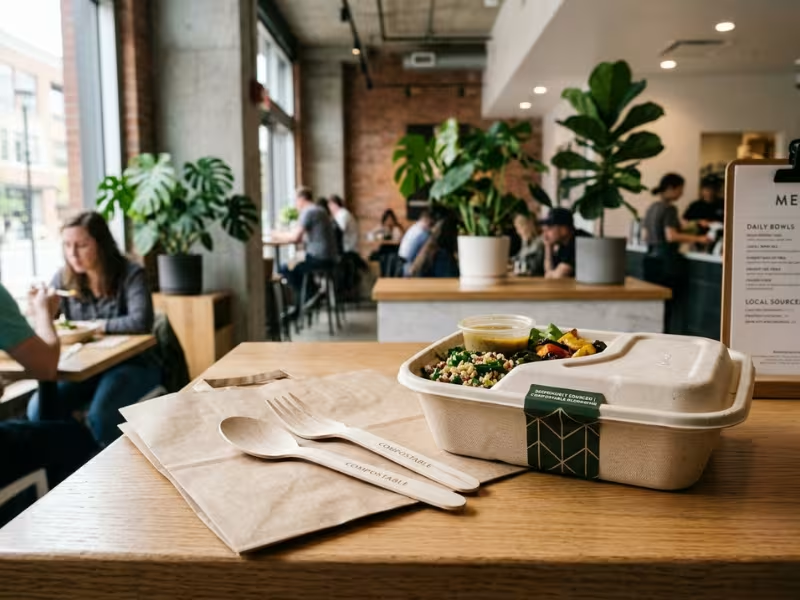
A city bans plastic forks. A wedding venue adds “compostable service ware only” to its contract. A customer posts a photo of your branded spoon lying in a gutter.
Food businesses feel this pressure from every side. So many owners order the first “biodegradable” case they find. Then the forks snap on grilled chicken, or the local hauler rejects them.
Choosing biodegradable cutlery takes more than a green label. It sits inside a broader category of biodegradable tableware, and products in that category vary widely in heat tolerance, strength, and disposal requirements. Wood, bamboo, PLA, and CPLA each behave differently in service. They also differ in where they can actually break down.
I help restaurants, caterers, and packaging buyers make this switch. In this guide, I’ll show you:
- What biodegradable cutlery actually is
- Which materials fit which use cases
- Which supplier claims you can trust
- How to switch without service problems
Why Food Businesses Are Replacing Plastic Cutlery, and Why Many Still Get It Wrong
Most owners I talk with don’t switch because they suddenly care more about the planet. They switch because pressure arrives from four directions at once.
Regulators move first. The EU banned single-use plastic cutlery in 2021. Several US states and cities now restrict plastic utensils or require “on request only” service. One inspection or a new ordinance can set your deadline for you.
Customers notice the details. A diner who pays $16 for a grain bowl expects the fork to match the menu. A shiny plastic utensil next to kraft packaging looks careless, and people say so in reviews.
Venues write the rules into contracts. More wedding venues, stadiums, and corporate campuses now add “compostable service ware only” to catering agreements. If your cutlery doesn’t qualify, you can lose the booking.
Delivery puts your packaging on display. In real service, cutlery performance often needs to be judged alongside biodegradable food containers, because both sit in the same hot, sealed delivery environment. Your order lands on a stranger’s kitchen table with your logo on the bag. The cutlery inside tells customers what kind of business you run.
All four pressures push owners to act fast. That speed is where the trouble starts.
A typical buyer searches “biodegradable cutlery,” filters by price, and orders a case. They treat it like a straight swap for plastic. But that green label covers materials that behave very differently. One fork holds up in hot curry. Another softens before the delivery driver leaves the lot. A third contains conventional plastic filler and won’t compost anywhere.
I see the same results again and again:
- The owner pays more. Biodegradable options often cost two to three times as much as plastic.
- The cutlery fails in service. Spoons bend in soup, and knives snap on grilled chicken.
- The local hauler rejects it. The “compostable” forks end up in landfill anyway.
- Customers have a worse meal and blame your business, not the supplier.
So the real job isn’t swapping out plastic. It’s matching the right material to your menu, your service style, and your local disposal route.
What Biodegradable Cutlery Actually Is, and What It Isn’t
When an owner shows me a new case of “eco” forks, I ask one question first: what will happen to these forks after your customer finishes eating? Most owners can’t answer that yet. The box can’t answer it either.
Before you compare materials or prices, you need to understand what the words on the label promise. You also need to know where the cutlery will actually end up.
Biodegradable, Compostable, Recyclable, and Reusable Aren’t the Same
These four words often appear side by side on supplier pages. They make very different promises.
Biodegradable is the weakest claim on its own. It only means microbes can break the material down at some point. It sets no timeline and no required conditions, and no standard defines it. A birch fork qualifies. So, in theory, does a fork that takes a century.
Compostable sets a real bar. A certified compostable fork must break down within a set time in a compost system and leave no toxic residue. Standards such as ASTM D6400 and EN 13432 define those limits, and marks like BPI or TÜV Austria OK compost confirm the product passed testing.
Recyclable rarely works for cutlery. Forks and spoons are too small for most sorting equipment, so they slip through the screens. PLA causes another problem. If it reaches a plastic recycling line, it can contaminate a batch of PET.
Reusable often wins for dine-in service. Metal flatware and a dish crew beat any disposable over time. But reusables don’t work well for delivery, festivals, or drop-off catering, because few customers send forks back.
Why Material and Disposal Matter More Than the Label
A label describes a material. The disposal route decides what actually happens to it.
The same fork can have three very different futures:
- Industrial compost: Facilities keep piles at about 131–160°F and manage air and moisture. Certified items usually break down within a few months.
- Home compost: Backyard piles usually stay below 100°F. Wood and bamboo still break down slowly. PLA and CPLA can sit there for a year and barely change.
- Landfill: Landfills compact waste and cut off oxygen. Wood, bamboo, and bioplastic all slow down sharply, and some can last for years.
So an “eco” label can mean a lot or almost nothing. It depends on where your customer’s fork lands.
I give owners a simple rule. Certification confirms the claim. Your local hauler confirms the outcome. You need both before the label means anything for your business.
Email your hauler or venue and ask which cutlery materials they accept. If they take wood but reject PLA, that answer shapes your material choice before you look at a single quote.
The Main Biodegradable Cutlery Materials Compared
Most of the cutlery on the market comes from four material groups. Each one solves a different problem, and each one fails in a different way.
When owners visit my sample table, I don’t ask which material is “greenest.” I ask what they serve, how they deliver it, and where their trash goes. Then I go through the options one by one, the same way I do below.
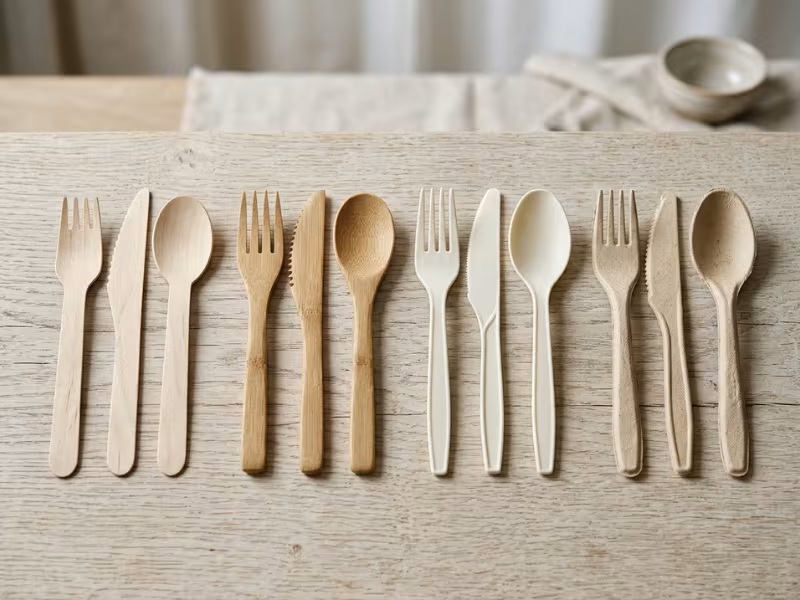
Wood Cutlery: Reliable, Simple, and a Little Rough
Most wooden cutlery is birch. Makers cut thin veneer sheets, press them into shape, and sand the edges. Good pieces need no coating or plastic binder.
Wood’s biggest strength is heat. A birch spoon stays rigid in boiling broth, hot curry, or a steaming takeout bowl. It also breaks down in a well-managed backyard pile, and compost sorters recognize it at a glance.
The weak point is how it feels in the mouth. Some customers dislike the dry, woody texture, especially with ice cream, yogurt, or soup. Cheap batches add splinters and fuzzy edges. Thin knives also struggle with grilled chicken or steak.
Before you approve a supplier, run your thumb along ten tines and ten knife edges. If you feel snags on more than one or two, keep looking.
Wood fits hot-food takeout, food trucks, and buffets well, especially where function matters more than polish.
Bamboo Cutlery: The Premium Look, at a Premium Price
Bamboo feels like a step up the moment you pick it up. It’s denser and smoother than birch, and thicker handles make it feel closer to real flatware.
That feel costs more. Bamboo often runs noticeably above birch per piece. Most of my clients who choose it want the impression it makes: plated weddings, boutique hotels, premium meal kits, or brands that want a disposable that looks reusable.
The detail most buyers miss is the finish. Bamboo cutlery usually comes in one of three types:
- Natural or carbonized: Heat-treated for color, with no coating. This option composts best.
- Food-grade oil: A light finish that rarely affects breakdown.
- Lacquer or varnish: Glossier, but it slows composting, and some facilities reject it.
A shiny sample usually means lacquer. Ask the supplier directly, and get the answer in writing.
PLA and CPLA Cutlery: Closest to Plastic, Easiest to Misjudge
PLA and CPLA look and feel the most like plastic. Customers barely notice the switch, and that’s why these materials sell so well. It’s also why owners misjudge them more than any other option.
Both come from polylactic acid, which makers produce from fermented plant sugars, usually corn or sugarcane.
PLA is the basic form. It’s light, smooth, and fairly cheap. Its weak spot is heat. PLA starts to soften at around 140–150°F, so a thin PLA spoon can curl in hot soup or coffee.
CPLA is crystallized PLA. Makers add a mineral filler, such as talc, and heat-treat the material. CPLA handles hot food up to about 185°F, feels stiffer, and usually comes in black or off-white. It also costs more.
Here’s the misunderstanding I correct most often. Owners see “compostable” on the box and assume the cutlery will break down anywhere. It won’t. Most PLA and CPLA carry industrial-only certification. They need sustained heat of about 131–160°F to break down. In a backyard bin or a landfill, they behave much like regular plastic.
Sorting adds another hurdle. A white PLA fork looks almost identical to polystyrene on a fast picking line, so some facilities reject all bioplastic cutlery.
So PLA and CPLA make sense only when three things line up:
- Your hauler accepts compostable bioplastic cutlery in writing
- Your menu suits the material: cold or warm food for PLA, hot food for CPLA
- Your customers expect a plastic-like feel
Bagasse and Other Niche Options
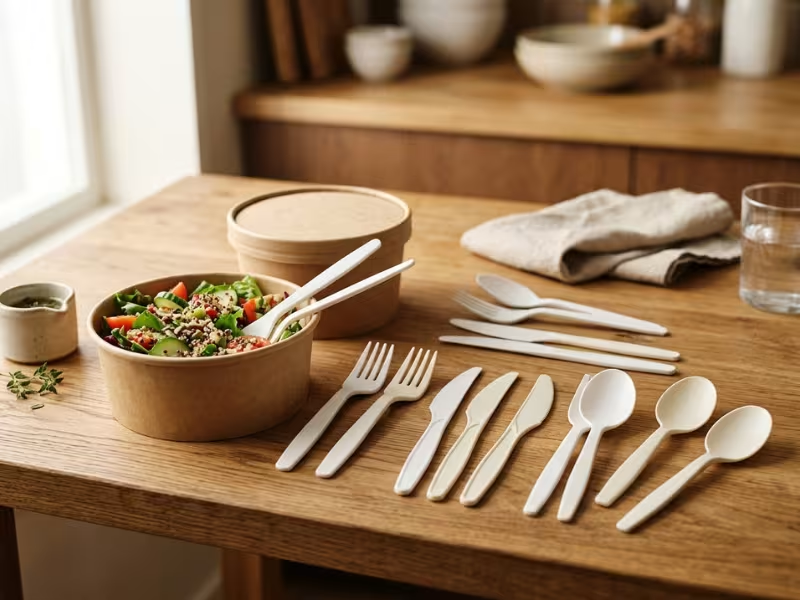
Bagasse cutlery comes from sugarcane fiber, the pulp left after juice extraction. Makers mold it under heat and pressure, much like bagasse plates and clamshells. It handles hot food well and often breaks down in home compost.
It works best for businesses that already use bagasse containers and want matching serviceware, especially those already sourcing sugarcane bagasse tableware for a more consistent hot-food setup. However, it’s thicker and less refined than wood or CPLA. Long soaks in soup or saucy dishes can soften it, and molded knives rarely cut well. Choose it for spoons and forks with short meals, not for steak.
Palm leaf cutlery suits weddings and garden events where looks matter most. It costs more and varies from batch to batch.
Edible cutlery gets attention, but high cost and short shelf life keep it a novelty for most operators.
How the Materials Stack Up
The table below shows how I sort these options for clients. Read it from right to left. Start with your service scenario and your biggest risk, then check cost.
Cost levels are relative and assume standard 6-inch pieces in wholesale cases. “Home compostable” means the material can realistically break down in a well-managed backyard pile. Always confirm with the specific product’s certification. Heat ratings reflect real service, not lab figures.
|
Material |
Cost Level |
Heat Tolerance |
Home Compostable |
Best-Fit Scenario |
Key Caution |
|---|---|---|---|---|---|
|
Birch wood |
Moderate |
High |
Yes |
Hot takeout, food trucks, buffets |
Rough edges and woody mouthfeel |
|
Bamboo |
Higher |
High |
Yes, if uncoated |
Weddings, premium brands, plated events |
Lacquer slows composting |
|
PLA |
Low to moderate |
Low (softens near 140°F) |
No |
Cold desserts, salads, smoothie bowls |
Bends in hot food and needs a facility |
|
CPLA |
Moderate |
Good (about 185°F) |
No |
Hot takeout with compost access |
Industrial-only; often rejected at sorting |
|
Bagasse |
Moderate |
High |
Often yes |
Operators already using bagasse containers |
Softens in long soaks; weak knives |
|
Palm leaf |
Higher |
Moderate |
Yes |
Garden weddings, display buffets |
Costly, with uneven thickness |
No single material wins every time. Wood beats CPLA for a food truck with no compost access. CPLA beats wood for a takeout counter whose hauler accepts it. Pick the material that matches your heaviest-use scenario.
The Claims Most Likely to Mislead Buyers
Most bad cutlery orders I review didn’t fail because the owner had a small budget. They failed because the owner trusted the wrong words. Suppliers know which phrases sell, and some use them loosely.
Five claims cause most of the trouble. Once you can spot them, you can filter out weak suppliers before you request a single sample.
“Biodegradable,” with no mark behind it. This word sounds reassuring, but it carries no test, no timeline, and no required conditions. Any supplier can print it on a carton. If I see “biodegradable” with no BPI, ASTM D6400, EN 13432, or TÜV Austria OK compost mark, I treat it as marketing copy. Ask for the certificate number. If the supplier can’t give you one, move on.
“Plant-based,” blended with conventional plastic. Many “cornstarch” forks mix starch with polypropylene (PP). The starch makes the product sound natural. The PP adds strength and can make up 30–50% of the fork. That blend will never compost. Yet the box can still say “plant-based,” “eco,” or “made from corn,” because each phrase is technically true. Ask for the full formula with percentages. If PP appears anywhere on that list, the product doesn’t count as compostable.
“Oxo-degradable” or “oxo-biodegradable.” These products are regular plastic with additives that make them crack apart in heat and sunlight. They don’t turn into compost. Instead, they break into smaller and smaller fragments that stay in soil and water. The EU banned oxo-degradable plastics in 2021 for this reason. If a supplier still sells this technology as eco-friendly, I question the rest of their catalog too.
A valid certificate your hauler won’t accept. This trap catches careful buyers. A real certificate proves the fork can break down in an industrial facility. It doesn’t prove your local facility takes it. Some sites reject all bioplastic cutlery because it looks like regular plastic on the sorting line. Others refuse cutlery entirely. I once watched a caterer buy thousands of certified CPLA kits for a venue whose hauler accepted only food scraps. Every kit went to landfill. Get your hauler’s answer in writing before you order.
Product photos and polished wording. A fork photographed on a bed of leaves proves nothing. Neither does “100% natural,” “earth-friendly,” or a green badge the supplier designed itself. I’ve even seen catalogs paste certification logos onto products that never passed testing.
Here’s how I verify a claim in about ten minutes:
- Ask for the certificate as a document, not a logo on a product page.
- Look up the number in the certifier’s public database.
- Check that the listing matches your exact item, including size and thickness.
- Confirm the company name matches the supplier or its factory.
If any step fails, treat the claim as unproven. A reliable supplier passes all four checks without hesitation.
How to Choose the Right Cutlery for Your Use Case
When an owner asks me which fork to buy, I don’t name a material right away. I ask what’s on the menu, how far the food travels, and which bins sit by the door at closing time. Those three answers point to the right material faster than any spec sheet.
Most food businesses fit one of four patterns. Start with the one closest to yours.
For Restaurants and Takeout Operations
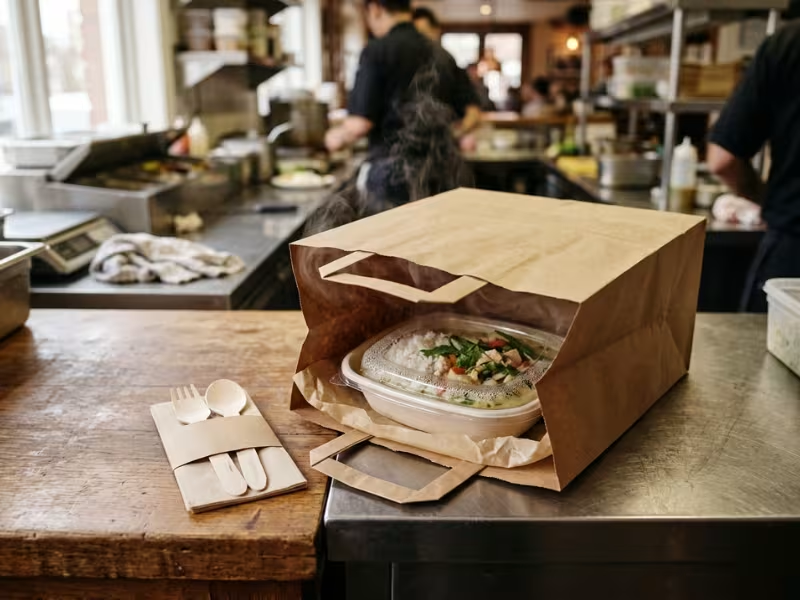
Takeout is the hardest job for disposable cutlery. The food is hot, the bag is sealed, and the meal may sit for 30 minutes before anyone eats it.
Start with your hottest dish, not your most popular one. Soup, ramen, curry, and chili often leave the kitchen at 160–185°F. Standard PLA starts to soften near 140°F, so it won’t survive that trip. Choose CPLA, which handles about 185°F, or birch, which stays rigid at any serving temperature.
Delivery steam adds a second test. Steam trapped inside a closed bag weakens thin pieces quickly. Pack a real order, seal it, and wait 30–40 minutes. Then cut your toughest protein and scoop your thickest sauce.
For strength, look for forks and knives of at least 4 grams if you serve rice bowls, pasta, or grilled meat. Don’t pay for that weight everywhere, though. A lighter spoon works fine for side salads and desserts.
Ask your hauler before you choose between birch and CPLA. If they reject bioplastic, birch usually costs about the same and gives you a real disposal route.
For Catering, Events, and Premium Presentation
At events, cutlery becomes part of the table setting. Guests hold it, photograph it, and judge the meal by it.
Match the material to the format:
- Plated dinners and weddings: Bamboo or palm leaf look polished next to linen and natural plates.
- Buffets and corporate lunches: Birch works well and keeps costs in check.
- Standing receptions: Choose thicker knives, or skip knives and serve bite-size food. Guests cutting brisket on a plate in one hand will snap thin wood.
Budget reality matters here. A premium bamboo set can cost two or three times more than birch. For 300 guests, that difference adds up fast. I often suggest a mix: bamboo on the head table and at plated courses, birch at the dessert and coffee stations.
Plan waste before the event, not during cleanup. Ask the venue three questions. Do they provide compost bins? Which hauler collects them? Which materials does that hauler accept? Then place clearly labeled compost stations near every trash can. Guests contaminate unlabeled bins within the first hour. Also order about 15% extra, because guests drop forks and grab new ones for dessert.
For Cold-Food Concepts and Dessert Businesses
This is the easiest group to equip. Cold food removes the biggest risk: heat.
Ice cream shops, frozen yogurt counters, smoothie bowl bars, salad concepts, and bakeries can use standard PLA with confidence. It’s smooth, light, and feels almost exactly like plastic. Most customers never notice the switch. It also costs less than CPLA, wood, or bamboo.
Wood often works against you here. Many people dislike a dry, woody texture against yogurt, mousse, or ice cream. A smooth spoon simply suits the product better.
Watch two limits. Hard ice cream straight from a deep freezer can snap a thin PLA neck, so choose a 4-gram spoon for hard-packed flavors. And PLA needs an industrial compost facility, so confirm your hauler accepts it.
For Businesses With No Composting Infrastructure
Here’s the honest tradeoff. If no local facility accepts compostable cutlery, your forks go to landfill no matter what they’re made of. In a landfill, PLA and CPLA behave much like regular plastic. You pay more for a benefit you never get.
That doesn’t mean you should give up. It means you should change the goal.
- Cut volume first. Switch to on-request service, where customers opt in for cutlery. Many operators see large drops in utensil use once they stop adding forks by default.
- Use reusables for dine-in. Metal flatware and a dishwasher cost less over time than any disposable.
- Choose wood for takeout. Birch handles hot food, meets most plastic bans, and can break down in a customer’s backyard compost pile.
Skip premium bioplastics in this situation unless a local rule requires certified compostable cutlery. Spend that money on fewer pieces, not fancier ones.
What It Really Costs, and Where the Cost Difference Comes From
When owners send me a supplier quote, they almost always circle one number: the price per piece. That number matters. But on its own, it rarely shows what the cutlery will cost your business over a month of service.
Start with the rough price ladder. Exact figures shift with region, season, and supplier, but the order stays fairly steady:
- Uncertified starch blends sit at the bottom. Many cost close to plastic, often because they contain polypropylene.
- PLA comes next, usually about 1.5 to 2 times the price of plastic.
- Birch wood often runs 2 to 3 times plastic.
- CPLA often matches or passes birch.
- Bamboo sits at the top, often well above birch.
Five factors explain most of the gap between two forks that look alike in a photo.
Certification costs money. Suppliers pay for lab testing and yearly fees to keep a BPI or OK compost mark. Uncertified products skip those costs, which partly explains their low prices.
Thickness and gram weight change both price and performance. A 4.5-gram CPLA fork costs more than a 3-gram one. It also survives a dense rice bowl that would bend the lighter fork.
Heat resistance adds processing. Turning PLA into CPLA takes mineral filler, extra heat treatment, and more factory time.
Coatings and finishes matter most with bamboo. Lacquer adds a step and a material. Carbonized or oiled pieces often cost less and compost more easily.
Shipping weight and volume surprise many buyers. Wood and bamboo weigh more and pack less tightly than bioplastic. On an overseas order, freight can erase a low factory price.
Order volume moves the price more than most owners expect. A retail pack of 100 forks can cost two to four times more per piece than a 1,000-piece wholesale case. A full container order drops the price again. If you want a printed or engraved logo, expect a higher minimum order, so plan your volume before you ask.
Now the part most quotes leave out. The cheapest eco fork often turns out to be the most expensive one.
Picture a thin PLA spoon at a noodle counter. It curls in the broth. Your staff hands out a second spoon, so you just paid double. The customer posts a photo of the bent spoon. A snapped birch knife on grilled chicken creates the same chain of costs.
I ask clients to run a simple check. Serve 50 portions of your hardest dish with each sample, and count the failures. A spoon that saves a cent but fails 10% of the time rarely saves anything.
So judge cost against three things, not unit price alone:
- Failure rate: How many pieces break or bend in real service?
- Compliance: Does the product meet your local rules and venue contracts?
- Disposal route: Will your hauler actually accept it?
CPLA without compost access costs extra and gives you nothing extra. Pay for the performance your menu needs and a disposal route you can use, not for a greener-looking label.
How to Make the Switch Without Service Problems
Most switching problems I see don’t come from the cutlery itself. They come from skipped steps. An owner orders a pallet on Monday, and by Friday the staff is digging through boxes for something that actually works.
The five steps below take about two to three weeks. They cost far less than one bad bulk order.
1. Audit What You Actually Use
Start with real numbers, not guesses. Pull your last three months of cutlery purchases and compare them with your order count.
Then break usage down by type:
- Item: Forks, spoons, knives, and wrapped kits
- Food temperature: Hot dishes versus cold dishes
- Service channel: Dine-in, takeout, delivery, and catering
Most owners find surprises. One café client handed out knives with 80% of orders, yet only 20% of its menu needed one. It cut knives from the default kit and lowered spending before it changed a single material.
This audit also shows where you need the toughest specs. You may need CPLA or birch for only a third of your volume. Lighter, cheaper options can cover the rest.
2. Check Local Rules and Composting Acceptance
Next, confirm what your city requires and what your hauler accepts. Treat these as two separate questions.
For rules, check your city or county website for single-use plastic ordinances. Look for banned materials, “on request only” requirements, and effective dates. If you cater, read each venue contract too.
For composting, email your hauler and ask:
- Do you accept compostable cutlery?
- Which materials do you take: wood, bamboo, PLA, or CPLA?
- Do you require a specific certification mark?
Save the reply. If the hauler takes wood only, you’ve already made your material choice for most items.
3. Request Certification and Sample Specs
Now contact two or three suppliers. Ask each one for the same package so you can compare them fairly:
- Certificate documents with numbers you can look up
- The full material formula, with percentages for any blend
- Gram weight and length per piece
- Maximum use temperature
- Shelf life and the storage conditions behind it
- Food-contact documents, such as FDA or LFGB reports
- MOQ, lead time, and price per 1,000 pieces
A reliable supplier sends this within a few days. If one stalls on certificates or formulas, drop it from your list.
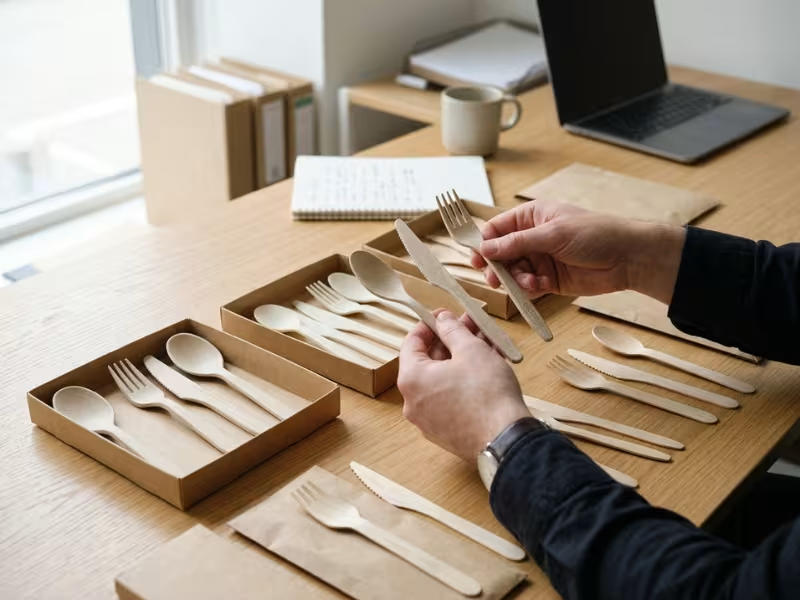
4. Run a Small Real-World Test
Order 200–500 pieces of your top two options. Test them during a busy shift, not a quiet afternoon.
Focus on your hardest conditions:
- Steam test: Pack your hottest dish, seal the bag, and wait 30–40 minutes. Then cut and scoop.
- Strength test: Use your densest items, such as rice bowls or grilled chicken.
- Storage test: Leave one sealed bag on your warmest shelf for a week, then check for warping.
Track failures per 100 uses. Ask staff how the kits feel to grab and wrap. Read customer comments for a full week.
If a sample fails more than two or three times per 100 uses, cut it. Then place your first bulk order for one location or one menu segment only.
5. Train Staff and Update Customer-Facing Wording
The best cutlery still fails if your team uses it wrong. Hold a ten-minute briefing before launch.
Cover three points:
- Which cutlery goes with which dishes
- When to add cutlery and when to wait for a request
- Which bin it belongs in at the end of service
Post a one-page guide at the packing station. Show a photo of each item next to the dishes it matches.
Then update your wording. Use claims you can prove, such as “certified compostable in industrial facilities.” Skip vague lines like “eco-friendly” or “saves the ocean.” Add clear bin signs for dine-in guests. Update menus, delivery app listings, and your website at the same time, so customers see one consistent message.
After 30 days, review three numbers: cost per order, failure rate, and complaints. Adjust your specs before you roll out to other locations.
Common Objections, Answered Honestly
Almost every owner I work with raises at least one of these doubts. They’re fair questions, and they deserve straight answers.
“Compostable cutlery costs too much.” On unit price alone, it does. Birch and CPLA often cost two to three times as much as plastic. But the gap narrows faster than most owners expect. On-request service can cut utensil volume sharply, so you buy fewer pieces at a higher price. Wholesale cases lower the unit cost further. Then add the costs plastic can create: fines under local bans, lost catering contracts, and venues that refuse non-compostable ware. For many operators, the real difference comes down to a few cents per order. If those cents keep a $5,000 catering account, the math settles itself.
“It won’t compost if people throw it away.” You’re partly right. Most takeout cutlery ends up in a home trash can, and landfills slow every material to a crawl. Certification still matters for two reasons. First, it keeps you compliant, since many ordinances and venue contracts require certified products. Second, it protects you from blends with hidden polypropylene, which leave plastic fragments wherever they land. Clear labeling helps too. A simple “compost here” sign at your dine-in bins raises the share that reaches the right stream. You can’t control every customer, but you can control what happens on your premises.
“Customers hate wooden forks.” Some do, mostly with cold, creamy foods. The fix is to match the material to the dish. Use smooth PLA for yogurt, ice cream, and salads. Save birch for hot, hearty meals, where texture matters less. When you do use wood, pay for sanded, splinter-free batches. Cheap wood causes most complaints, not wood itself. Bamboo feels smoother if your budget allows. Set expectations with your team as well. A disposable fork won’t feel like steel, and customers don’t expect it to.
“Is bioplastic really better than plastic?” It depends on what you measure. Most lifecycle studies find that PLA uses less fossil fuel than conventional plastic and often produces lower carbon emissions during manufacturing. But it requires farmland, water, and fertilizer. In a landfill, it behaves much like regular plastic. So I tell owners not to claim more than they can prove. Bioplastic makes the most sense when it reaches an industrial compost facility. Without that route, wood or lower volume often delivers a better result. For dine-in service, reusable flatware beats every disposable option.
None of these objections should stop you from switching. They should shape how you switch.
FAQ
How long does biodegradable cutlery take to break down?
It depends on where the cutlery ends up. In an industrial compost facility, birch and certified PLA often break down in about 2–4 months. CPLA and bamboo can take 3–6 months. In a home compost pile, birch usually needs 3–6 months, while PLA barely changes. In a landfill, low oxygen can stretch the timeline to years for every material. Ask your hauler how long its compost cycle runs, since some sites finish in 45–90 days and screen out thicker pieces.
Can biodegradable cutlery go in home compost?
Wood, uncoated bamboo, and bagasse usually can. To speed things up, snap pieces in half and keep the pile damp. PLA and CPLA usually can’t. Most carry industrial-only certification and need about 131–160°F for several weeks, while backyard piles rarely go above 100°F. If you want a bioplastic that breaks down at home, look for the TÜV Austria OK compost HOME mark on the exact item you plan to buy.
Is bamboo cutlery better than wooden cutlery?
It isn’t better, just different. Bamboo feels smoother and denser, and it looks closer to real flatware. That makes it a good fit for plated weddings and premium brands. It also costs noticeably more. Birch handles hot food just as well, costs less, and often breaks down faster, so it works better for takeout, food trucks, and buffets. If you choose bamboo, ask about the finish. Lacquer slows composting, and some facilities reject it.
Are PLA utensils safe for hot food?
Standard PLA starts to soften at around 140–150°F. Soup, ramen, and coffee often leave the kitchen at 160–185°F, so PLA can bend in them. Use PLA for salads, cold desserts, and smoothie bowls. For hot dishes, choose CPLA, which handles about 185°F, or birch. For food safety, ask your supplier for FDA or LFGB food-contact documents that cover the exact item, not just the base material.
What certifications should I look for?
In North America, look for BPI Certified Compostable, which confirms testing to ASTM D6400. In Europe, look for EN 13432 or TÜV Austria OK compost INDUSTRIAL. The OK compost HOME mark confirms the item can break down in a backyard pile. Ask for the certificate document itself, look up the number in the certifier’s public database, and check that it matches your exact size and thickness. Then confirm that your local hauler accepts that material. A certificate alone doesn’t guarantee acceptance.
Does biodegradable cutlery cost more than plastic?
Yes, if you compare unit prices. PLA usually costs about 1.5 to 2 times as much as plastic, and birch about 2 to 3 times as much. CPLA and bamboo often cost more than birch. You can narrow the gap, though. Wholesale cases cost far less per piece than retail packs, and on-request service cuts how many pieces you hand out. Also factor in the failure rate. A cheaper spoon that bends in 10% of hot orders costs you replacement pieces, staff time, and bad reviews.
Choose by Service, Then Prove It
A green label won’t tell you whether a fork survives your menu. Four checks will:
- Pick by use case. Match the material to your hottest dish, your delivery window, and your service style.
- Verify every claim. Ask for certificate numbers and full formulas. Then look them up yourself.
- Check your disposal route. Get your hauler’s list of accepted materials in writing before you compare prices.
- Test before you scale. Real service exposes weak cutlery faster than any spec sheet.
Most owners I advise end up with two materials, not one. That’s normal. A cold dessert spoon and a hot takeout fork do very different jobs.
Your next step is simple. Shortlist two or three certified suppliers this week, and request samples of your top options. Then run a 30-day trial at one location. Track failures, cost per order, and complaints. Roll out only what holds up.