


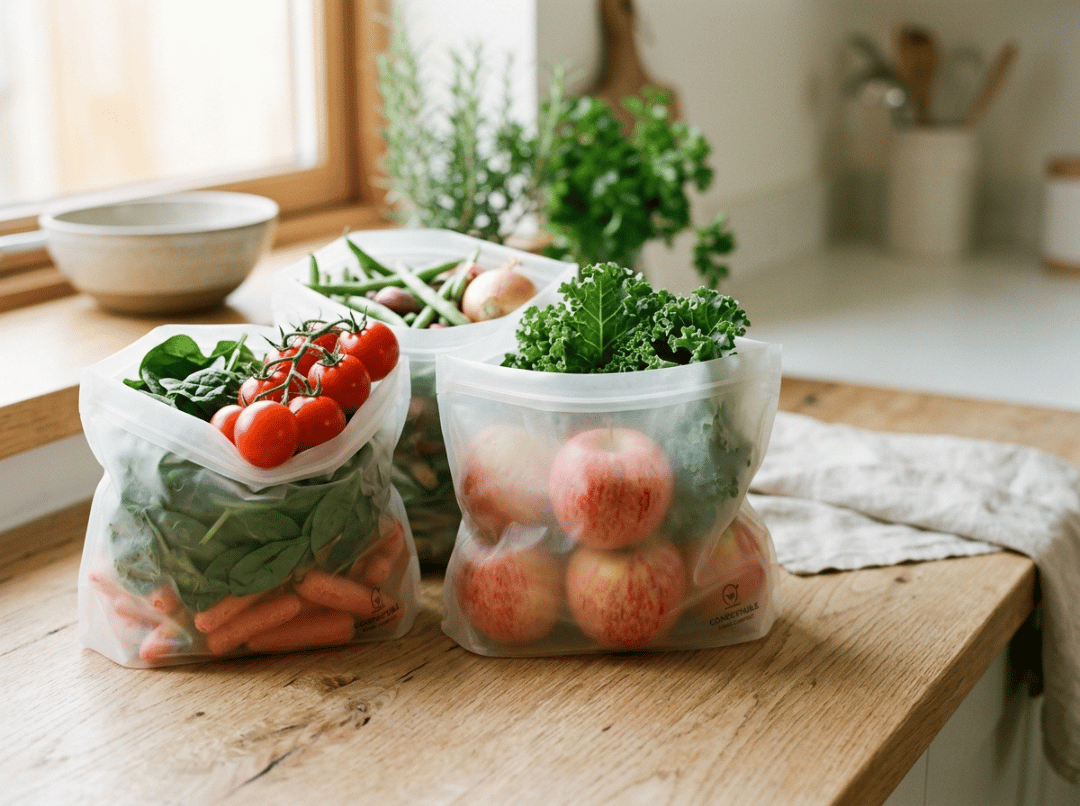
Most grocery store produce bags are not compostable. The thin, clear roll bags near the fruit and vegetable aisle are almost always conventional plastic. Only bags carrying a recognized compostable certification — like ASTM D6400, EN 13432, or OK Compost — should be treated as truly compostable. Words like “eco-friendly,” “green,” or even “biodegradable” prove nothing on their own.
Here’s the twist most people miss: home composting and industrial composting are not the same, and a bag’s certification tells you which one it’s built for. Get that wrong, and a “compostable” bag may sit intact in your backyard bin for a year.
What you’ll learn in this guide:
- How to tell a genuinely compostable bag from a greenwashed one, in seconds
- What each certification actually promises
- How shoppers should dispose of these bags correctly
- What retailers and buyers must verify before sourcing
Are All Grocery Store Produce Bags Compostable?
No — and the difference comes down to three distinct categories. Knowing which one you’re holding matters far more than any slogan printed on the roll.
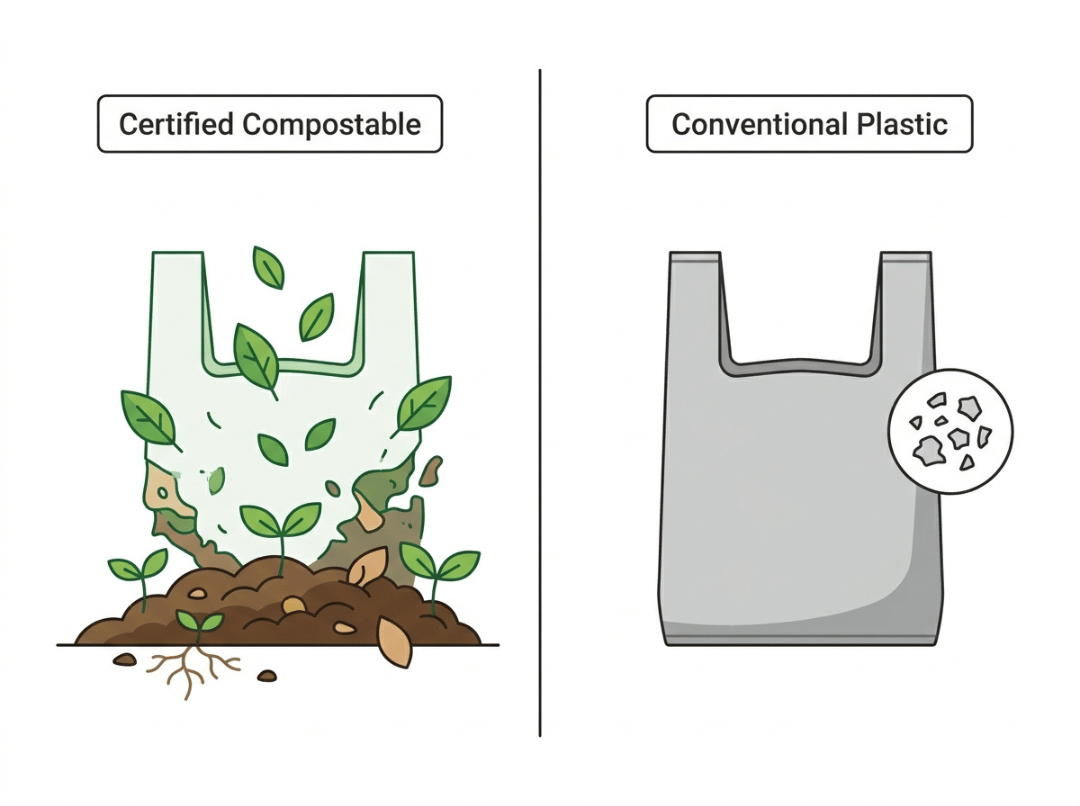
Conventional plastic bags (the default)
These make up the vast majority of produce bags in supermarkets. They’re high- or low-density polyethylene (HDPE/LDPE), petroleum-based, and built to last. They are not compostable and should never go into a compost or food-waste bin.
“Biodegradable” bags (the trap)
Some bags are marketed as “biodegradable” or contain oxo-degradable additives that make plastic fragment faster. But breaking into smaller pieces isn’t the same as breaking down. These often leave microplastics behind and carry no verified end point.
Certified compostable bags (the real thing)
Made from PLA, PBAT, or starch-based blends, these are tested to disintegrate into water, CO₂, and biomass with no toxic residue — under defined conditions. This is the only category you can confidently call compostable.
Takeaway: “Compostable” is a regulated, testable claim, not a vibe. If it isn’t certified, don’t assume it qualifies.
Compostable vs Biodegradable vs Recyclable: What’s the Difference?
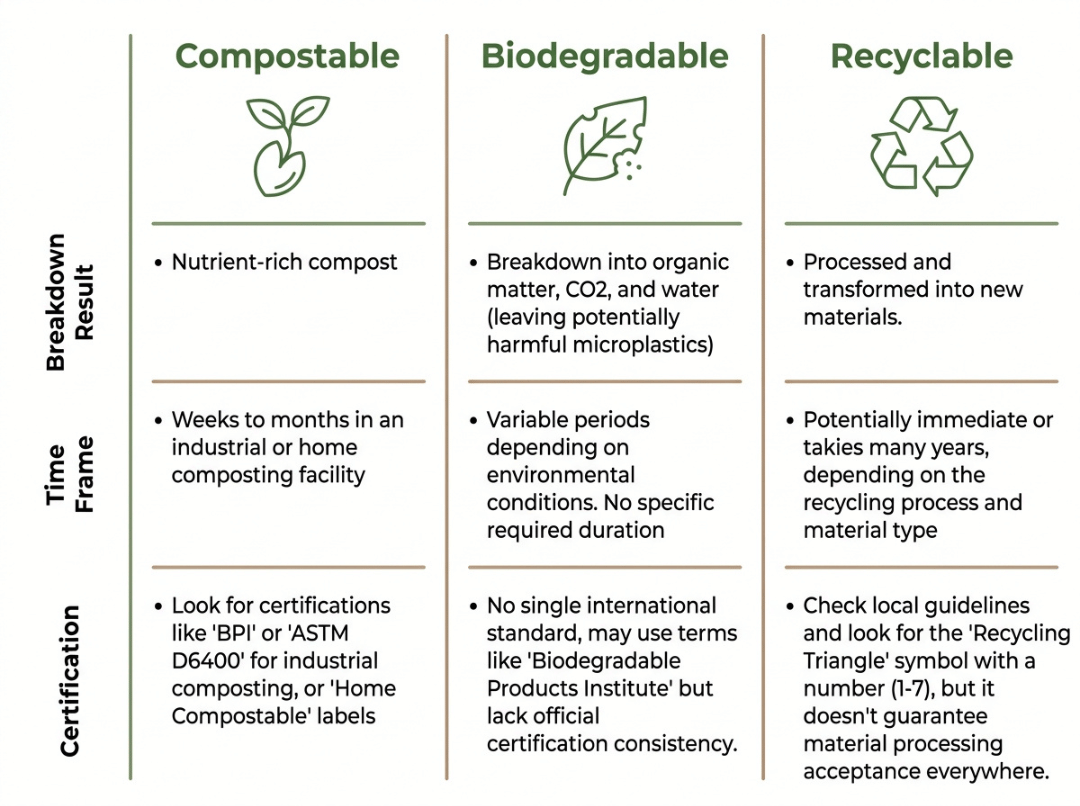
People use these three words interchangeably, but they point to completely different disposal paths.
- Compostable: Breaks down into natural elements within a defined, tested time frame, usually under specific composting conditions.
- Biodegradable: A vague term meaning something can break down eventually — with no standard for how, or how long.
- Recyclable: Can be reprocessed into new material, but only through the correct recycling stream.
|
Feature |
Compostable |
Biodegradable |
Recyclable |
|---|---|---|---|
|
Breaks down into |
Water, CO₂, biomass |
Varies; not clearly defined |
Reprocessed into new material |
|
Time frame |
Set, tested time frame |
Undefined |
Depends on facility |
|
Leaves microplastics? |
No (if certified) |
Possibly |
No |
|
Needs special facility? |
Often industrial composting |
Not standardized |
Recycling stream |
|
Backed by certification? |
Yes (ASTM, EN, etc.) |
Usually not |
Depends on material |
|
Safe in food waste bin? |
Only if certified for it |
No |
No |
Key insight: Biodegradable ≠ compostable, and compostable ≠ recyclable. Each word sends the bag to a different place.
How to Tell If a Produce Bag Is Genuinely Compostable
This is where you take back control. Don’t trust the front of the packaging — run through a short, repeatable check. Picture yourself holding a bag at the store or standing over your kitchen bin: here’s exactly what to look for, in order.
Step 1: Look for a certification mark
Scan the bag and the packaging or core for a recognized logo or standard number: ASTM D6400, EN 13432, OK Compost, OK Compost HOME, or the BPI seedling logo. These are the only reliable signals that a third party actually tested the product.
Scenario: A bag says “100% eco-friendly, breaks down naturally” but shows no logo and no standard number. Treat it as conventional plastic. A real compostable bag has almost no reason to hide its certification.
Step 2: Read whether it says home or industrial
This single line changes everything. A bag marked “industrial composting only” will not fully break down in your backyard bin. A bag marked home compostable (like OK Compost HOME) is verified for lower, variable temperatures.
Scenario: You compost at home and grab a bag stamped only “ASTM D6400.” That’s an industrial standard — it belongs in a municipal composting stream, not your garden pile.
Step 3: Check the material statement
Look for named materials: PLA, PBAT, or a starch blend. A clear material declaration is a good sign. Vague wording with no material listed is a red flag.
Step 4: Watch for greenwashing language
“Eco,” “natural,” “earth-friendly,” and “green” carry no legal weight on their own. If there’s no standard or certification behind the words, treat them as marketing — not proof.
Step 5: When in doubt, don’t assume
If a bag carries no recognized mark, default to treating it as non-compostable. That’s the safer call for you and for the composting stream, which gets contaminated when the wrong bags end up in it.
The 5-second check — screenshot this:
- Is there a certification logo or standard number?
- Does it say home or industrial composting?
- Is the material named (PLA, PBAT, starch)?
- Are the “green” claims backed by proof?
- If any answer is no → treat it as non-compostable.
What Each Certification Actually Promises
Certification is the backbone of trust here. Each standard sets a defined time frame, a disintegration threshold, and a no-toxicity requirement — so the label means the same thing every time. But not all marks promise the same thing, and that difference matters when you’re choosing where a bag goes.
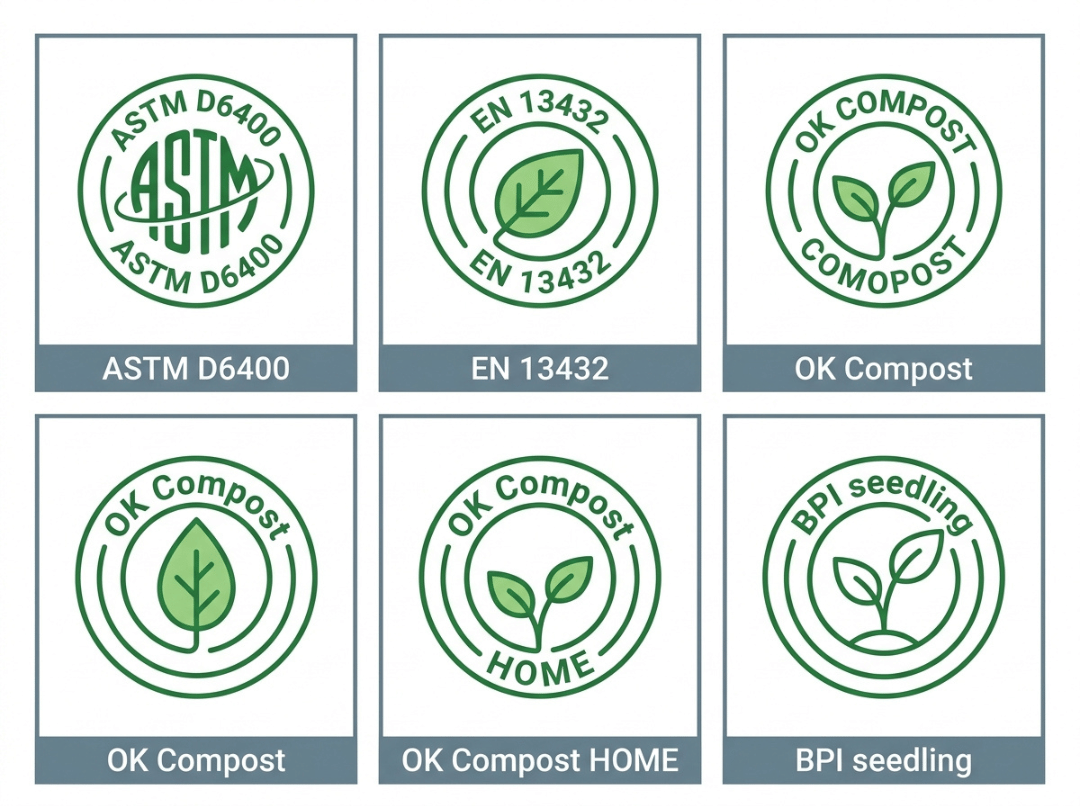
ASTM D6400 (North America, verified by BPI)
The primary North American standard for industrial compostability, used across the US and Canada. A bag certified to it is verified to fully break down in a commercial composting facility — not necessarily your backyard.
EN 13432 (Europe)
The core European standard for industrial compostability. It confirms a product decomposes within a set period with no toxic residue or harmful microplastics. This is the mark European buyers should prioritize.
OK Compost / OK Compost INDUSTRIAL (TÜV Austria)
Confirms suitability for industrial composting systems that rely on high heat and controlled conditions. Widely recognized across the EU alongside EN 13432.
OK Compost HOME (TÜV Austria)
The one to look for if you compost at home. It verifies breakdown at the lower, less consistent temperatures of a backyard bin — a genuinely harder test to pass.
BPI Certification (the fast trust signal)
The BPI seedling logo confirms a product has met ASTM D6400 (or D6868) through independent verification. For North American shoppers and buyers, it’s the quickest way to trust a claim at a glance.
A note on region: Certifications carry the most weight in their home market. Match the standard to where the bag will actually be sold and disposed of — ASTM/BPI for North America, EN 13432 / OK Compost for Europe.
Home vs Industrial Composting: Why It Trips People Up
This is the single most common point of confusion, and getting it wrong means a “compostable” bag never actually composts.
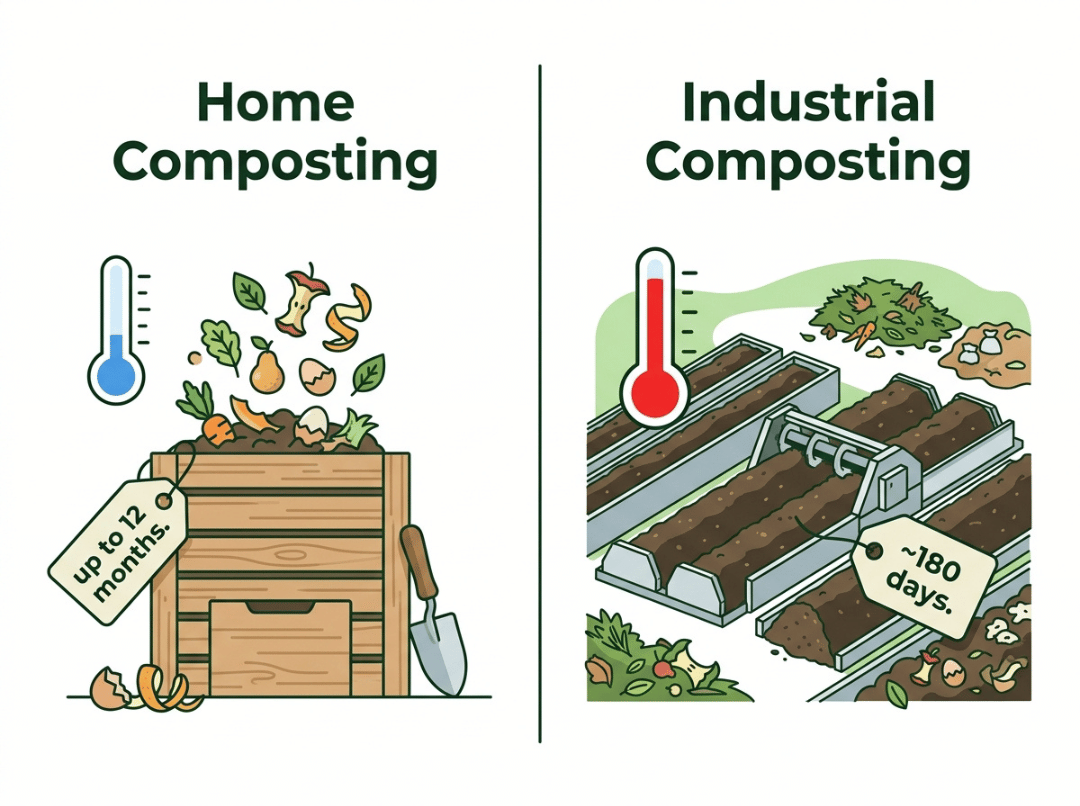
Industrial composting
Commercial facilities generate high, sustained heat, controlled moisture, and heavy microbial activity. These conditions break certified bags down fast — often within about 180 days.
Home composting
A backyard bin runs cooler and far less consistently. Only bags with a home-composting certification are verified to break down there, and even then it can take up to a year.
Scenario: A shopper drops an industrial-only PLA bag into their compost tumbler and checks back in six months. It’s still largely intact — not because it’s fake, but because it never reached the temperature it needs.
Practical rule: Match the certification to the composting method you actually have access to. Home certification for home bins; industrial certification only if your area collects for industrial facilities.
For Shoppers: How to Dispose of Produce Bags Correctly
A bag’s label describes its potential, not its guaranteed fate. Where it ends up matters just as much as what it’s made of.
- In landfill: No oxygen, little microbial activity. Even certified compostable bags may not break down as intended when buried.
- In plastic recycling: Compostable bags do not belong here. They contaminate the stream and can cause good material to be rejected.
- In a food-waste or compost bin: Only where your local program specifically accepts certified compostable bags — rules vary widely by city.
Actionable tip: Before you toss any bag, check your municipality’s food-waste and composting guidance. A bag is only as “compostable” as the facilities available to you.
Common shopper mistakes to avoid:
- Assuming “biodegradable” means compostable
- Tossing compostable bags into plastic recycling
- Trusting vague “green” claims with no certification
- Home-composting bags rated for industrial facilities only
For Retailers and Buyers: How to Source Compliant Compostable Bags
If you’re buying compostable produce bags at scale, a few disciplined checks protect your budget, your brand, and your compliance position. This is where good sourcing separates credible products from greenwashing risk.
Verify certification documents, not logos
Ask for the actual test reports and certificate numbers — not just a logo on a spec sheet. Logos can be copied; certificates can be independently verified.
Confirm the target-market standard
Buy for the market where the bags will be used and disposed of. That means ASTM D6400 / BPI for North America and EN 13432 / OK Compost for the EU. A bag certified for the wrong region invites compliance and marketing problems.
Check food-contact compliance
Produce bags touch food directly. Confirm the material is verified safe for food contact — not only compostable. These are two separate requirements.
Review functional specs
Look beyond compostability at thickness, load capacity, haze/transparency, and breathability. A bag that tears at the checkout or fogs up over fresh produce won’t serve your customers, no matter how green it is.
Assess supplier reliability
Evaluate customization options, realistic lead times, and consistent quality control. A dependable supplier is as important as a certified product.
Align your claims with disposal reality
Telling shoppers a bag is “home compostable” when it’s industrial-only invites greenwashing complaints and erodes trust. Communicate the correct disposal path on-pack and in your marketing.
Buyer’s takeaway: Certificate number, target-market standard, food-contact proof, and functional specs — verify all four before you commit to an order.
Frequently Asked Questions
Are grocery store produce bags compostable at home?
Only if they carry a home-composting certification such as OK Compost HOME. Most standard bags aren’t compostable at all, and industrial-only bags won’t fully break down in a backyard bin — so check the mark before you compost it.
Can compostable produce bags go in food waste bins?
Only where your local program specifically accepts certified compostable bags. Rules vary widely by municipality, so confirm your city’s guidance first; when in doubt, keep them out.
How long do compostable produce bags take to break down?
Certified bags break down within about 180 days in industrial composting. Home composting is slower and can take up to 12 months, depending on temperature and conditions.
Are compostable produce bags recyclable instead?
No. Keep them out of plastic recycling — they contaminate the stream and can cause otherwise good material to be rejected. Composting is their path, not recycling.
What certifications should compostable produce bags have?
Look for ASTM D6400, EN 13432, OK Compost, OK Compost HOME, or BPI — matched to the market where the bag will be used and disposed of.
Are PLA produce bags truly compostable?
Yes, when certified — but PLA is usually verified for industrial composting, not home composting. Always check the specific certification rather than assuming.
Do compostable bags leave microplastics?
Certified compostable bags are tested to break down without leaving harmful residue or microplastics. Uncertified “biodegradable” bags offer no such assurance.
Are compostable produce bags safe for fruits and vegetables?
Certified food-contact bags are non-toxic and designed for safe produce handling. When sourcing, confirm food-contact compliance separately from the compostability claim.
Conclusion: Check the Mark Before You Trust the Claim
The short answer holds: most grocery store produce bags aren’t compostable, and certification is the only thing that proves the difference. The color, the feel, the “eco” wording — all noise until you check the mark, read whether it’s home or industrial, and confirm the material.
If you’re a shopper, dispose of bags the way your local program allows and keep the composting stream clean. If you’re sourcing compostable produce bags for retail or wholesale, don’t stop at the logo — ask for the certificate number, confirm it matches your target market, and verify food-contact compliance before you commit. Those few checks are what separate a genuinely compostable choice from an expensive greenwashing risk.