


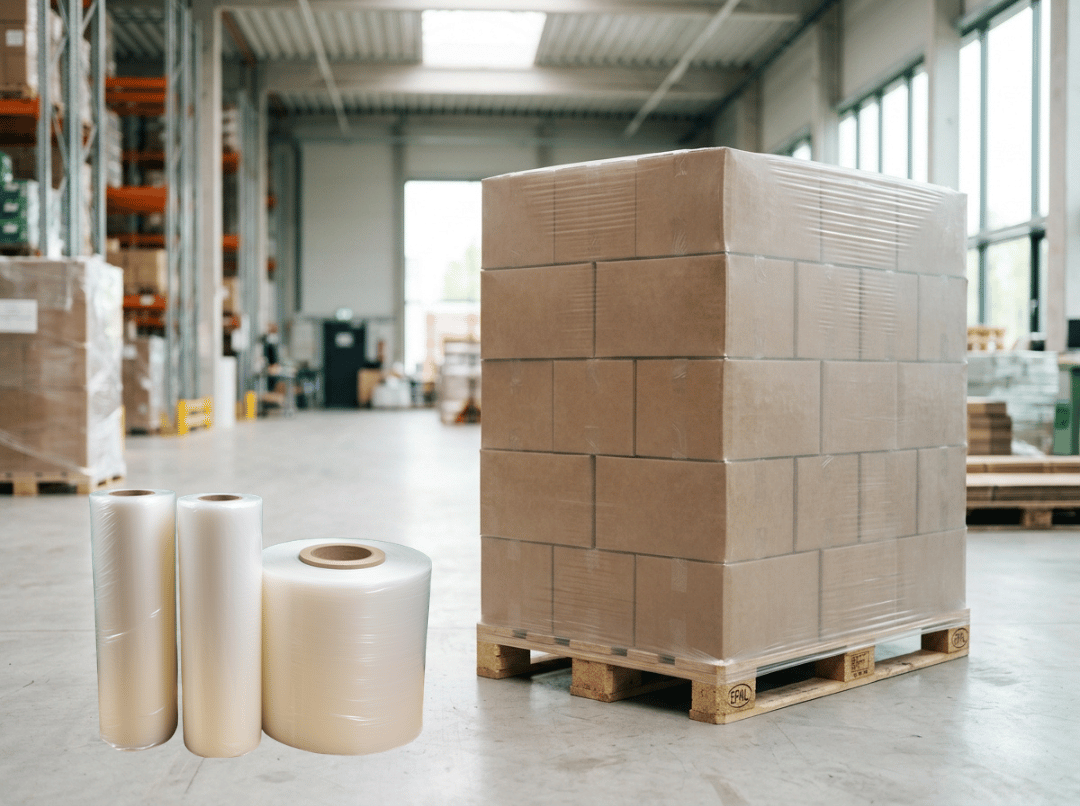
Yes, compostable stretch film can replace conventional PE stretch film — but only in the right conditions. It wraps and stabilizes pallets like standard film, then breaks down into water, CO₂, and biomass at end-of-life instead of persisting for centuries. The catch: only certified films compost as promised, only where industrial composting facilities exist, and performance varies by load. This guide helps procurement, packaging, and warehouse teams decide whether a switch fits their operation — covering performance, certifications, best-fit scenarios, limitations, and a concrete sourcing checklist. The guidance draws on recognized standards: ASTM D6400, EN 13432, TÜV Austria, and BPI.
What Is Compostable Stretch Film?
Compostable stretch film is a thin, elastic pallet-wrapping film made from bio-based polymers tested to compost under defined conditions. On the pallet, it behaves like any stretch wrap. The real difference shows up after delivery, in how it ends its life.
Most films blend two polymers. PLA (polylactic acid) adds rigidity and clarity; PBAT (polybutylene adipate terephthalate) brings the flexibility, stretch, and toughness a wrapping film needs. Some add starch-based content. These come from renewable feedstocks like corn or sugarcane, and the blend ratio drives both performance and breakdown speed.
Here’s the distinction that matters most: “compostable” is a tested, regulated claim, while “biodegradable” is not. Biodegradable only means something can break down eventually — no standard for how, how completely, or how long. A “biodegradable stretch film” may simply fragment into microplastics. Every certified compostable film is biodegradable; the reverse is not true.
Takeaway: Verify the certification, not the wording. The material blend determines both how the film performs and whether it actually composts.
Compostable Stretch Film vs Plastic Stretch Film
On the roll, compostable stretch film and conventional plastic film look nearly identical. The compostable stretch film vs plastic difference lives in the base material, end-of-life behavior, and how you dispose of each.
|
Factor |
Compostable Stretch Film |
Conventional Plastic (PE) Stretch Film |
|---|---|---|
|
Base material |
PLA / PBAT / starch blends |
Polyethylene (petroleum-based) |
|
End-of-life |
Composts into water, CO₂, biomass |
Persists for hundreds of years |
|
Recyclable? |
No — not for plastic recycling |
Sometimes, via film recycling |
|
Compostable? |
Yes, if certified |
No |
|
Certifications |
ASTM D6400, EN 13432, OK Compost, BPI |
N/A |
|
Microplastics risk |
None (if certified) |
Yes, over time |
|
Typical use fit |
Sustainability-led, moderate loads |
Heavy-duty, broad conditions |
|
Disposal dependency |
Needs composting infrastructure |
Needs film recycling access |
Key insight: Both films do a similar job on the pallet. The meaningful difference appears at end-of-life — and it hinges on the disposal access you actually have. A compostable film with no composting facility nearby loses much of its advantage.
Is Compostable Stretch Film Strong Enough for Pallet Wrapping?
Yes — modern compostable films handle many standard palletizing tasks. But don’t assume parity with PE on every load. Evaluate against real performance metrics, because this is the section that decides whether a switch actually works in your warehouse.
Stretch rate (pre-stretch)
Stretch rate is how far the film elongates before application, shown as a percentage. A 200% pre-stretch film means one meter of film covers roughly three meters of pallet. Higher stretch means fewer meters per pallet and lower cost per load. Compostable films reach useful pre-stretch levels, but the ceiling may sit below premium PE — so check the rated figure instead of guessing.
Scenario: If you currently run PE at 250% pre-stretch to hit a cost target, and the compostable film tops out at 200%, your film consumption per pallet rises. Factor that into the real cost comparison before you switch.
Holding force and cling
Holding force keeps the load tight after wrapping; cling keeps the film’s tail sticking to itself instead of unraveling. For tall, stacked, or shifting loads, consistent holding force is what prevents lean and collapse in transit. Request the holding-force rating and confirm cling behavior — some compostable films cling differently than PE, which can surprise operators used to a specific feel.
Puncture and tear resistance
Sharp corners, protruding edges, and rough handling test toughness. Puncture resistance stops piercing; tear resistance keeps a small nick from running into full failure. This is where PBAT earns its place, adding toughness to an otherwise stiffer PLA base.
Scenario: A pallet of boxed glassware with hard corners is a puncture-resistance test, not a stretch test. If that describes your product, weight this factor heavily and test it specifically.
Load stability and containment
All the metrics above roll into one question buyers actually care about: does the pallet arrive intact? Containment is stretch, holding force, and puncture resistance working together across your real lanes. A film can look strong on a spec sheet and still fail on a wobbly, mixed-height pallet — which is exactly why paper specs aren’t enough.
How to run a proper trial
Never switch on datasheets alone. Run a controlled trial that mirrors your worst case, not your easiest:
- Pick 2–3 representative loads — include your heaviest and your sharpest-edged.
- Wrap on your actual equipment at your normal settings.
- Ship on real lanes, not a test dock.
- Measure two numbers against your PE baseline: film usage per pallet and damage/rejection rate on arrival.
- Repeat over a few weeks to catch temperature and humidity effects.
Practical takeaway: Match film performance to your heaviest and sharpest loads, not your easiest ones. If it holds up on your worst pallet, the rest follow.
Hand vs Machine Compostable Stretch Film
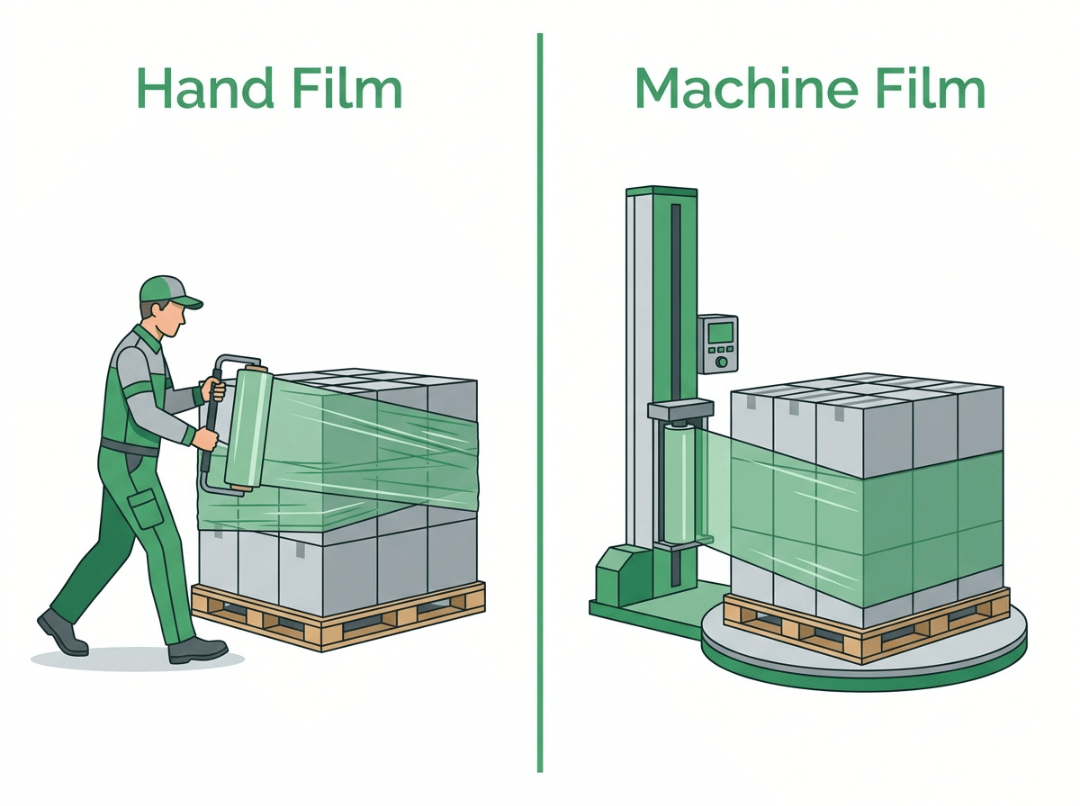
Getting this wrong wastes an order, so treat it as a procurement decision, not a detail. A machine stretch film compostable grade and a hand-wrap grade are not interchangeable — roll format, gauge, and tolerance for mechanical pre-stretch all differ.
- Choose hand film for manual wrapping, lower volumes, and mixed or irregular loads. Rolls are shorter and lighter gauge, but consistency depends on the operator — expect some pallet-to-pallet variation.
- Choose machine film for automated or semi-automated wrappers and higher throughput. Rolls run longer and heavier, and the machine delivers repeatable tension and pre-stretch on every load. This is the route for a compostable pallet wrap program at volume.
The step buyers skip: confirm the film is rated for your wrapper type and pre-stretch settings. Not all films tolerate high mechanical pre-stretch — pushed too far, they thin out, tear, or lose holding force. Share your wrapper model and pre-stretch level, and get compatibility confirmed in writing.
Practical rule: Match film type to your wrapping method and volume first, then compare prices. A cheaper roll that jams your machine costs more in the end.
Where Compostable Stretch Film Fits — and Where It Doesn’t
Treat this as your decision filter. Being honest about fit builds more trust than claiming the film works everywhere — and it saves you from an expensive mismatch.
Best fit
- Sustainability-led brands and retailers with packaging-reduction or ESG targets, where a certified material beats a vague “eco” label.
- Standard pallet unitizing on predictable lanes with moderate, consistent loads.
- E-commerce and secondary packaging where disposal messaging supports the brand story.
- Export or compliance-driven programs where a market or customer mandates compostable materials.
- Operations with real composting access, so the film’s end-of-life benefit is actually realized.
Not ideal fit
- Very heavy or high-tension loads that push film past its comfort zone.
- Sharp-edged products with a high puncture risk, unless testing proves otherwise.
- No industrial composting nearby, which strips away the core advantage.
- Buyers expecting identical PE behavior across every metric and condition.
- Long, uncontrolled storage in hot or humid environments.
Takeaway: The strongest fit is a moderate-load, controlled-condition operation paired with real access to industrial composting. If two or more “not ideal” points describe you, test hard before committing — or keep PE on those lines.
Key Certifications to Look For
Certification is the backbone of any credible compostable claim. Each standard defines a set time frame, a disintegration threshold, and a no-toxicity requirement — so a certified label means the same thing every time.
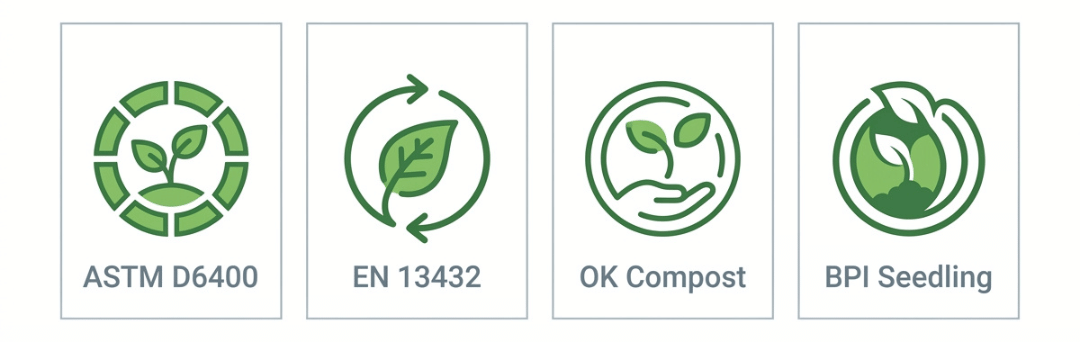
- ASTM D6400 (North America): The core industrial compostability standard for the US and Canada. An ASTM D6400 stretch film is verified to break down fully in a commercial facility — the anchor mark for North American buyers.
- EN 13432 (Europe): The European industrial compostability standard. An EN 13432 stretch film decomposes within a set period with no toxic residue or harmful microplastics. Prioritize this if you ship within or into the EU.
- OK Compost / OK Compost INDUSTRIAL (TÜV Austria): Confirms suitability for industrial composting systems; widely recognized across Europe, often alongside EN 13432.
- BPI Certification: The seedling logo signals independent North American verification against ASTM D6400 (or D6868) — a fast trust signal that a claim was third-party checked.
One expectation to set early with your team and customers: most compostable stretch films are certified for industrial composting, not backyard bins. Industrial facilities supply the sustained heat these films need; a home pile usually won’t get hot enough.
Verify claims: Request the actual certificate number and test report, not just a logo on a spec sheet. Logos can be copied; certificates can be checked. Match the standard to your market — ASTM/BPI for North America, EN 13432 / OK Compost for Europe.
A Sourcing Checklist for Buyers and Procurement Teams
Buying compostable stretch film at scale is a verification exercise, not a leap of faith. Work through these actions before you sign off:
- Verify certification documents. Request certificate numbers and full test reports, matched to your target market. Confirm the certificate is current and applies to the exact film grade you’re buying.
- Get specs in writing. Stretch rate, holding force, puncture and tear resistance, gauge, and roll length. Vague performance language is a red flag; documented numbers are a good sign.
- Confirm machine compatibility. If you wrap by machine, have the supplier verify the film suits your wrapper and pre-stretch settings before you order.
- Request samples and run a trial. Test on real products, loads, and lanes. Measure film usage per pallet and damage rates against your PE baseline.
- Align MOQ, customization, and lead times. Match order minimums and roll specs to how your operation runs, and confirm reorder timing so you don’t run short.
- Match disposal claims to reality. Communicate the correct end-of-life path — industrial composting — on-pack and in marketing. Claiming “home compostable” when it’s industrial-only invites greenwashing complaints.
Screenshot this: certificate verified → specs documented → machine compatibility confirmed → samples trialed vs PE → MOQ and lead times aligned → disposal claims accurate.
Frequently Asked Questions
What is compostable stretch film made of?
Typically PLA (polylactic acid) and PBAT (polybutylene adipate terephthalate), often with some starch-based content, from renewable feedstocks like corn or sugarcane. The blend ratio shapes both performance and breakdown speed.
How long does compostable stretch film take to decompose?
Under industrial composting conditions, certified film generally breaks down within about six months into water, CO₂, and biomass. It won’t decompose the same way in a landfill or home bin, which lack the sustained heat and microbial activity it needs.
Is compostable stretch film biodegradable or recyclable?
It’s certified compostable — a stricter, tested version of biodegradable. It is not recyclable in plastic film streams; keep it out of PE recycling, where it contaminates the batch. Composting is its intended end-of-life path.
Can compostable stretch film replace PE stretch film?
In many moderate-load applications, yes. Validate performance on your actual loads first, especially for heavy or sharp-edged products, and run a trial against your PE baseline before committing to full volume.
Is compostable stretch film suitable for machine wrapping?
Yes, when the film is specifically rated for machine application and matched to your wrapper’s pre-stretch settings. Not every film tolerates high mechanical pre-stretch, so confirm compatibility with the supplier first.
Is compostable stretch film food safe?
It’s mainly designed for industrial and secondary packaging, not direct food contact. For direct food use, confirm separate food-contact certification — compostability and food-contact safety are two different requirements.
What certifications should compostable stretch film have?
Look for ASTM D6400, EN 13432, OK Compost, or BPI, matched to the market where the film will be used and disposed of. Always ask for the certificate number and test report, not just a logo.
Conclusion: Decide With Evidence, Not Labels
Compostable stretch film can be a genuinely strong alternative to PE — when it’s certified, performance-matched to your loads, and paired with real composting access. Everything else, from the “eco” wording to the look of the roll, is noise until you check the evidence.
Keep the decision path simple: verify the certifications and certificate numbers, validate performance on your own pallets, confirm machine compatibility, and be honest about your disposal reality. Get those four right and you’ll know whether a switch fits — or whether it’s worth waiting.
If your team is weighing a move, start small: request the certification documents and a sample roll, then run a short trial against your current PE film before committing to volume. The team at hongrenpacking.com can help you match the right compostable stretch film specs to your loads, wrapping method, and target market.