


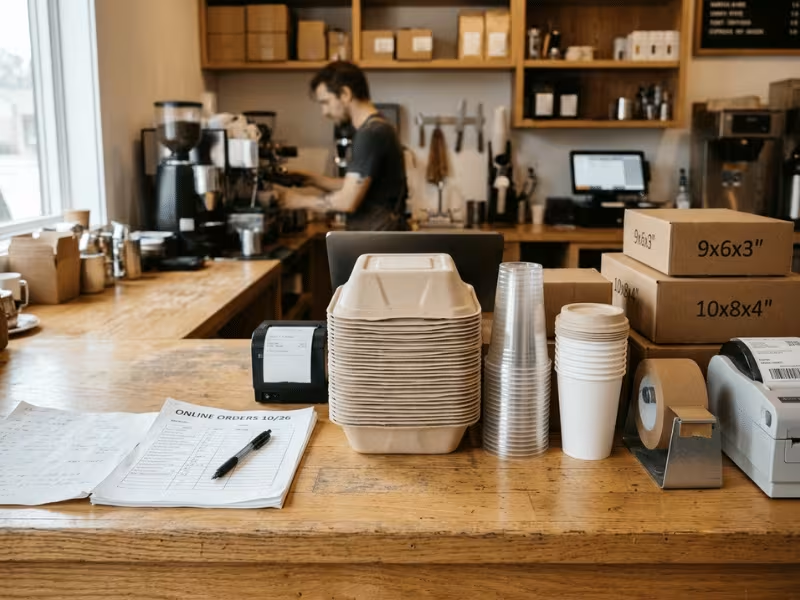
Biodegradable packaging used to be a nice extra. Now it shapes real buying decisions. Customers notice what a brand hands them, and clients expect clear answers about materials and disposal.
The hard part is sorting through the market. One product says “biodegradable,” another says “compostable,” and a third claims to be “recyclable” even though local programs may not take it. Certifications get mixed up, and performance and pricing are rarely clear.
This guide doesn’t try to cover every green product on the market. It focuses on three practical questions: which items to switch first, how to judge a supplier’s claims, and which options are worth paying for. The answers come from real procurement work in food service and e-commerce packaging.
Why More Businesses Are Switching in 2026
The push toward biodegradable products now comes from several directions at once. In buyer conversations this year, three pressures come up again and again. Each one affects a different part of the business, and together they make waiting harder to justify.
Customers Notice What You Hand Them
A takeout container or shipping mailer is often the only part of a brand that a customer physically holds. People form an opinion fast.
A café that still uses foam clamshells gets called out in reviews. An online shop that ships orders packed in plastic fill shows up in unflattering social media photos.
Customers may never read a sustainability report, but they will notice the cup in their hand.
Plastic Rules Keep Getting Tighter
Many U.S. states and cities already ban foam food containers and single-use plastic bags. New local rules arrive every year.
In Europe, the Packaging and Packaging Waste Regulation starts applying in August 2026. It sets stricter requirements for how companies design and label packaging.
You don’t need to track every new rule. But if you sell across several regions, switching early is the safer move. Waiting for a ban usually leads to a rushed and expensive change.
Your Own Clients Are Asking Harder Questions
This pressure catches smaller suppliers off guard more than any other. Large retailers, hotel groups, and corporate cafeterias now set sustainable procurement targets. Their buyers send questionnaires about materials, certifications, and end-of-life claims.
Distributors regularly lose bids because they can’t offer a compostable option with real documentation behind it. Price and quality still matter. When two offers come in close, though, a clear sustainability answer often decides the contract.
Switching now isn’t only about doing good. It protects sales, keeps you compliant, and keeps you on approved vendor lists. The more useful question is which products deserve attention first.
Biodegradable, Compostable, and Recyclable: What the Difference Means in Practice
These three words appear on almost every eco-friendly spec sheet. Buyers often treat them as interchangeable. They aren’t, and mixing them up leads to bad orders and claims you can’t back up.
Here’s how each term plays out in a purchasing decision.
Biodegradable means microbes can eventually break the material down. The problem is the word “eventually.” The label rarely says how long that takes or what conditions it needs. Given enough time, nearly any material breaks down, so the term on its own tells buyers very little. A “biodegradable” bag in a sealed landfill can sit there for years.
Compostable sets a much clearer bar. Certified compostable products must break down within a set time under defined conditions, usually in an industrial composting facility. Those facilities run hotter and wetter than a backyard pile. So “compostable” doesn’t mean “home compostable.” Unless a product carries a home compost certification, your customers’ garden bins won’t handle it well.
Recyclable has nothing to do with breaking down. It means a recycling system can collect, sort, and reprocess the material. Whether that actually happens depends on local programs. A product can be technically recyclable and still end up in the trash because the local hauler won’t accept it. PLA cups are a common example. They look like plastic, but most recycling streams reject them.
Bio-based describes where a material comes from, such as corn, sugarcane, or other plants. It says nothing about how the product ends its life. Some bio-based plastics break down no faster than conventional plastic.
Whenever a supplier uses any of these terms, ask one follow-up question: under what conditions, and who confirms it?
|
Term |
What it means |
What buyers should check |
|---|---|---|
|
Biodegradable |
Breaks down over time, with no fixed timeline |
Test data, timeline, and disposal conditions |
|
Compostable |
Breaks down within a set time under defined composting conditions |
Certification, plus industrial vs. home rating |
|
Recyclable |
Local systems can collect and reprocess it |
Whether your customers’ local programs accept it |
|
Bio-based |
Made partly or fully from plant sources |
Percentage of bio-based content and end-of-life claims |
The Certifications That Actually Matter
A certification mark tells you that an outside party checked a specific claim. Each mark checks something different, though. Buyers sometimes reject a solid product and approve a weak one simply because they misread the logos.
The fix is simple. Match each certification to the claim you plan to make, then check what it leaves out.
Compostability: ASTM, BPI, and TÜV Austria
ASTM D6400 and D6868 are test standards, not logos. D6400 covers compostable plastics, such as PLA cups and film bags. D6868 covers paper or fiber products with a compostable coating. Both standards confirm that a product breaks down in an industrial composting facility within a set time and leaves no toxic residue.
A supplier can say a product “meets ASTM D6400” without anyone verifying it. That’s why third-party marks matter.
BPI Certified Compostable is the main mark in North America. BPI reviews lab results against the ASTM standards and lists approved products in a public database. It also bans intentionally added PFAS, which matters for fiber food containers. Before you order, search the database for the exact product name.
TÜV Austria offers two marks. OK compost INDUSTRIAL tests to EN 13432, the European standard, and works much like BPI. OK compost HOME confirms that a product breaks down at the lower temperatures of a backyard pile. If you want to tell customers “compost at home,” you need this one.
Sourcing: FSC for Paper Products
FSC tracks where paper fiber comes from. It confirms responsibly managed forests and a verified chain of custody. It says nothing about how the product ends its life. An FSC mailer with a plastic coating still can’t go in a compost bin.
What None of These Marks Prove
No compostability certificate tests how a product performs in use. A certified bagasse bowl can still soften under hot soup. A certified PLA cold cup can still warp with a hot drink. Always run your own heat, grease, and moisture tests.
|
Certification |
Best for |
What it confirms |
What it does not confirm |
|---|---|---|---|
|
BPI Certified Compostable |
Food packaging, cups, bags (North America) |
Verified industrial compostability, no added PFAS |
Heat or grease performance, local facility access |
|
ASTM D6400 / D6868 |
Plastics / coated paper and fiber |
Test method for industrial compostability |
Independent verification on its own |
|
TÜV OK compost INDUSTRIAL |
EU and export markets |
Breakdown under EN 13432 conditions |
Home compostability |
|
TÜV OK compost HOME |
Products sold with “home compost” claims |
Breakdown in backyard conditions |
Durability in use |
|
FSC |
Paper mailers, boxes, napkins |
Responsible fiber sourcing |
Compostability or recyclability |
Labels That Prove Nothing
“Eco-safe,” “earth-friendly,” and “green product” have no standard and no auditor behind them. The FTC’s Green Guides warn against broad claims like these. If a spec sheet relies on them without a certificate number, ask for documentation or walk away.
Which Biodegradable Products Are Worth Switching First
The most common mistake in a sustainability switch is trying to replace everything at once. Costs jump, staff struggle with new routines, and nobody can tell which swap actually worked.
Start with a short list instead. The strongest first candidates usually check four boxes:
- High usage volume. You buy it every week, so savings or problems show up fast.
- Mature alternatives. Proven options already sell at stable prices, like bagasse containers or corrugated mailers.
- Strong customer visibility. Customers hold it, see it, and remember it.
- Easy-to-test performance. You can check heat, grease, or shipping strength within days.
Products that meet all four give you quick wins and clear data. That data makes the next swap an easier call.
For most businesses, those products sit in two places: the food counter and the shipping table.
Best Biodegradable Products for Food Service
Food service is where a switch to biodegradable products shows up first. It’s also where a bad swap gets noticed fastest. A customer may never think about your trash bags, but they will remember a clamshell that leaked curry onto their car seat.
Every food service product faces three stress factors: heat, grease, and liquid. Each material handles them differently. A product can look natural and earthy and still fail ten minutes into a delivery run.
Here’s how the four core product types hold up in daily service.
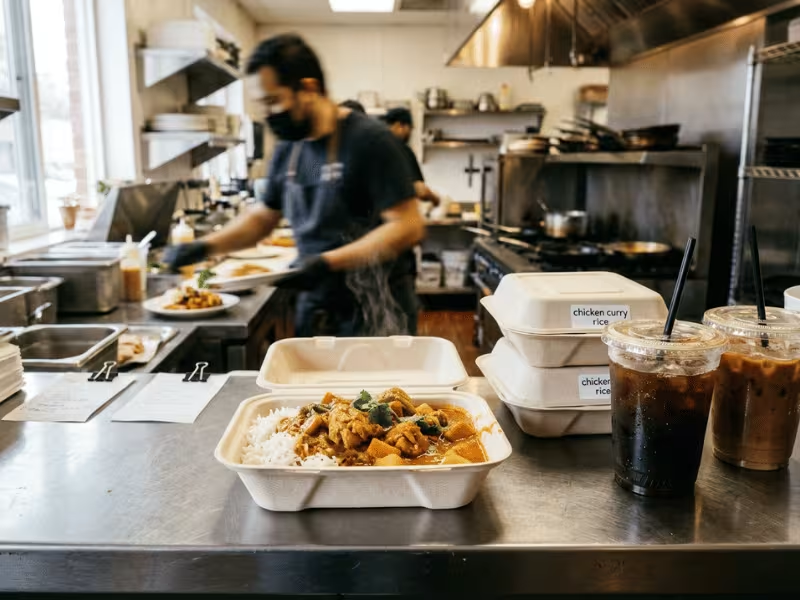
Clamshells and Takeout Containers
Bagasse containers and molded fiber containers work best for takeout, delivery, and hot meals with moderate sauce. Think burgers, fried rice, grilled chicken, or noodle dishes.
Main advantage: Bagasse handles heat well. Most quality containers tolerate food up to about 212°F, and many survive a short microwave reheat. Plastic clamshells can’t do that, and foam is banned in many cities.
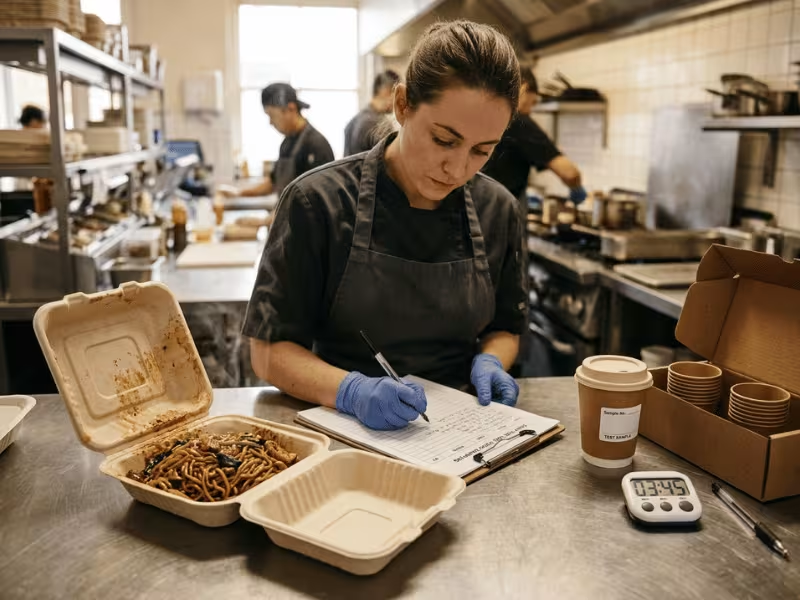
Common pitfall: Steam and liquid. A sealed clamshell traps steam, and the fiber softens from the inside. Thin soups and oily curries can seep through the hinge within 20 to 30 minutes. Many suppliers now make PFAS-free containers, and some of these resist grease less than older versions. Before you commit, fill a sample with your oiliest dish, close it, and leave it for 30 minutes.
Plates and Bowls
Bagasse plates and bowls suit dine-in service, catering, food trucks, and events. Palm leaf plates also work well for upscale catering where presentation matters.
Main advantage: They feel sturdy and look good on a buffet table. Customers often read them as a deliberate brand choice, not a cost cut.
Common pitfall: Weight and soak time. A thin plate can bend under a heavy portion of ribs and sides. Saucy dishes can soften the center after 20 minutes on a table. Check the plate’s gram weight, not just its diameter. For bowls, test with your hottest soup rather than room-temperature water.
Cutlery
Wooden cutlery made from birch or bamboo suits quick-service counters and delivery. CPLA cutlery fits operations that want a more familiar, plastic-like feel.
Main advantage: Wood stays rigid in hot food. CPLA, a heat-treated form of PLA, typically handles temperatures up to around 185°F.
Common pitfall: Mouthfeel and bending. Cheap wooden spoons can feel dry or leave splinters. Corn starch and standard PLA cutlery can bend in hot broth, which is a real problem for soup-heavy menus. Hand a sample to your staff and have them eat a full meal with it.
Cups and Lids
This category trips up more buyers than any other, because PLA comes in different forms.
Compostable clear cups made from PLA work well for iced coffee, smoothies, and cold drinks. They look almost identical to PET cups. But standard PLA starts to soften around 110°F, so it can’t hold hot drinks.
Hot cups are usually paper cups with a thin PLA lining in place of the plastic coating. Pair them with CPLA or fiber lids, which can handle steam.
Common pitfall: Mixing up hot and cold stock. Cafés sometimes pour hot tea into clear PLA cups and watch them warp. Label storage shelves clearly. Also check lid fit, because a loose lid causes more complaints than the cup itself.
Quick Comparison
|
Product type |
Best use |
Watch-outs |
|---|---|---|
|
Bagasse clamshells and containers |
Takeout, delivery, hot meals |
Steam buildup, oily sauces, hinge leaks |
|
Bagasse or palm leaf plates and bowls |
Dine-in, catering, events |
Heavy portions, soak time, thin walls |
|
Wooden or CPLA cutlery |
Quick service, delivery |
Splinters, mouthfeel, bending in hot soup |
|
Clear PLA cups |
Cold drinks only |
Warps above about 110°F |
|
PLA-lined paper cups with CPLA lids |
Hot coffee and tea |
Lid fit, pairing hot and cold stock correctly |
Appearance alone won’t tell you how a product performs in service. Test every item with your real menu, at real temperatures, for as long as your real delivery takes.
Best Biodegradable Products for Retail and E-commerce
For online sellers, packaging does two jobs. It protects the product through a rough parcel network, and it gives the customer a first physical impression of your brand. Some biodegradable swaps handle both jobs well. Others look great in a product photo and fail at a sorting hub.
Retail packaging falls into three groups: easy wins, items that affect shipping performance, and swaps that come with real limits.
The Easy Wins: Corrugated Mailers and Paper Tape
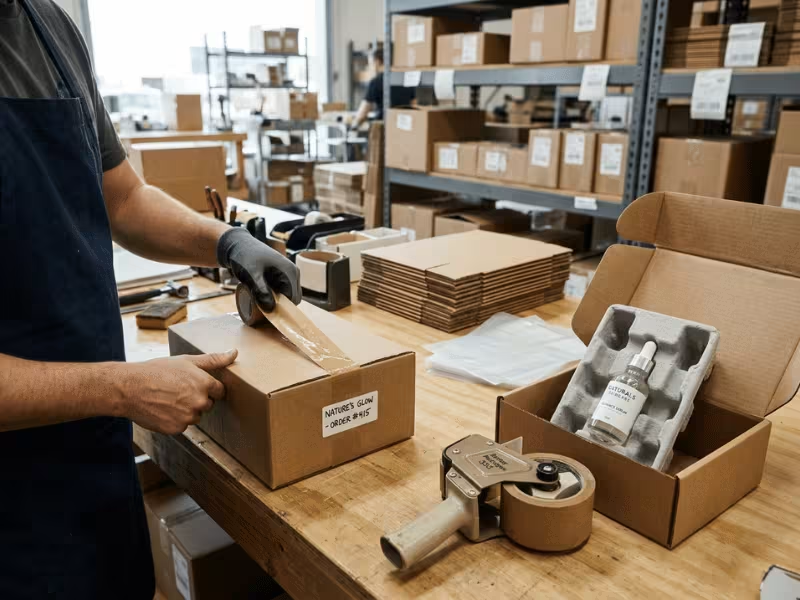
Corrugated mailers make the simplest first switch. They protect well, stack flat, and most curbside programs in the U.S. and Europe accept them. Choose FSC-certified board with high recycled content. Skip glossy plastic lamination, because it blocks recycling.
Paper tape pairs naturally with these mailers. Water-activated, fiber-reinforced tape bonds into the box surface and holds better than most plastic tape on heavy cartons. Self-adhesive paper tape works for lighter parcels. Customers can drop the whole box in the recycling bin without peeling anything off.
Where Shipping Performance Is Won or Lost
Inner protection decides whether products arrive intact. A careless swap here shows up quickly as returns and damage claims.
Molded pulp inserts suit cosmetics, glass bottles, small electronics, and gift sets. A custom-fit insert holds the product firmly and feels premium at unboxing. The catch is tooling. Custom molds add lead time and upfront cost, so they make sense once a product sells in steady volume. Drop-test every corner from about 30 inches before you approve a design.
Starch-based packing peanuts replace polystyrene fill and dissolve in water. Customers like rinsing them down the sink. That same water sensitivity creates storage problems, though. In a humid warehouse, the peanuts turn soft and sticky. They also compress more than foam under heavy items. Keep them in sealed bags, and use them for light to mid-weight goods.
The Honest Caveat: Plant-Based Poly Bags
Compostable mailing bags and garment bags, usually made from PLA and PBAT blends, carry strong marketing value. Customers see “compostable” and feel good about their purchase.
The disposal story is more complicated. Most of these bags need an industrial composting facility, and many facilities refuse packaging film because it tangles their equipment. Only bags with a home compost certification belong in a backyard bin. Without access to either option, the bag goes to landfill, where it breaks down little faster than ordinary plastic.
These bags also have a shelf life, often around 9 to 12 months, and they lose strength in heat and humidity. Buy in smaller batches, rotate your stock, and print clear disposal instructions on every bag.
If most of your customers can’t compost the bag, a recycled-content mailer may support your sustainability claims better. Start with mailers and tape, test inserts and fill carefully, and adopt compostable film where disposal access actually exists.
What to Skip, Test Carefully, or Roll Out Later
A product can carry a valid certificate and still not be ready for your operation. Smart buyers know when to say “not yet.” A useful approach is to sort every proposed swap into three groups: switch now, test first, or set aside for later.
Hot drink lids need the toughest trial. A lid deals with steam, pressure, and a customer’s mouth at the same time. A lid made from standard PLA can soften and pop off near the sip hole. Even CPLA and molded fiber lids vary from one supplier to the next. Have staff use sample lids on real orders through a full morning rush. Count spills and drips, not just how the lid fits an empty cup.
PLA-lined hot cups struggle in humid storage. Paperboard absorbs moisture in a damp stockroom or a coastal kitchen. The cups lose stiffness, stick together in sleeves, and leak at the seam sooner. Store one case in your actual stockroom for two weeks. Then fill a few dozen with hot coffee and check the seams and bottoms after 30 minutes.
Poly bags that need industrial composting can wait. If your customers can’t reach a composting facility, the bag delivers little real benefit. Roll these out only in markets where a local facility accepts film, or wait until you can source a bag with home compost certification.
Eco office supplies rank lowest. Compostable pens, bamboo notebooks, and seed-paper sticky notes feel good to buy, but they barely change your plastic footprint. A café that switches 2,000 lids a week does more than an office that swaps 50 pens a year. If your budget is tight, cut volume first. Refillable dispensers, reusable breakroom mugs, and less printing do more than a greener pen.
A simple rule keeps these decisions clear:
- Switch what is proven and used in high volume.
- Test anything exposed to heat, moisture, or disposal limits.
- Delay anything that looks good but changes little.
These choices also shape your budget, because the price gap between biodegradable and conventional options varies widely by category.
How the Costs Compare and When the Switch Makes Sense
Most buyers expect biodegradable products to cost more. That’s often true, but the gap depends heavily on the category. Some swaps now cost about the same as plastic. Others still carry a premium that only certain businesses can absorb.
Here’s how the numbers usually break down.
Where the Premium Still Bites
Compostable poly mailers carry the biggest gap. They often cost two to three times as much as standard plastic mailers. Their shorter shelf life also adds waste if you overbuy.
Bagasse clamshells still cost noticeably more than foam, because almost nothing competes with foam on price. In cities that already ban foam, though, the real comparison is bagasse versus plastic clamshells. That gap is much smaller.
Where Prices Have Caught Up
Corrugated mailers and paper tape now sell close to conventional options. Wooden cutlery, PLA cold cups, and bagasse plates usually run only slightly above plastic at volume.
Molded pulp inserts need upfront tooling. Once a product sells steadily, the per-unit cost often lands near foam inserts.
Why High-Volume Foodservice Items Come First
Cups, containers, and cutlery are the best place to start testing. You buy them every week, so even a small per-unit gap shows up clearly on invoices. You also learn quickly whether the product holds up.
Volume gives you leverage, too. A buyer with steady monthly orders can negotiate price tiers that an occasional buyer can’t.
When the Premium Pays Off
Businesses with higher price points absorb the gap more easily. A few extra cents barely registers on a premium poke bowl or a boutique skincare set. Brands like these can also make packaging part of the story customers already pay for.
A discount operation with thin margins feels every cent. If that describes your business, start with near-parity items and hold off on the premium ones.
When Switching Doesn’t Add Up
Compostable products lose much of their real value when no local facility accepts them. You pay extra, and the item still ends up in landfill. In that case, a recyclable or recycled-content option often supports a stronger claim for less money.
|
Category |
Typical price gap |
Worth switching now? |
Notes |
|---|---|---|---|
|
Corrugated mailers and paper tape |
Little to none |
Yes |
Widely recyclable, easy first swap |
|
Wooden cutlery |
Small |
Yes |
Test mouthfeel and hot-soup strength |
|
PLA cold cups |
Small |
Yes |
Cold drinks only |
|
Bagasse plates and containers |
Small vs. plastic, higher vs. foam |
Yes, for foodservice |
Test with hot, oily dishes |
|
Molded pulp inserts |
Tooling cost up front, then near parity |
Yes, at steady volume |
Drop-test before approval |
|
Compostable poly mailers |
High, often 2–3x |
Only with composting access |
Short shelf life, buy small batches |
Check your customers’ disposal options before you pay extra for compostability. Many costly buying mistakes start with skipping that step.
Common Buying Mistakes Businesses Make
Most failed switches don’t fail because of the material. They fail because of how the order was placed. The same five mistakes show up in procurement reviews again and again, and each one costs money that a little checking would have saved.
1. Buying on the word “biodegradable.”
A supplier prints “biodegradable” on the carton, and the buyer approves the order. That word carries no timeline and no conditions. Ask which standard the product meets and where it breaks down. If the answer stays vague, treat the claim as marketing.
2. Taking certificates at face value.
A PDF that says “meets ASTM D6400” proves very little. Suppliers sometimes send expired certificates or certificates for a different product. Others send lab reports that no one has independently checked.
Search the BPI or TÜV Austria database for the exact product name and certificate number. Then confirm that the listing covers the size and model you plan to buy. A certified 32 oz bowl doesn’t automatically cover the 12 oz version.
3. Approving samples without real-world tests.
A sample that looks fine on a desk tells you very little. Fill containers with your hottest, oiliest dish and hold them for your longest delivery time. Pour fresh coffee into hot cups and check the seams after 30 minutes.
Ship a few mailers to a coworker across the country. Store one case in your actual stockroom for two weeks. Real conditions expose weak points within days.
4. Ignoring where the product ends up.
Many buyers pay a compostable premium and only later learn that no local facility accepts it. Call your waste hauler before you order. Ask whether they take compostable packaging, and which types.
Some facilities accept fiber containers but reject PLA cups and film. E-commerce sellers should check disposal options in their biggest customer markets, not only in their own city.
5. Switching everything in one week.
A full rollout sounds efficient. In practice, staff mix up hot and cold cups, storage space runs out, and complaints arrive with no clear cause.
Change one or two items at a time. Track complaints, waste, and cost for each item before you add the next one.
Nearly all five mistakes come from one gap: trust without proof. The right supplier helps you close that gap before the first pallet arrives.
How to Choose the Right Supplier
A good supplier does more than quote a low price. They prove their claims, ship on time, and flag problems before those problems reach your customers. Supplier checks work best in three stages, and each stage filters out a different kind of risk.
Before Sampling
Ask for the certificate number before you request a single sample. Then check it yourself in the BPI or TÜV Austria database. The listed name, size, and model must match the exact item you plan to buy.
Get quotes from at least three suppliers per category. One quote gives you no benchmark. Three show you the real price range, and the outlier often points to a weak spot.
Ask about MOQ and lead times early. A supplier with a 50,000-piece minimum and a 60-day lead time may not suit a café group that reorders every month.
During Testing
Ask for samples from regular production, not a hand-picked batch. Get that promise in writing.
While you test for heat, grease, and shipping strength, ask about shelf life and storage. PLA products and compostable film weaken over time, especially in heat and humidity. Find out the recommended shelf life, the ideal storage conditions, and how the supplier dates each carton.
Before Scale-Up
Before you place a large order, collect the documents behind your marketing claims. You need certificates, test reports, and approved wording for labels. If your bag says “certified compostable,” you need paperwork to back it up.
Also make sure the bulk order will match your approved sample. Ask the supplier to notify you before they change any material, coating, or factory.
|
Checkpoint |
Why it matters |
|---|---|
|
Certificate listed in the BPI or TÜV database |
Confirms the claim covers your exact product |
|
Three quotes per category |
Shows fair pricing and exposes weak offers |
|
MOQ and lead time |
Keeps orders in line with storage space and cash flow |
|
Samples from regular production |
Ensures your test results match what you receive |
|
Shelf life and storage terms |
Prevents brittle or weakened stock |
|
Compostability documents |
Backs up every claim on your packaging |
|
Advance notice of material changes |
Stops unannounced material swaps after approval |
A supplier who answers these questions quickly and clearly is usually the one worth keeping.
A Practical Way to Start Without Disrupting Operations
Real progress doesn’t require a full sustainability overhaul. The smoothest switches follow the same pattern: one product, one test, and clear numbers. Here’s a rollout plan that works for most businesses.
1. Pick one high-volume item.
Choose the product you reorder most, such as cold cups, takeout containers, or shipping mailers. High volume gives you fast feedback and a cost difference you can actually measure. Leave everything else alone for now.
2. Run a 2–4 week real-world test.
Order samples from two or three suppliers. Put them into normal service during your busiest shifts, on your longest delivery routes, and in your actual stockroom. Two weeks catches obvious failures. Four weeks shows how stock holds up in storage.
3. Track four things.
Keep a simple log for each sample:
- Performance: leaks, warping, bending, or damage in transit
- Complaints: from customers and from staff
- Storage: how cartons handle heat and humidity, and how much shelf space they take
- Cost: price per unit, plus waste from failed pieces
Ask your team to log problems the day they happen. Details fade fast during a busy week.
4. Confirm disposal access.
Call your waste hauler and ask exactly which compostable items they accept. If you ship nationally, check your top customer markets too. If nobody nearby accepts compostables, a recyclable option may serve you better.
5. Expand in small steps.
Once the first item passes, lock in the supplier and move to the next product on your list. Add one or two items per month. Brief staff before each change, and label shelves so hot and cold stock never mix.
This pace can feel slow at first. But it keeps service steady, protects your budget, and gives you proof behind every claim you make.
FAQs
How long do biodegradable products take to break down?
It depends on the material and where it ends up. Certified compostable items, such as bagasse bowls or PLA cups, usually break apart within about 12 weeks in an industrial composting facility. Products with a home compost certification can take up to 12 months in a backyard pile.
In a landfill, the same items can last for years, because landfills lack the oxygen and heat that microbes need. A “biodegradable” label with no standard behind it gives you no reliable timeline.
Can compostable packaging go in home compost?
Only if it carries a home compost certification, such as TÜV Austria OK compost HOME. Most compostable packaging, including standard PLA cups and many poly mailers, needs the high heat of an industrial facility. A backyard pile rarely gets that hot, so these items can sit there for a year or more.
Uncoated fiber often breaks down faster at home. Still, check the certificate before you print “home compostable” on anything.
What is the difference between PLA and bagasse?
PLA is a bioplastic made from plant sugars, usually from corn or sugarcane. It looks like clear plastic, so it works well for cold cups and deli containers. Standard PLA softens around 110°F, so keep it away from hot food and drinks.
Bagasse is the fiber left over after sugarcane is crushed for juice. Manufacturers press it into opaque plates, bowls, and clamshells that handle hot food well. Steam and oily sauces can still soften it over time.
Do biodegradable products expire or lose performance in storage?
Some do. Compostable film bags often last about 9 to 12 months before they turn brittle. PLA cups and cutlery can warp in a hot warehouse. Paper cups and bagasse absorb moisture in humid rooms.
Store stock in a cool, dry space and rotate it first in, first out. For compostable film, order no more than a few months of supply at a time.
Will customers know how to dispose of compostable packaging?
Most won’t unless you tell them. Many people toss PLA cups into recycling bins, where they contaminate the stream.
Print short, specific instructions on the item itself, such as “Commercially compostable only. Do not recycle.” Add matching signs at your waste stations, and use color-coded bins where you can. Clear instructions guide customers better than a certificate logo alone.
How can a business avoid greenwashing claims?
Make claims you can prove, and keep them specific. Say “certified compostable in industrial facilities” instead of “eco-friendly.” Keep certificate numbers and test reports on file for every product you label.
If few composting facilities serve your market, say so on the label. The FTC Green Guides recommend that kind of qualifier. Review your packaging text every time you change suppliers, since a new product may not carry the same certification.
Planning your first switch or comparing samples across categories? Contact our team to talk through certified biodegradable and compostable packaging options that fit your products, volumes, and markets.