


A plate folds under hot barbecue sauce halfway through dinner. Or you buy “biodegradable” plates, toss them in your backyard compost, and find them still intact months later.
Hosts, caterers, and food service buyers tell me both stories all the time.
The real problem has two parts. Your plate must survive the meal. Then it must break down the way the label promises.
I help event planners and food businesses source eco-friendly tableware. In this guide, I show you how to match each plate to your food, your event, and your disposal method. If you plan to buy bowls, cups, and cutlery along with your plates, the same logic applies across the wider range of biodegradable tableware.
The goal is simple: buy once and buy right.
The 3 Things That Actually Decide Whether a Plate Is Right
Most buyers start with the material or the eco label. I ask my clients to start somewhere else. Three simple questions decide which plate will work, and they make every later choice easier.
What You’re Serving
Your food sets the first limit. Hot gravy, oily ribs, and saucy pasta push a plate much harder than cookies or fruit.
Check three things: temperature, moisture, and weight. A plate that handles dry snacks may soften within minutes under curry. Plan for your messiest dish, not your neatest one.
Where the Plate Ends Up
Buyers skip this question most often. Yet it decides whether “compostable” means anything at all.
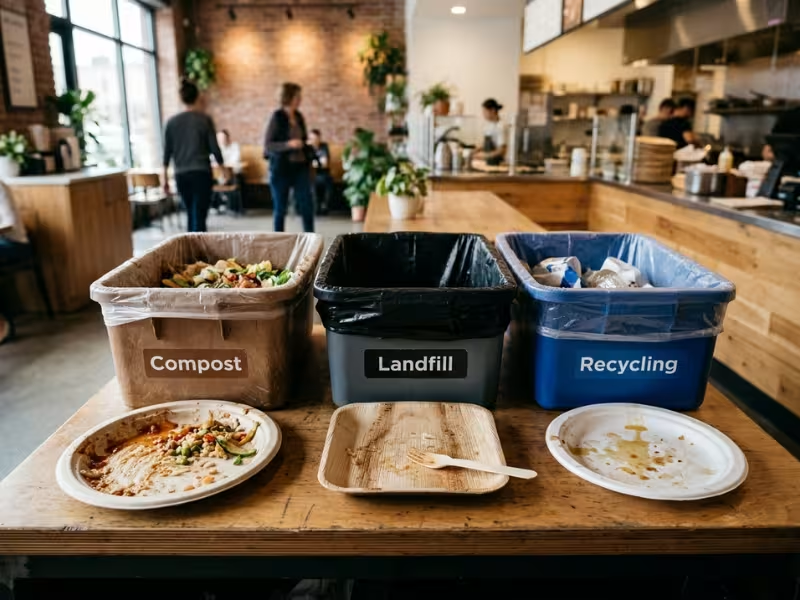
Every used plate goes to one of four places:
- A home compost pile
- An industrial compost facility
- A landfill
- A recycling bin
Each destination needs a different product. A plate built for industrial composting can sit almost unchanged in your backyard pile for a year. Know your bin before you pick your plate.
How Much Looks and Cost Matter
A backyard BBQ and a wedding dinner need different plates. One values strength and price. The other values how the table looks in photos.
Set a per-guest budget early. If you order in large volumes, check supplier consistency too. Natural materials like palm leaf can vary in thickness and color from batch to batch.
Answer these three questions first. The right material gets much easier to spot.
Start With Disposal, Not the Label
Most plate mistakes happen after the meal, not during it. Before you compare materials, figure out where your used plates will actually go. That one answer rules out half the products on the shelf.
“Biodegradable” vs. “Compostable” vs. “Home Compostable”
These three words sound alike. They promise very different things.
Biodegradable is the weakest claim. Almost everything biodegrades eventually, including some plastics. The word carries no standard timeline and no required conditions. A brand can print it on a plate that takes decades to break down.
Compostable means more. A certified compostable plate turns into soil-safe material under set conditions. Look for BPI certification, ASTM D6400, or EN 13432 on the package.
Home compostable sets the bar for backyard users. A mark like TÜV Austria OK compost HOME shows the plate passed testing at everyday temperatures.
I treat labels like “eco-friendly” or “earth-friendly” as red flags when no certification appears beside them. If a supplier can’t give you a certificate number to check online, assume the claim means nothing.
Commercial Composting Is Not Your Backyard Pile
Many well-meaning buyers go wrong here. A plate can carry a real certification and still fail in your garden.
Industrial compost facilities run hot. Their piles typically hold around 55–60°C (131–140°F). Operators turn the material, control moisture, and manage airflow. Under those conditions, an uncoated bagasse plate can disappear in a matter of weeks.
A home pile works differently. It rarely gets that hot, and its heat rises and falls. Many backyard piles never pass 40°C (104°F).
That gap matters. Many BPI-certified plates, especially PLA-lined ones, need industrial heat to break down. In a backyard bin, they can sit nearly untouched for a year or more.
My rule for clients is simple. If you compost at home, buy only plates with a home compostable mark. Uncoated bagasse and palm leaf usually perform best. Tear them into small pieces to speed things up.
What Happens When Compostable Plates Hit the Landfill
Most labels leave this part out. A compostable plate in a landfill stops acting like a compostable plate.
Landfills pack waste tight and cut off oxygen. Without air, the microbes that drive composting can’t do their job. Decomposition slows to a crawl or stalls completely. When organic material does break down without oxygen, it can release methane.
So even a fully certified plate gives you little benefit if it ends up in the trash. Your disposal route matters more than the material itself.
Before you order, take these steps:
- Ask your city or waste hauler whether they accept compostable serviceware, not just food scraps.
- Find out which certifications they require. Some facilities reject PLA entirely.
- For events, confirm your venue or caterer has compost bins and a hauler lined up.
If no compost route exists, a sturdy uncoated fiber plate still beats plastic. Just don’t pay extra for a certification you can’t use.
Which Plate Material Works Best?
Every material on the market has a sweet spot and a weak spot. Most buyers only hear about the sweet spot. Let’s look at both, so you can see which plate fits your table and your bin.
I judge each material on four points: what it handles well, where it fails, how you need to dispose of it, and who should buy it.
Bagasse: The Safest All-Around Pick for Hot, Wet Meals
Bagasse comes from leftover sugarcane fiber. When clients ask me for one plate that handles almost anything, I point them here first.
What it does well: It holds up under gravy, chili, oily ribs, and saucy pasta. Many bagasse plates handle hot food well, often up to around 95°C (200°F), and many tolerate short microwave reheats. Exact limits depend on thickness, so check the supplier’s specs.
Where it fails:
- Thin, budget plates flex under heavy portions and soften if food sits for 30 minutes or more.
- Long soaks let brothy soups seep through eventually.
Disposal: Uncoated bagasse breaks down quickly in industrial compost. It also does well in an active home pile if you tear it up first.
One tip I always give: ask for PFAS-free bagasse. Some older products used fluorinated chemicals for grease resistance.
If bagasse fits your menu, compare a few grades of sugarcane bagasse tableware side by side. Rim strength, thickness, and plate shape vary a lot between suppliers.
Best for: caterers, BBQ hosts, food trucks, and anyone serving hot, messy food on a budget.
Palm Leaf: Better Looks, Strong Structure, Higher Cost
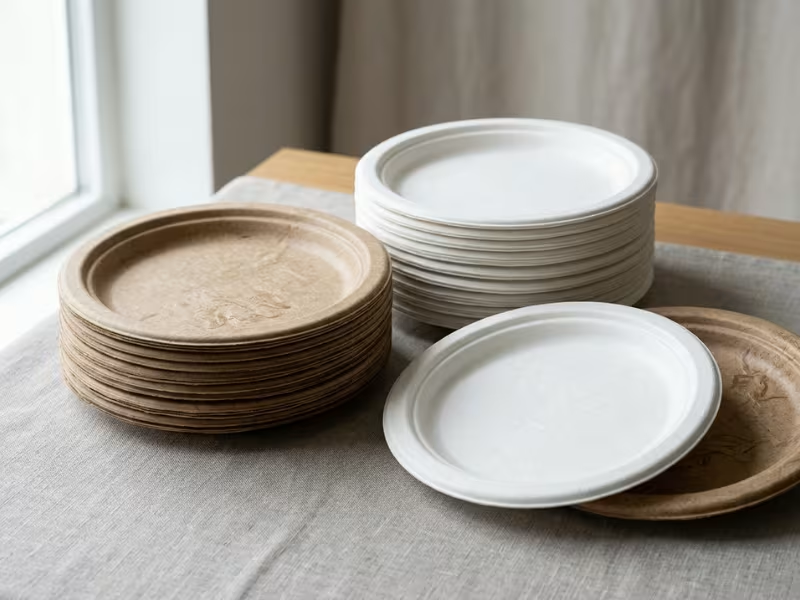
Palm leaf plates come from fallen areca palm leaves pressed with heat and water. No glue, no coating. Each plate shows its own grain, and guests notice.
What it does well: A good palm leaf plate feels rigid and carries a full dinner portion without bending. Dry foods, grilled meats, salads, and thick sauces all work well.
Where it fails: Thin liquids can seep through the natural grain over time. Batches vary in color and thickness. Cost usually runs two to three times the price of bagasse.
Disposal: Palm leaf works great in home compost. Break it into pieces, and it typically breaks down within a few months, depending on your pile and climate.
Request photos of the actual batch before you place a large order.
Best for: weddings, upscale catering, and events where presentation matters as much as strength.
Bamboo and Bamboo Blends: Check for Binders First
“Bamboo” covers three very different products. I see buyers mix them up all the time.
- Solid bamboo plates feel sturdy and work as reusables for family meals and picnics. They don’t belong in a compost bin after one use.
- Pressed bamboo pulp plates behave much like bagasse. They handle moist foods and compost well.
- Bamboo fiber with melamine causes the trouble. These plates look natural but rely on a plastic resin binder. They won’t compost at all, and hot or acidic food can pull melamine into your meal. EU authorities have cracked down on these products for that reason.
Disposal: Pulp plates go to compost. Solid bamboo stays in your cupboard. Melamine blends go to the trash.
If a listing says “bamboo fiber” without a clear compostable certificate, ask the supplier directly about binders.
Best for: households wanting reusable plates, or buyers who verify pulp-only construction.
PLA-Lined or Plastic-Coated Paper: Where Many Buyers Get Misled
These plates look like ordinary paper, so buyers assume they compost or recycle like paper. Most don’t.
- PE-coated paper carries a thin plastic layer. It won’t compost, and many recycling facilities reject it.
- PLA-lined paper uses a plant-based plastic coating. It qualifies as compostable, but usually only in industrial facilities.
Where it fails: Heat. Standard PLA typically starts to soften somewhere around 45–55°C (113–131°F). Pile hot lasagna on a PLA-lined plate, and it may warp or go limp.
Disposal: Industrial compost only. In a home pile, it can sit for a year or longer.
Best for: cafés and offices with confirmed industrial composting, serving cold or room-temperature foods.
Other Fiber Plates: When Wheat Straw and Blends Make Sense
Wheat straw plates use stalks left over after harvest. They usually perform close to bagasse with moist and warm foods, and they compost similarly.
Where it fails: Quality varies more by supplier. Also, processing removes most gluten proteins, but I still advise against wheat straw for guests with celiac disease. The cross-contact risk isn’t worth it.
Blended fiber plates mix bagasse, bamboo pulp, or other plant fibers. A good blend adds stiffness. Just confirm the certification covers the exact product, not one ingredient.
Best for: buyers with reliable suppliers and no gluten-sensitive guests.
Match the Plate to the Meal
Most plate failures don’t come from bad materials. They come from bad matches. A great plate for cake can fail badly under chili. Here’s how I pair plates with real menus.
Oily, Saucy, and Heavy Meals
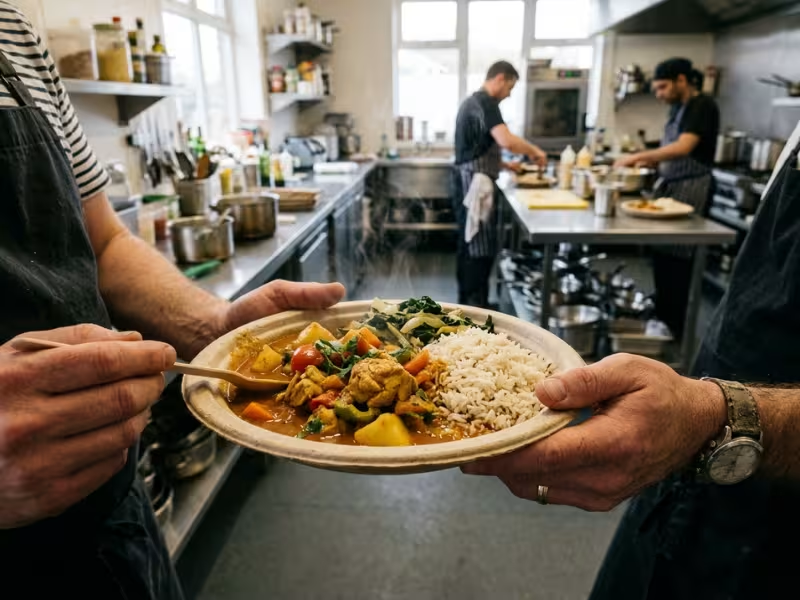
These meals push a plate the hardest. Sauce soaks into the fibers. Grease weakens the surface. Weight drags the center down when a guest holds the plate in one hand.
For these dishes, I go straight to molded fiber, usually bagasse or a dense fiber blend. Then I check the shape, because shape matters as much as material:
- Raised rim: keeps gravy and curry from running over the edge.
- Deep well: holds saucy food in the center, away from the rim.
- Thick base: resists softening when food sits for a while.
- Reinforced molded rim: a rolled or ribbed edge keeps the plate from folding.
Always test with your heaviest dish. Load a full portion and let it sit for 15 to 20 minutes. Then carry it across the room and cut the food with a knife. If the base bends or the bottom feels damp, keep looking.
A common mistake: One caterer I worked with picked pretty 7-inch salad plates for a curry-and-rice buffet. By the second round, plates sagged and rice slid onto the floor. Salad plates run flat and thin. They aren’t built for wet, heavy food.
Dry or Light Foods
Lighter meals give you much more freedom. Sandwiches, cookies, fruit, cake, and finger foods barely stress a plate.
Thin bagasse, palm leaf, uncoated paper, and wheat straw all work here. You can choose on price, looks, or disposal needs alone.
Watch for hidden moisture, though. Frosting, dressings, and cut fruit release liquid over time. If food will sit on a dessert table for an hour or more, step up to a slightly thicker plate.
Hot Foods, Reheating, and the Microwave
Heat changes the rules. Never assume “biodegradable” means microwave-safe.
Check the package for a microwave symbol and a stated temperature limit. Then follow both exactly.
Here’s how the main materials usually behave:
- Bagasse typically handles short reheats well.
- Palm leaf can dry out, crack, or scorch with longer heating.
- PLA-lined paper can soften and warp under fresh lasagna or hot soup.
If the label says nothing about heat, treat the plate as not microwave-safe. For bulk orders, ask the supplier for the tested maximum temperature in writing.
When One Plate Isn’t Enough
Sometimes the smart move is more support, not a different material. You have three options.
Size up. At buffets, guests pile food high and come back for seconds. A 10-inch plate costs a little more than a 9-inch one. A collapsed plate costs far more in cleanup and embarrassment. Compartment plates also help by spreading weight and keeping sauces apart.
Double up. Stacking two light plates adds strength in a pinch. But it doubles your cost and your waste. I treat it as a backup plan, not a strategy.
Add an underplate. For formal dinners, set a palm leaf plate on a reusable charger. At food trucks, a sturdy tray under a fiber plate keeps the meal stable on the walk to a table.
Two Buying Mistakes I See Every Week
First, buyers judge plates by diameter alone. Two 10-inch plates can carry very different loads. One sits flat with a thin edge. The other has a deep well and a molded ridge. Press the rim with your thumb. If it bends easily, it will bend under food too.
Second, buyers trust the material name. “Bagasse” on the box doesn’t promise strength. A thin bagasse plate can fail faster than a well-built paper one.
Keep these quick cues in mind:
- Saucy or brothy meals: molded fiber with a raised rim
- Heavy portions: deep well, thick base, reinforced rim
- Buffets or seconds: size up rather than risk a collapse
- Reheating: check the label and never assume
Best Choices by Real-World Use Case
Knowing the materials is one thing. Picking the right plate for your actual event is where most buyers get stuck. Here’s what I recommend in the four situations I hear about most, including when to skip my top pick.
Backyard BBQs and Family Gatherings: Bagasse Wins
At a backyard party, nobody eats neatly. Guests balance ribs, baked beans, and coleslaw on one plate. They hold it in one hand and set it on uneven grass.
That’s why I recommend bagasse here. It forgives mistakes. It handles grease, sauce, and heavy portions without much fuss. It also costs far less than palm leaf, which matters when you’re feeding 40 relatives.
Two tips make it even safer:
- Choose 10-inch plates with a raised rim for main dishes.
- Grab a small pack of 6-inch plates for desserts and snacks.
When to skip it: If your menu centers on soup, stew, or ramen, flat plates won’t hold up for long. Serve those in bagasse bowls instead.
Weddings and Formal Events: Palm Leaf, With a Plan
Weddings flip the priorities. Guests see the plates in photos, and the table setting carries real weight.
Palm leaf earns its place here. Its natural grain looks warm and polished. It also feels rigid, so it carries a plated dinner with confidence.
But palm leaf brings risks that bagasse doesn’t. Color and thickness can shift from one batch to the next. I once watched a planner open boxes two days before a wedding and find half the plates noticeably darker than the samples.
Protect yourself with these steps:
- Request photos of the actual production batch, not stock images.
- Order 10–15% extra so you can pull uneven plates.
- Book your supplier at least six weeks out.
When to skip it: Avoid palm leaf for soup courses, thin sauces, or very tight budgets. For a large reception on a lean budget, a premium white bagasse plate still looks clean and costs much less.

Catering, Takeout, and Food Service: Plan the Whole Disposal Chain
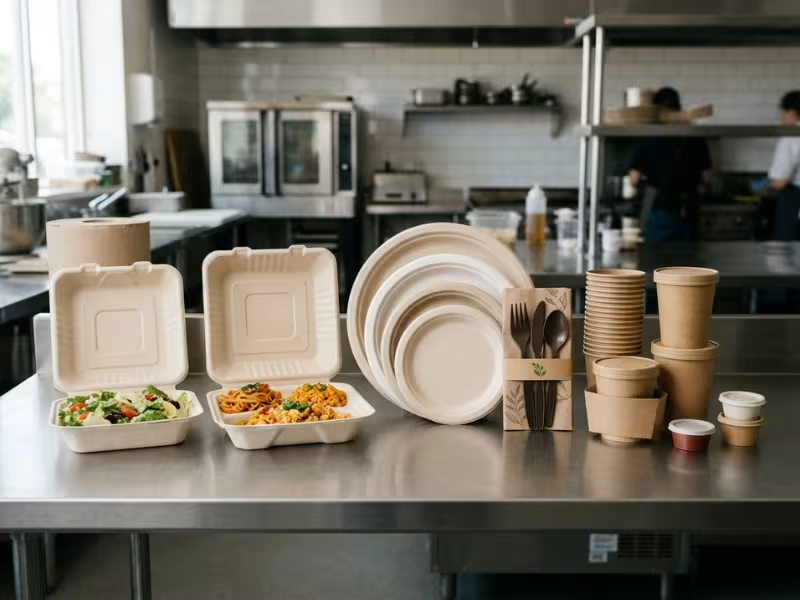
Food businesses face a bigger challenge. You don’t just buy plates. You buy a system: plates, biodegradable food containers, lids, cutlery, napkins, and the bins where customers toss them.
That system only works if every piece shares the same disposal route. A compostable clamshell paired with a plastic fork and a PE-coated cup will usually end up in the landfill.
For hot takeout, I recommend bagasse clamshells. They hold heat, resist grease, and survive delivery bags well.
CPLA often works best for cutlery and rigid lids. It typically tolerates more heat than standard PLA, but check the supplier’s tested range. Like PLA, it usually needs industrial composting.
Before you switch, check three things:
- Does your local hauler accept compostable serviceware?
- Do they accept CPLA, or only fiber products?
- Can you label your bins clearly so customers sort correctly?
When to skip it: If your area has no commercial composting, CPLA adds cost without a real disposal benefit. Stick with uncoated fiber products and skip the plant-based plastic pieces.
Everyday Home Use: Balance Cost, Strength, and Your Bin
At home, the right plate depends on how often you reach for disposables.
If you use them a few times a month, a mid-weight bagasse plate covers almost everything. It handles weeknight pasta and birthday cake alike. If you compost at home, choose uncoated bagasse with a home compostable mark, and tear it up before it goes in the pile.
If you use disposables daily, the math changes. A set of solid bamboo plates without melamine often pays for itself within a few months. Keep a small stack of bagasse for parties and busy weeks.
When to skip disposables altogether: If you have a dishwasher and no compost access, reusable plates almost always make more sense. Even the best compostable plate does little good in a landfill.
How to Verify a Plate Before You Buy in Bulk
A sample pack costs a few dollars. A bad pallet costs hundreds, plus a messy evening. Before I approve any large order, I run each plate through five checks. They take about a day, and they catch most problems before they reach your guests.
1. Check the Certification
Start with the paperwork, because a logo alone proves nothing. Look for BPI, ASTM D6400, EN 13432, or TÜV Austria OK compost HOME on the box.
Ask the supplier for the certificate number and look it up on the certifier’s website. Make sure the listing names the exact product and size you plan to buy. Some suppliers certify one plate and then print the logo across their whole catalog.
2. Confirm Your Disposal Route
A real certificate still needs a real destination. Call your hauler or compost facility before you order, and ask:
- Do you accept compostable plates, or only food scraps?
- Which certifications do you require?
- Do you accept PLA-lined products?
Get the answers by email if you can. Policies change, and a written reply protects you if someone gives you a different answer later.
3. Inspect Thickness, Rim, and Shape
Order samples from two or three suppliers and lay them side by side.
Press each rim with your thumb. A good plate pushes back. Look for a deep well, a molded ridge along the edge, and an even base. Hold the plate up to a window, because bright patches often mark thin, weak spots. Weigh plates of the same size too. The heavier one usually has denser fiber.
4. Run a Real Meal Test
Spec sheets can’t tell you how a plate handles your menu. Your food can.
Serve your heaviest, wettest dish at its real serving temperature. Let it sit for 15 to 20 minutes. Carry the plate across the room and cut through the food. Then flip it and check the bottom for damp or soft spots.
Test at least three plates, not just one. If you cater or sell takeout, pack a loaded plate in a delivery bag as well.
5. Ask About Binders and Coatings
The last check covers what you can’t see. Ask what’s in the plate besides plant fiber, and get the answers in writing:
- PFAS: Request a PFAS-free statement backed by a third-party lab report.
- Melamine: Watch for it in “bamboo fiber” plates. Any melamine rules out composting.
- Liners: PE coatings won’t compost. PLA liners usually need an industrial facility.
A good supplier answers these questions within a day. If a supplier dodges them, find another one.
Biodegradable Plates at a Glance
This table puts everything on one screen. Use it to narrow your list to two or three materials, then go back to the sections above for the reasons behind each rating. Always test samples before you commit to a bulk order.
|
Material |
Best for |
Wet/greasy foods |
Home compost potential |
Typical downside |
Best fit users |
|---|---|---|---|---|---|
|
Bagasse |
Hot, saucy, everyday meals |
Strong. Handles gravy, grease, and chili well |
Good if uncoated. Tear it up first |
Thin budget plates sag. Brothy foods seep through over time |
BBQ hosts, caterers, food trucks, families |
|
Palm Leaf |
Weddings and upscale events |
Good with thick sauces. Thin liquids can seep through |
Excellent. Usually breaks down within a few months |
Costs 2–3x more than bagasse. Color and thickness vary by batch |
Event planners, upscale caterers |
|
Bamboo / Bamboo Blends |
Reusable sets (solid) or moist foods (pulp) |
Good for solid and pulp versions |
Pulp: good. Solid: reuse instead. Melamine blends: none |
Melamine binders hide behind “bamboo fiber” labels |
Households wanting reusables, buyers who verify pulp-only builds |
|
PLA-Lined Paper |
Cold or room-temperature foods |
Fair for cool foods. Can soften under hot food |
Poor. Usually needs an industrial facility |
Looks like paper but doesn’t compost like it |
Cafés and offices with confirmed industrial composting |
|
Wheat Straw / Fiber Blends |
Warm, moist everyday meals |
Good. Usually performs close to bagasse |
Good, if the certificate covers the exact product |
Quality swings between suppliers. Not ideal for celiac guests |
Buyers with reliable suppliers and no gluten-sensitive guests |
FAQs
Are biodegradable and compostable plates the same?
No. “Biodegradable” has no standard timeline or required conditions. “Compostable” means the plate passed testing to break down under set conditions. Trust a certification mark over either word.
Do biodegradable plates break down in landfill?
Barely. Landfills compact waste and seal out air, which slows decay dramatically. Researchers have dug up newspapers still readable after decades underground. If your plates will end up in a landfill, choose on cost and performance.
Can compostable plates go in home compost?
Only plates with a home compostable mark, such as TÜV Austria OK compost HOME. Uncoated bagasse and palm leaf usually work well if you tear them up and keep the pile damp. Leave out PLA-lined plates, since backyard piles rarely get hot enough.
Which plate material is best for hot and greasy food?
Molded bagasse usually offers the best heat and grease resistance for the price. Palm leaf makes a good second choice when looks matter. Skip PLA-lined paper for anything served steaming hot.
Are bamboo plates always compostable?
No. Pressed bamboo pulp composts well, and solid bamboo works best as a reusable. A glossy, ceramic-like finish or a “dishwasher safe” claim on a disposable plate often signals a melamine binder. Ask the supplier to confirm “100% plant fiber” in writing.
Can biodegradable plates go in the microwave?
Some can. Bagasse typically handles a short one- to two-minute reheat, while palm leaf may scorch and PLA-lined plates may warp. Follow the label, and never put a fiber plate in a conventional oven unless the supplier says it’s oven-safe.
How should I test plates before a bulk order?
Test at least three samples from each supplier with your heaviest dish at serving temperature. Let each plate sit as long as it would at your event. If you serve outdoors or deliver, test in those exact conditions too.
Choose for the Meal, the Event, and the Bin
A good plate passes three tests. It handles your food. It fits your event. Then it goes somewhere that can actually break it down.
Miss one, and the plate fails. A sturdy plate with no compost route just becomes landfill waste. A certified plate that sags under chili ruins dinner first.
Here’s the plan I give every client:
- Pick two or three materials that fit your menu and your bin.
- Order samples from more than one supplier.
- Test them with your real food, at serving temperature, for as long as guests will hold them.
- Call your hauler or compost facility and confirm in writing what it accepts.
Do all four before you buy in bulk. If you source plates for catering, takeout, or branded food service, work with a manufacturer that can share certificate numbers, PFAS test reports, and consistent batch samples up front. A few dollars in samples and one phone call cost far less than a pallet of plates you can’t use.