


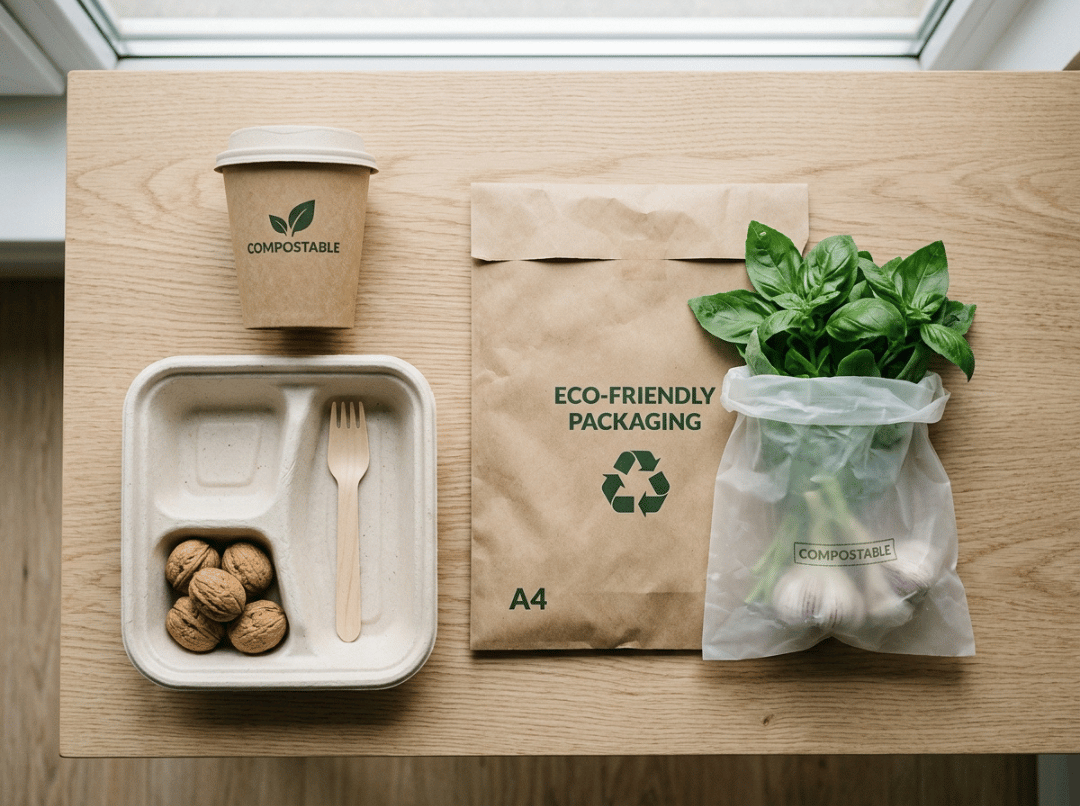
Choosing compostable packaging sounds simple until you face the real questions. Which material fits your product? Which certification does your market require? Will your customers even have a place to compost it? Get these wrong, and you risk failed disposal, false-claim penalties, and wasted budget.
This guide walks you through the exact decisions a B2B packaging buyer needs to make in 2026. We write from hands-on experience in compostable resin production and certified manufacturing, so the advice here focuses on what works in practice, not marketing spin.
Here’s what you’ll get:
- A clear split between compostable and biodegradable, so your claims stay compliant
- The four certifications that actually matter, and how to read them
- How to pick the right material by application: food, retail, e-commerce, and produce
- The most common buying mistakes, and how to avoid them
Let’s start with the basics, then move straight into how to choose.
What Is Compostable Packaging?
Compostable packaging is packaging designed to break down, under defined conditions, into water, carbon dioxide, and nutrient-rich compost with no toxic residue. The key phrase is “defined conditions.” A product only earns the compostable label when it passes recognized lab testing against a set standard and timeline.
That makes “compostable” a measurable, verifiable claim, unlike vaguer green terms. Common compostable materials include PLA (polylactic acid) from corn starch, PBAT (a flexible bio-based polymer), and molded fiber or paper with plant-based coatings.
Keep one thing in mind from the start: compostable does not mean “throw it anywhere and it disappears.” It means the product will break down properly when it reaches the right composting environment. That distinction shapes almost every decision in this guide.
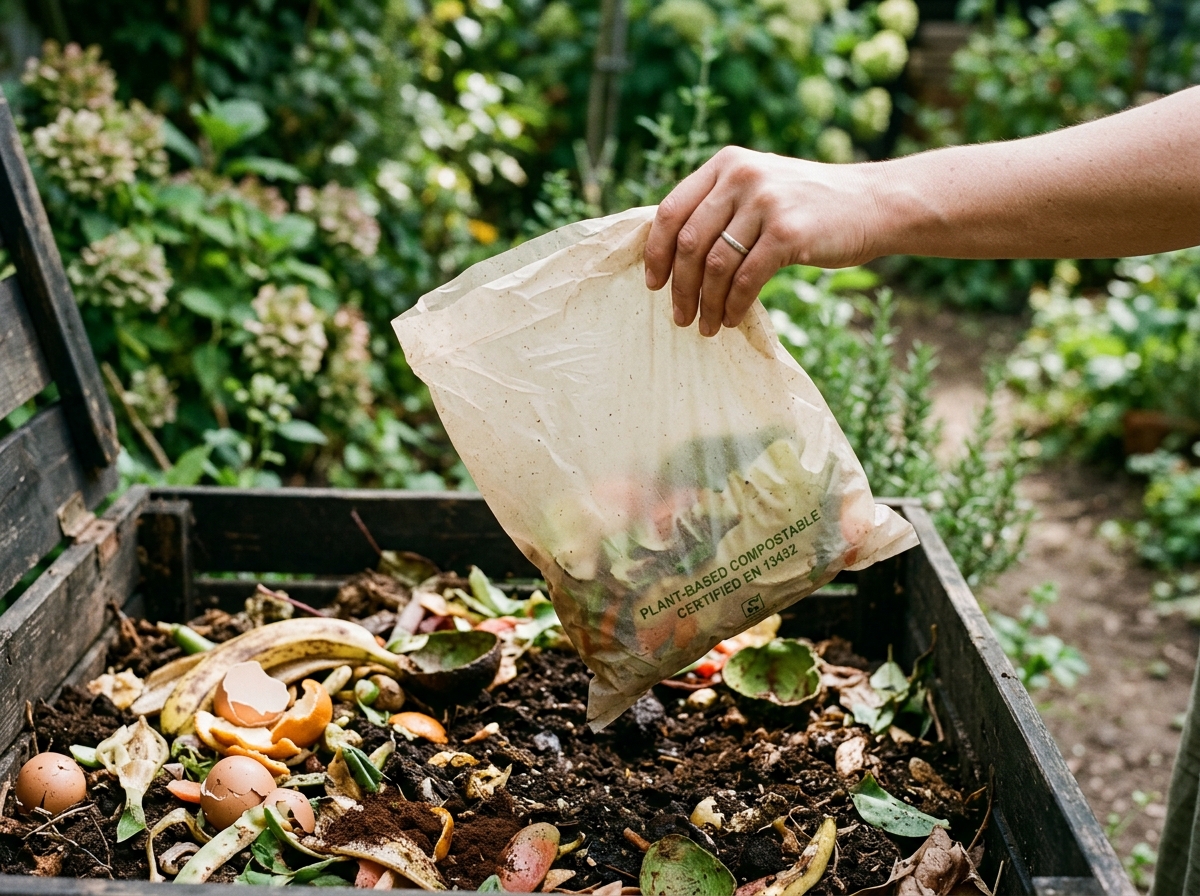
Compostable vs Biodegradable: What’s the Key Difference?
Buyers mix up these two terms constantly, and it causes real problems with compliance and customer trust. They are not interchangeable.
Biodegradable means a material can break down through natural processes, but with no fixed timeline and no guaranteed end result. A “biodegradable” product might take months or decades. It may also leave behind microplastics. Because the term is so loose, many regions now restrict how brands can print it on labels.
Compostable is the stricter claim. A certified compostable product breaks down within a set period, under specific conditions, into safe compost. It must pass recognized testing to carry that label.
You might be wondering: if I only remember one rule, what is it? This one: never market a biodegradable product as compostable. That single mistake creates both disposal failures and legal risk.
Quick reference: biodegradable vs compostable
|
Factor |
Biodegradable |
Home Compostable |
Industrial Compostable |
|---|---|---|---|
|
Breakdown time |
Undefined |
Up to 12 months |
90–180 days |
|
Conditions needed |
Any natural setting |
Backyard compost bin |
Commercial facility |
|
Certification |
Rarely certified |
OK Compost HOME |
EN 13432, ASTM D6400 |
|
Residue risk |
Possible microplastics |
Minimal if certified |
Minimal if certified |
|
Best use |
Avoid vague claims |
Food scraps, light films |
Foodservice, retail bags |
Takeaway: “Compostable” is a promise you can prove. “Biodegradable” usually is not. Choose your wording as carefully as you choose your material.
Why Compostable Packaging Matters in 2026
You don’t need a market lecture to make a good buying decision, but you do need to know what’s pushing this shift. Three forces make compostable packaging a serious sourcing factor in 2026.
Regulation is tightening. The EU’s Packaging and Packaging Waste Regulation (PPWR) sets binding rules on recyclability and compostability, phasing in over the coming years. Extended Producer Responsibility (EPR) schemes now charge producers based on how much and what kind of packaging they put on the market. Single-use plastic bans and taxes keep spreading across the EU, UK, and several US states.
Buyer demand is real. More than half of consumers now actively choose products with sustainable packaging, and retail buyers pass that pressure up the supply chain.
Costs are shifting. Well-designed compostable packaging can lower EPR fees in some schemes, so material choice affects your bottom line, not just your image.
The practical implication: compliance and disposal now matter as much as price. That’s why the rest of this guide focuses on choosing correctly, not chasing trends. One trend worth flagging early, though, is PFAS-free barrier coatings, which have moved from a bonus feature to a baseline requirement for food-contact packaging.
Which Compostable Packaging Certifications Actually Matter?
Certifications are your strongest defense against greenwashing. Four matter most for B2B buyers.
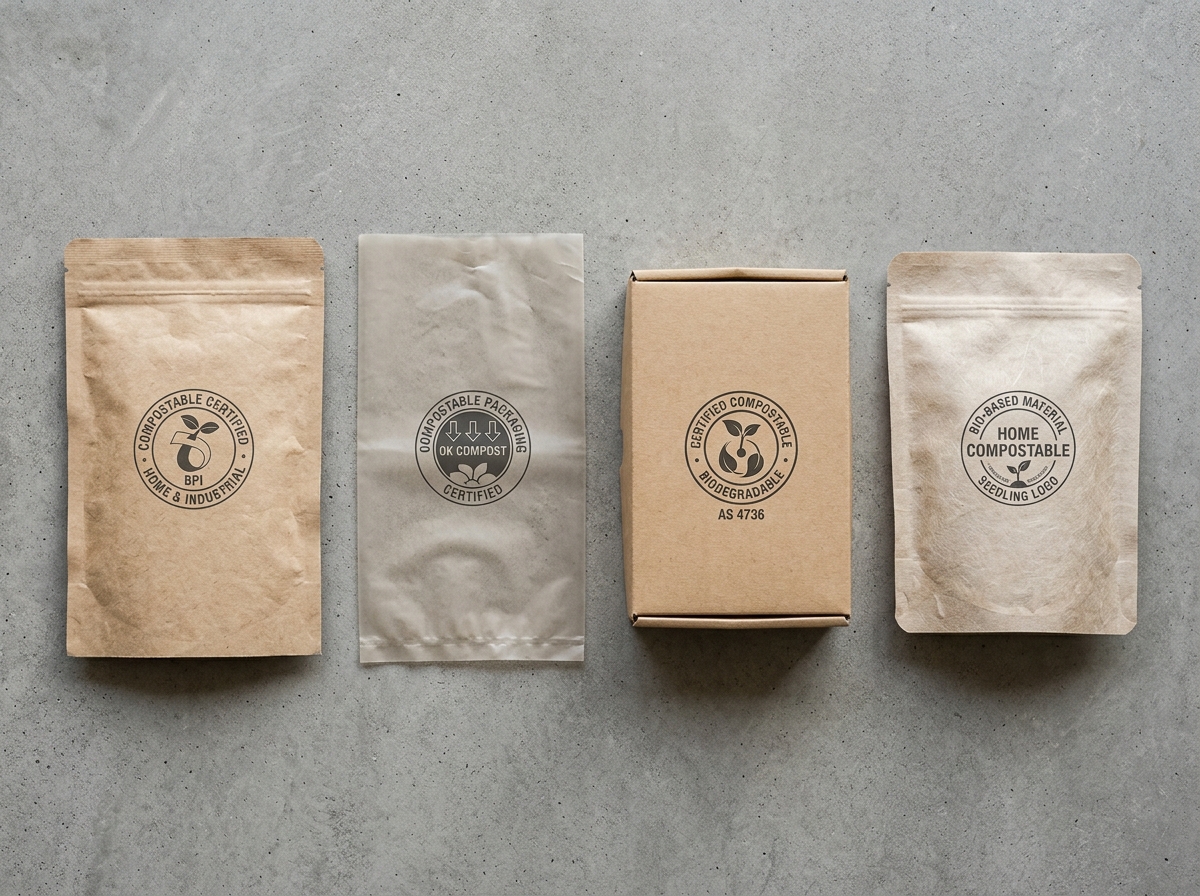
EN 13432 (Europe)
EN 13432 is the European standard for industrial compostability. It tests disintegration, biodegradation, heavy-metal content, and final compost quality. A product must break down by at least 90% within six months to pass. European buyers treat it as the trusted baseline.
ASTM D6400 (United States)
ASTM D6400 is the US equivalent, covering how packaging breaks down in municipal and commercial composting facilities. If you sell into the US market, this is your reference standard.
BPI Certification
The Biodegradable Products Institute certifies products against ASTM standards and adds strict labeling rules. In the US, BPI acts as a floor, not a ceiling. It gives composters and buyers confidence that a product is genuinely compostable, not just labeled that way.
OK Compost HOME vs INDUSTRIAL
TÜV Austria’s OK Compost mark comes in two versions, and the difference is critical. OK Compost INDUSTRIAL confirms breakdown in commercial facilities. OK Compost HOME confirms breakdown in a backyard bin at lower temperatures. Always check which mark a product carries before you promise home compostability.
How to read a certification label without getting fooled
Use this quick checklist:
- Look for a named standard (EN 13432, ASTM D6400) or logo (BPI, OK Compost).
- Confirm whether it says home or industrial.
- Check that the certificate is current and tied to the exact product, not the brand in general.
- Be skeptical of vague words like “eco-friendly” with no standard behind them.
Judgment call: a certificate is necessary, but it is not the whole story. It proves a product can break down under the right conditions. It does not prove your customers have those conditions. That leads to the next decision.
Home Compostable vs Industrial Compostable: How Do You Choose?
This is the decision buyers get wrong most often, and it can quietly sink an otherwise good product. The two are not interchangeable.
Industrial compostable products need the sustained high heat, moisture, and microbial activity of a commercial facility. They break down in roughly 90 to 180 days there. Drop them in a backyard bin, and they may barely change.
Home compostable products break down in a backyard setup at lower, uncontrolled temperatures, usually within 12 months. The trade-off is that home-compostable films often sacrifice some strength and shelf life for that easier end-of-life.
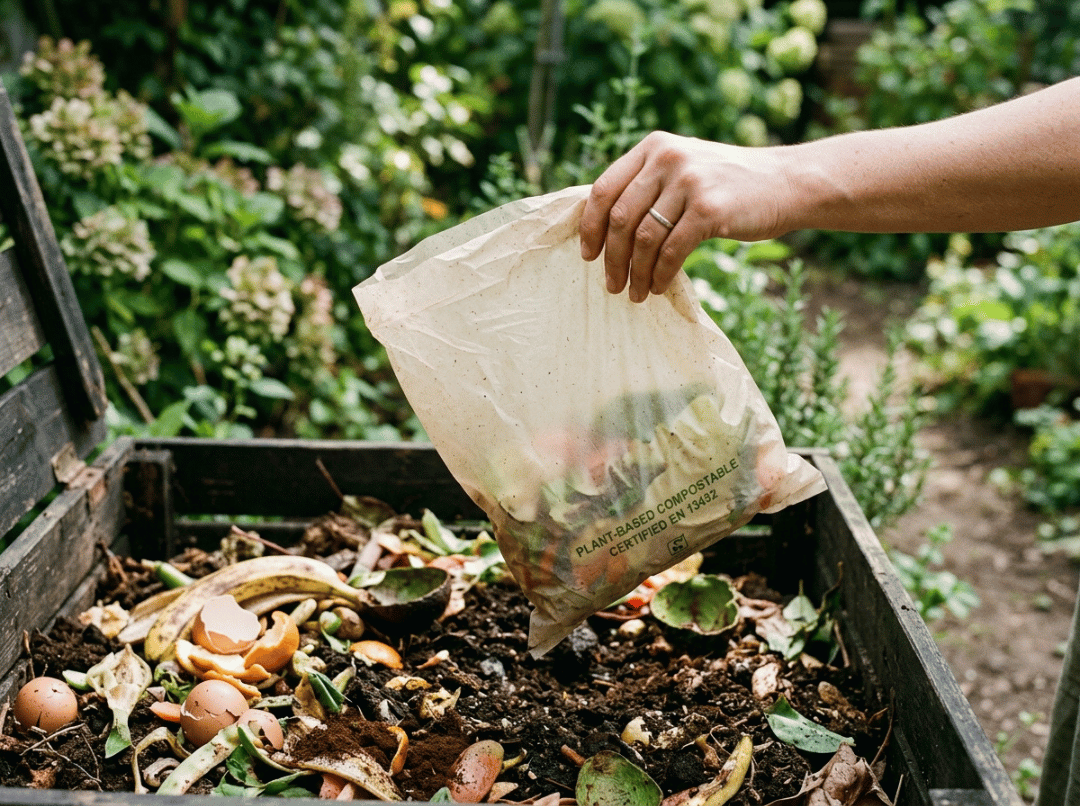
The question that decides it: where will your customer dispose of it?
Match the certification to your customer’s real disposal access, not to what sounds greenest.
- Sell to consumers with no access to industrial composting? Home compostable is the honest, functional choice, even if it limits material options.
- Sell to foodservice, events, or B2B clients with commercial composting contracts? Industrial compostable gives you stronger, more versatile materials.
- Sell across mixed regions? State the requirement clearly on-pack and in your product data, so buyers dispose of it correctly.
Common trap: certifying a product as industrial compostable, then marketing it to households. When customers can’t break it down, it lands in landfill anyway, and your green claim backfires. Infrastructure, not the label alone, determines the real outcome.
Takeaway: decide on disposal access first, material second. That order protects both your compliance and your reputation.
How to Choose Compostable Packaging by Application
The right material depends entirely on what you’re packaging. Here’s how to match need to solution across the four most common B2B scenarios.
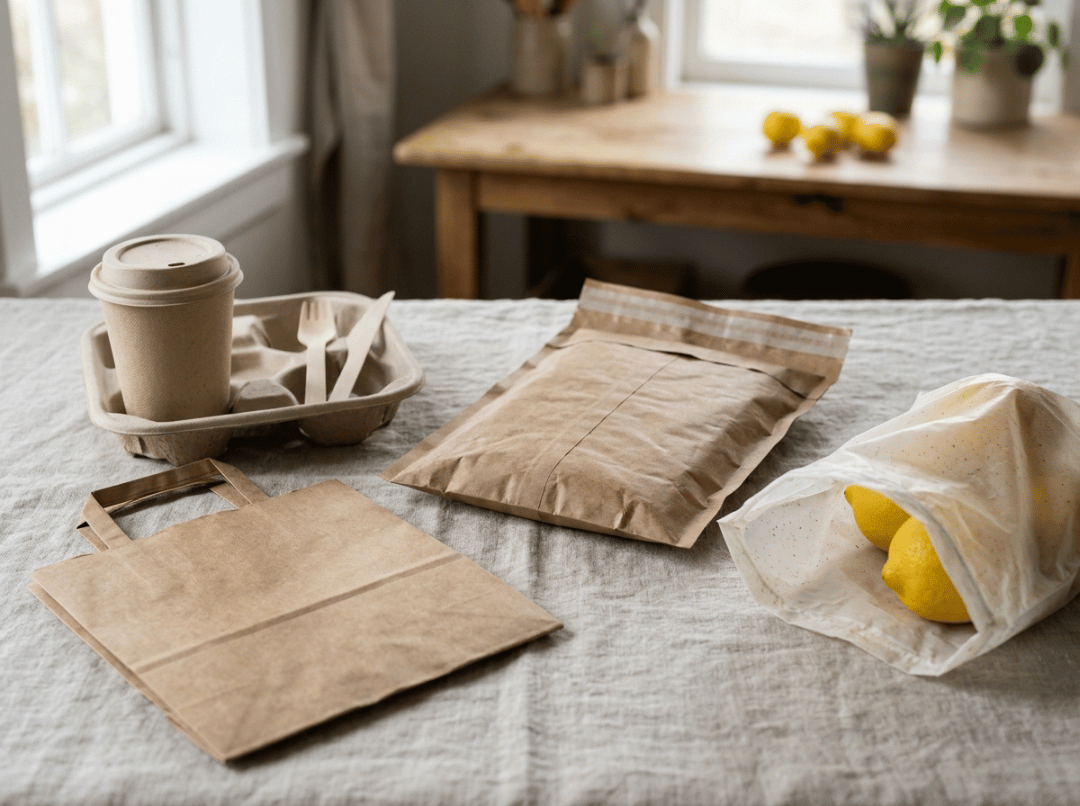
Best compostable packaging for foodservice
Cups, trays, and cutlery face heat, grease, and moisture. Molded fiber or paper with a PFAS-free coating performs well here and is easy for customers to understand. Decide early whether you need home or industrial compostability, since that shapes both the material and your on-pack messaging. For cutlery specifically, PLA or CPLA (a heat-resistant PLA variant) holds up better against warm food.
Best compostable packaging for retail and shopping bags
Shopping bags need strength, clean print quality, and shelf appeal. PBAT/PLA blends deliver the flexibility and tear resistance shoppers expect while staying fully compostable. Most of these blends need industrial composting, so confirm your key markets can handle that before scaling.
Best compostable packaging for e-commerce and courier mailers
Mailers must survive shipping, resist moisture, and protect goods. Compostable courier bags built from PBAT/PLA blends offer that toughness. One practical rule: test performance under real shipping conditions, including transit humidity and rough handling, before committing to volume orders.
Best compostable packaging for fresh produce and grocery bags
Produce bags need breathability and food-contact safety. Certified PBAT/PLA blend bags handle grocery use well and support retailer plastic-reduction targets. Match the certification (home or industrial) to your region’s composting setup so the claim actually holds up at disposal.
Material selection cheat sheet
|
Use Case |
Recommended Material |
Certification to Check |
|---|---|---|
|
Foodservice cups & trays |
Fiber + PFAS-free coating |
EN 13432 / BPI |
|
Cutlery |
PLA or CPLA |
ASTM D6400 |
|
Shopping bags |
PBAT/PLA blend |
EN 13432 / OK Compost |
|
Courier mailers |
PBAT/PLA blend |
EN 13432 |
|
Produce bags |
PBAT/PLA blend |
OK Compost HOME or INDUSTRIAL |
So what should you do next? Shortlist the material for your top-selling product first, request samples, and test it under your real conditions before rolling it out across your range.
Common Compostable Packaging Mistakes Buyers Make
Even careful buyers slip up. Avoid these four, and you’ll dodge most costly errors.
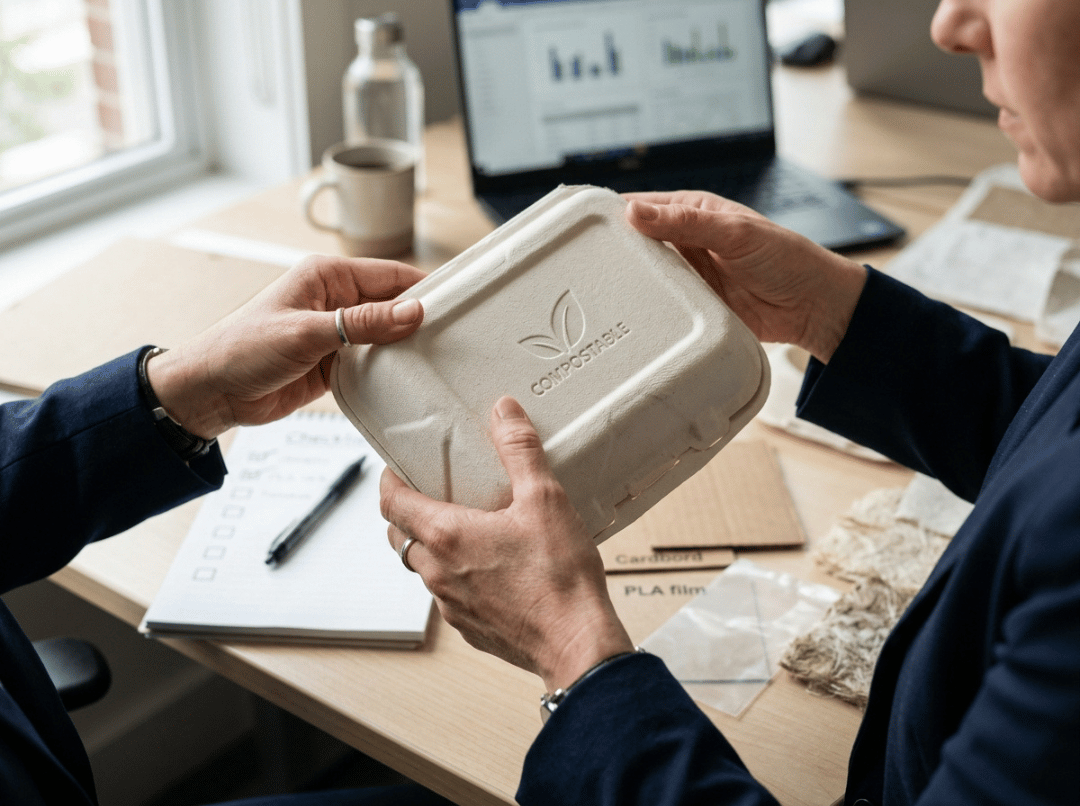
Mistake 1: Assuming biodegradable equals compostable
This is the single most common error. A biodegradable label promises far less than a certified compostable one. Marketing a biodegradable product as compostable risks both disposal failure and false-claim penalties. Fix: only use “compostable” when you hold a matching certificate.
Mistake 2: Treating industrial compostable as home compostable
An industrial compostable product will not reliably break down in a backyard bin. When customers try, it ends up in landfill and trust erodes. Fix: match the claim to where the product will actually be composted, and state it clearly on-pack.
Mistake 3: Believing certification alone guarantees local recyclability
Certification proves a product can break down under the right conditions. It does not guarantee your local system accepts it. Fix: before you scale, confirm that composting infrastructure exists where your customers live and dispose of packaging.
Mistake 4: Ignoring shelf life and storage
Compostable materials react to heat and humidity over time. Poor storage can weaken bags and films before they ever reach your customer. Fix: store stock in cool, dry conditions, rotate inventory, and ask suppliers for realistic shelf-life data.
Takeaway: most failures trace back to a mismatch between the claim and the real-world disposal setting. Close that gap, and your packaging performs as promised.
What Leading Brands Teach Smaller Buyers
You don’t need an enterprise budget to learn from big rollouts. Three short examples show the pattern.
Starbucks rolled out home-compostable paper cups in parts of its EMEA market, using a mineral-based coating instead of plastic lining. Buyer takeaway: fiber plus a safe coating can replace plastic-lined cups, even at smaller volumes.
Tesco removed billions of pieces of plastic and trialed OK Compost–certified produce bags. Buyer takeaway: start with high-volume, low-risk items like produce bags, where the switch is simple, and the impact is clear.
Unilever pushed more recycled and plant-based content into flexible film, one of the hardest formats to make fully compostable. Buyer takeaway: progress beats perfection. Convert the formats you can now, and build toward the harder ones later.
The shared lesson: even the largest brands move step by step. They prove results in one category, then expand. You can follow the same path at your scale.
Frequently Asked Questions
Is compostable packaging better than biodegradable packaging?
In most cases, yes. Compostable packaging meets defined standards and breaks down into safe compost within a set time. Biodegradable is a vague term with no fixed timeline or guaranteed clean result.
How long does compostable packaging take to break down?
Industrial compostable products usually break down within 90 to 180 days in a commercial facility. Home compostable products can take up to 12 months in a backyard bin, depending on conditions.
What certifications should compostable packaging have?
Look for EN 13432 in Europe, ASTM D6400 and BPI in the US, and OK Compost for home or industrial settings. These prove the product was tested against recognized standards.
Can compostable packaging go in a home compost bin?
Only if it carries a home compostable certification such as OK Compost HOME. Industrial compostable products need commercial facility conditions and will not reliably break down in a backyard bin.
Is compostable packaging suitable for e-commerce shipping?
Yes. PBAT/PLA blend courier mailers offer the strength and moisture resistance shipping requires while staying fully compostable. Test performance under real conditions before placing large orders.
Does compostable packaging contain PFAS?
Quality compostable packaging should not. Reputable products now use PFAS-free barrier coatings. Always confirm PFAS-free status, especially for food-contact packaging, since regulators keep tightening the rules.
Choosing the Right Compostable Packaging: Your Next Step
Choosing compostable packaging in 2026 comes down to three decisions, in this order. First, confirm where your customers will actually dispose of the product. Second, match the certification (home or industrial) to that reality. Third, pick the material that fits your use case, whether that’s fiber for foodservice, PBAT/PLA blends for bags and mailers, or PLA for rigid items. Get that sequence right, and you satisfy both compliance and customer trust.
You don’t have to work it out alone. The lowest-risk way to start is small: request samples to test performance under your real conditions, ask for certification guidance for your target markets, or book a short material consultation to match packaging to your products.
The brands winning in 2026 are the ones that started early and learned as they scaled. With the right material, the right certification, and a clear disposal plan, your business can join them.