


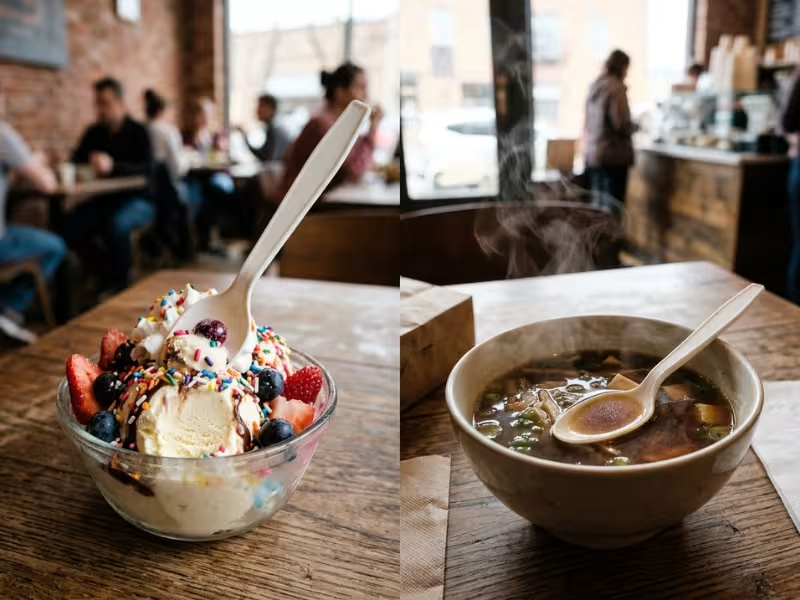
A dessert shop hands out corn starch spoons with every sundae. The noodle stall next door does the same. By noon, the stall’s spoons have bent in the hot broth.
Buyers ask me the same three questions. How much heat can these spoons take? How strong are they? How long do they last in storage?
Start with one key fact. Most “corn starch spoons” are PLA or starch blends, not pure starch. They belong to a wider range of biodegradable tableware, and products in that category vary a lot in heat performance and real use.
This guide helps you judge whether these spoons fit your menu and storage. It also shows when a backup material makes more sense.
Why Corn Starch Spoons Raise So Many Questions in Real Use
On a sample table, a corn starch spoon looks like an easy swap. It’s white, smooth, and light, and it feels almost exactly like the plastic spoon it replaces. Most buyers order a case, put it out, and expect it to behave the same way.
That’s where the trouble starts. Plastic spoons forgive a lot. Corn starch spoons don’t.
When buyers call me after a bad order, they rarely ask whether the spoon is good for the planet. They ask what went wrong during service:
- “Why did it bend in the soup?” A customer stirs hot broth, and the spoon curls like a leaf.
- “Why did it snap?” Someone digs into hard ice cream straight from the freezer, and the handle cracks in half.
- “Why is this case brittle?” A box that sat in a hot storeroom all summer now breaks when staff pull it out.
None of these problems shows up on the box. The front of the pack usually says “compostable” or “made from corn,” and that’s it. That label tells you how the spoon should break down after use. It says nothing about how the spoon handles heat, pressure, or six months on a warehouse shelf.
So a spoon can carry a valid compostable certificate and still fail on your menu. I see this most with cafés that serve both iced drinks and hot soup. The same spoon works in the morning and fails at lunch.
A good buying decision depends on three things the label leaves out: heat limits, real strength, and shelf life. Once you understand those, you can quickly tell whether these spoons belong on your counter.
What Corn Starch Spoons Are Actually Made Of
When a buyer hands me a “corn starch spoon,” my first question is simple: what else is in it? The name sounds like a single material. In practice, it covers several different recipes, and each one behaves differently.
Before you judge heat limits or strength, you need to know which recipe you’re holding. Two checks cover most of it: the base material and the certification behind it.
Most “Corn Starch Spoons” Are PLA or Starch Blends, Not Pure Starch
Corn starch is usually the starting point, not the finished material.
PLA (polylactic acid) makes up most of what’s on the market. Makers ferment plant sugars, often from corn, into lactic acid. They then link those molecules into a plastic-like polymer. The result looks and feels like a regular plastic spoon, but no starch remains in the final product.
Starch blends mix real starch with other polymers. Common partners include PLA, PBAT, or polypropylene (PP). Starch lowers cost and adds a slightly matte feel. The partner polymer adds strength, and it also decides whether the spoon can compost at all. A PP blend may contain a large share of conventional plastic.
Pure starch cutlery does exist, but you rarely see it in bulk orders. It softens quickly with moisture and heat, and it often feels chalky. Most suppliers reserve it for niche or novelty lines.
So “corn starch spoon” works as shorthand for the plant origin. It tells you very little about performance. Ask your supplier one direct question: “What is the exact formula, and what percentage of each material does it contain?” A serious supplier answers that in one email.
Which Labels and Certifications Are Worth Checking
Once you know the formula, check the paperwork. The marks below tell you what the spoon has proven it can do:
- BPI Certified Compostable: The main North American mark. It confirms lab testing to ASTM standards.
- ASTM D6400: The US standard for plastics that break down in industrial composting facilities.
- EN 13432: The European standard for industrially compostable packaging.
Watch out for spoons that say only “biodegradable” or “eco.” Those words carry no test and no timeline. I’ve seen PP-filled starch spoons use them freely.
A valid certificate confirms what the spoon is designed to do after use: break down in an industrial facility within a set time. It doesn’t promise home compostability or heat resistance. Look up the certificate number in the certifier’s online database, then match it to your exact spoon size and thickness.
How Much Heat Corn Starch Spoons Can Really Handle
Heat causes more returns on corn starch spoons than anything else. When a buyer tells me a batch “failed,” a hot dish or a hot storeroom is usually the cause.
The tricky part is that one number on a spec sheet doesn’t tell the whole story. I’ll start with what that number means. Then I’ll show how it plays out with real food and in real storage.
Where PLA-Based Spoons Start to Soften
Most PLA-based spoons start to soften at around 140–150°F (60–65°C). Below that range, the material stays stiff. Above it, the polymer chains loosen and the spoon loses its shape.
Treat that range as a material figure, not a safe-use line. Labs measure it under controlled conditions, often with a set load over a set time. Your customers don’t eat that way. They stir, press, and leave the spoon sitting in the bowl.
In practice, three things work together:
- Temperature: How hot the food is
- Time: How long the spoon stays in it
- Pressure: How hard someone pushes or stirs
A spoon can handle 130°F food for a quick bite. Leave it in that same bowl for ten minutes, and it may start to droop.
Softening rarely looks like melting. The bowl of the spoon curls at the edges. The neck bends when someone scoops. The handle feels rubbery. Once it cools, the spoon often keeps its warped shape, so the damage stays.
What That Means for Real Foods and Drinks
Here’s how I rate standard PLA and starch-blend spoons across common menu items. These ratings assume a typical spoon of about 3–4 grams.
|
Food or Drink |
Typical Temperature |
Spoon Performance |
What to Expect |
|---|---|---|---|
|
Ice cream, frozen yogurt, cold desserts |
Below 40°F |
Excellent |
No heat risk; hardness is the real limit |
|
Salads, fruit cups, cold sides |
35–70°F |
Excellent |
Stays rigid throughout the meal |
|
Rice bowls, pasta, served warm |
120–140°F |
Fair |
Fine for quick eating; may flex if left in the bowl |
|
Warm foods held on a buffet |
Around 135°F |
Risky |
Long contact pushes spoons toward softening |
|
Hot soup, ramen, chili, porridge |
160–185°F |
Poor |
Bends or curls, often within a minute or two |
|
Boiling liquids |
212°F |
Fails |
Deforms almost at once |
|
Coffee or tea stirring |
160–185°F |
Poor |
Curls during stirring and may warp for good |
|
Sealed takeout with hot food |
Steam above 150°F |
Poor |
Softens inside the bag before the customer opens it |
Takeout steam catches many buyers off guard. That’s why I judge spoons together with the biodegradable food containers they travel with, since both sit in the same hot, sealed bag. A spoon taped to the lid of a hot soup sits in trapped steam for 20–30 minutes. By the time the order arrives, it may already feel limp. I’ve seen restaurants blame the supplier when the packing method caused the problem.
Coffee stirring causes a similar surprise. The contact lasts only a few seconds, but fresh coffee sits well above PLA’s softening range. A barista using these spoons as stirrers will see bent tips by mid-morning.
If your menu falls in the bottom half of this table, plan for a backup material. CPLA utensils handle hot food up to about 185°F, and wood stays rigid at any serving temperature. Many operators pair those utensils with sugarcane bagasse tableware for hot bowls and plates, since bagasse holds up well with hot, saucy food.
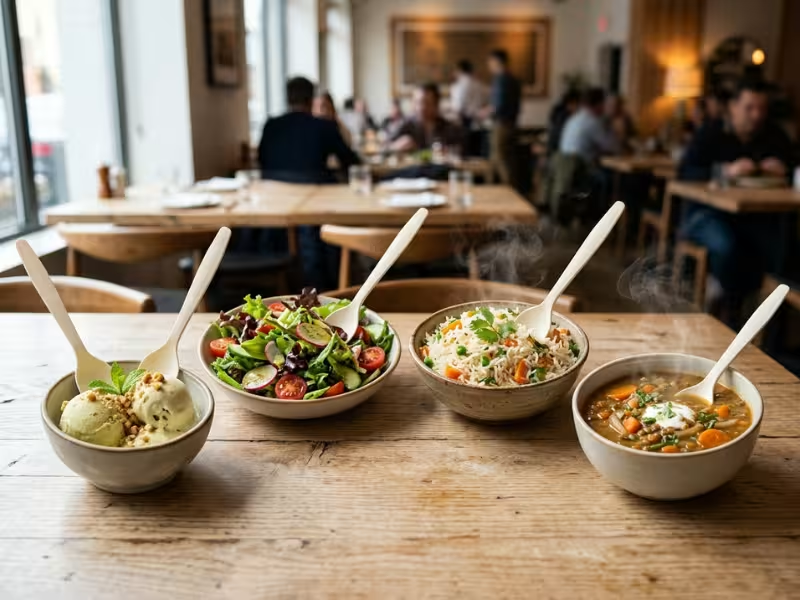
Heat During Storage Can Also Ruin Them
Many spoons fail before they ever touch food. The heat damage happens in the supply chain.
Watch these four danger zones:
- Hot cars: A parked car in summer can pass 140°F inside. Leave a case in the trunk for a hot afternoon, and you may find warped spoons.
- Summer warehouses: Metal-roof buildings can stay above 100°F for weeks. That won’t melt spoons, but it speeds up aging and brittleness.
- Shipping containers: Containers that cross warm regions can reach 130–150°F inside. Ask your supplier about shipping season and stacking.
- Direct sunlight: A case near a window or on a loading dock heats up fast. UV light also breaks down the material over time.
Dishwashers and microwaves don’t suit these spoons either. A dishwasher runs at 140–180°F, and a microwave heats food well past the softening range. Treat corn starch spoons as single-use, cold-to-warm tools.
How Strong Corn Starch Spoons Actually Are
Buyers often ask me, “Are these spoons strong?” My answer is always another question: strong enough for what?
The same spoon that handles a rice bowl with ease can snap in a pint of hard ice cream. Strength isn’t a yes-or-no feature. It depends on three things: the food, the way someone applies force, and the spoon’s specs. Let’s look at each one in real service.
Where They Hold Up Well
Corn starch spoons do their best work with scooping. When you scoop, the force pushes into the bowl of the spoon, and that curved shape resists bending well.
In my experience, a standard 3–4 gram spoon handles these foods without trouble:
- Rice bowls: Loose grains scoop easily, as long as the food stays below the heat limits covered above.
- Pasta: Penne, macaroni, and short shapes work well. Long noodles are harder, since twirling puts sideways stress on the neck.
- Soft desserts: Pudding, mousse, soft-serve, and cake slices give almost no resistance.
- Salads: Greens, grain salads, and chopped vegetables scoop cleanly.
- Yogurt and parfaits: These are ideal. They’re cold, soft, and easy to lift.
PLA spoons often feel stiffer than polypropylene spoons in the hand. That stiffness has a catch, though. A PP spoon flexes under pressure and springs back. A PLA spoon holds firm until it reaches its limit, and then it cracks.
Where They Bend, Crack, or Fail
Most strength failures I see come from foods that fight back, or from people using the spoon as a tool.
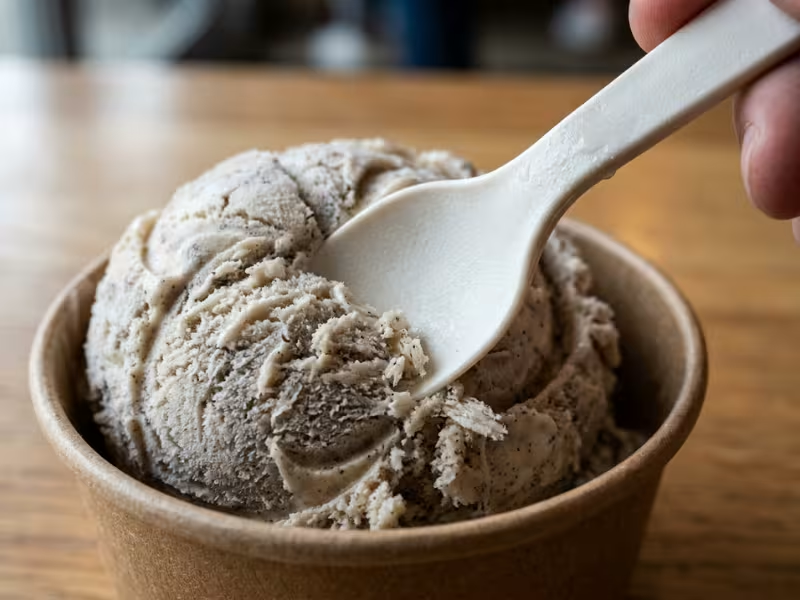
Hard ice cream causes the most breaks. Ice cream straight from a deep freezer can sit near 0°F, and PLA gets more brittle as it gets colder. When someone digs into a fresh pint, the neck often snaps.
Frozen desserts cause the same problem. Gelato tubs, frozen fruit cups, and icy granitas all push back hard.
Dense foods strain the handle. Thick mashed potatoes, sticky rice clumps, and firm cheesecake all need more force than a thin spoon can give.
Heavy stirring wears spoons down fast. Thick smoothies, milkshakes, and protein drinks put constant sideways pressure on the neck.
Leverage does the most damage. When someone braces the spoon on a cup rim and pries, the rim becomes a pivot point. The neck takes all the force and breaks.
These breaks matter for more than convenience. Snapped PLA can leave sharp edges or small shards. For dessert shops, I suggest two simple fixes. Let hard ice cream sit for five to ten minutes before serving, or switch to a heavier spoon for frozen items only.
Why Thickness and Mold Design Matter So Much
Two spoons can share the same material and still perform very differently. The design often decides more than the formula.
When I compare samples, I check four things:
- Gram weight: Budget spoons often weigh 2.5–3 grams. Heavy-duty versions run 4–5 grams. That extra gram or two makes a big difference with dense food.
- Handle thickness: Look closely at the neck, where the handle meets the bowl. A thicker neck, or one with a raised center rib, resists snapping far better than a flat one.
- Bowl depth: A deeper, more curved bowl stays stiffer under pressure. Flat, shallow bowls flex and crack more easily.
- Mold quality: Cheap molds leave thin spots, rough edges, and tiny air bubbles. Each flaw becomes a weak point. Better molds give you even walls and clean edges.
You can test this yourself in a few minutes. Weigh 10 spoons from each sample on a kitchen scale. Big swings in weight point to poor mold control. Then hold a spoon up to the light and check the neck for thin or cloudy patches.
Finally, try one honest stress test. Scoop your densest menu item and press firmly. If the spoon flexes badly or cracks, it’s not the right spec for your menu, no matter what the box says.
Shelf Life and Storage: How Long They Last Before Use
A plastic spoon can sit in a back room for years and still work fine. A corn starch spoon can’t. The chemistry that lets it break down in a compost facility also lets it age on your shelf.
That surprises many buyers, especially after a big discount order. So let’s look at how long these spoons really last, what speeds up aging, and how to keep your stock usable.
How Long They Usually Last on the Shelf
Most manufacturers quote a shelf life of 12–24 months for PLA and starch-blend spoons. I treat that as a practical range, not a guarantee.
That range assumes good conditions: a cool, dry room, sealed cartons, and no direct sun. Change any of those, and the clock runs faster.
The formula also decides where a batch lands. Pure PLA spoons often reach the upper end. Starch-heavy blends absorb moisture more easily, so they tend to age sooner.
Before you order, ask your supplier two questions:
- What shelf life do you guarantee, and under what storage conditions?
- Does each carton show a production date or batch code?
If the carton carries no date, you can’t track its age. I push suppliers for date-coded cartons on every order.
Aging spoons usually give you warning signs:
- Yellowing or uneven color
- Brittleness, where the spoon snaps instead of flexing slightly
- Warping or curled edges
- A stale or sour smell when you open the bag
What Makes Them Age Faster
Five factors cause most of the early failures I see.
Heat does damage even below the softening point. A storeroom that stays above 90°F all summer can take months off the shelf life.
Humidity attacks the material directly. Water slowly breaks PLA’s long polymer chains into shorter ones, and shorter chains mean weaker spoons. Starch blends also absorb water and swell slightly. Damp basements and storage near dish pits or ice machines cause real trouble.
UV and sunlight break down the surface of the spoon. Cases near a window or loading dock fade and turn brittle first.
Poor packaging lets the air in. Thin bags with loose seals admit moisture. Torn or crushed cartons expose spoons to light and humidity.
Long shipping and warehouse time adds age at every stop. Sea freight often takes four to six weeks. Goods may then sit at a port or distributor for months. A “fresh” delivery may already be three to six months old when it reaches you. Check the production date, not the delivery date.
How to Store Them So They Stay Usable
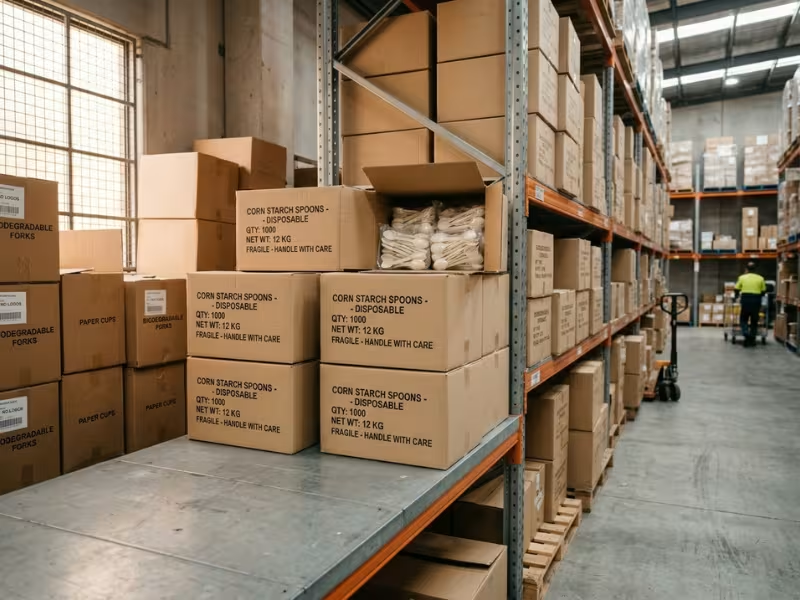
Good storage costs very little. Here’s the setup I recommend to clients:
- Keep it cool. Aim for below about 85°F. Avoid shelves above kitchens, near ovens, or under metal roofs.
- Keep it dry. Target humidity under about 60%. Put cartons on shelves or pallets, not on bare concrete, which can wick up moisture.
- Keep it sealed. Leave spoons in their inner bags until you need them. Reseal opened bags or move the spoons into lidded bins.
- Keep it dark. Store cartons away from windows and doors.
- Rotate your stock. Use first in, first out. Write the arrival date on each carton, and place new cartons behind older ones.
Then size your orders to real usage. A bulk discount looks great until half the pallet turns brittle. I suggest ordering no more than 6–12 months of expected use at a time, based on last year’s actual sales. Seasonal businesses should cut orders before the slow season starts.
If you find an old case in the back, test a handful before service. Bend a few spoons gently and scoop your densest menu item. If they snap easily, pull that case from the counter.
What Happens After Disposal, and Why It Shouldn’t Drive the Whole Decision
Many buyers choose corn starch spoons for what happens after the meal. That’s a fair reason. But where these spoons end up depends far more on your local bins than on the spoon itself.
Industrial composting is where they work best. Certified PLA and starch-blend spoons are designed for facilities that hold piles at about 131–160°F for weeks, with managed air and moisture. In those conditions, a certified spoon usually breaks down within a few months.
Home compost works very differently. Most backyard piles stay below 100°F. That’s warm enough for leaves and coffee grounds, but not for PLA. I’ve had clients pull spoons from garden compost after a full year, and they still looked close to new. Unless the carton carries a home-compost mark, such as OK compost HOME, keep these spoons out of the backyard bin.
Landfill slows almost everything down. Landfills pack waste tightly and cut off oxygen. Without heat and air, a “biodegradable” spoon can sit there for years, much like a regular plastic one.
So the real question is simple: does your hauler or venue accept compostable cutlery? Some facilities reject all PLA items because they look like regular plastic on a fast sorting line. If no one in your area takes them, most of the environmental benefit disappears. You pay more for a spoon that ends up in the same place as plastic.
Still, I never let disposal drive the whole decision. A spoon that composts perfectly but bends in your soup still creates waste. Staff hand out a second spoon, and the customer leaves unhappy.
I rank the checks in this order:
- Can it handle your food temperature?
- Is it strong enough for your densest menu item?
- Will it survive your storage conditions?
- Can your local system actually compost it?
A spoon that passes the first three but fails the fourth may still make sense, especially where local rules require compostable serviceware. A spoon that fails any of the first three won’t work, even with a perfect disposal route.
Who Should Use Corn Starch Spoons, and Who Should Avoid Them
When a client asks me whether these spoons suit their business, I don’t start with the material. I ask them to walk me through a busy Saturday. What’s on the menu? How hot does it get? Where do the cases sit before service? Where does the trash go at closing?
Those answers sort most businesses into one of two groups. Find the setting closest to yours below.
Where Corn Starch Spoons Work Well
These spoons do their best work with cold, soft food served quickly.
Ice cream and frozen yogurt shops fit well. Cold product means no heat risk at all. The only limit is hardness. Let fresh tubs soften for a few minutes before scooping, or choose a 4-gram spoon for hard-packed flavors.
Smoothie bars work well for açaí and smoothie bowls. Customers scoop cold fruit, granola, and soft toppings, so the spoon never strains.
Salad bars and grab-and-go cases suit them too. Greens, grain salads, and fruit cups stay cold or near room temperature, and light scooping puts almost no stress on the neck.
Dessert counters and bakeries get some of the best results. Pudding, mousse, cheesecake cups, and parfaits all pair well with a smooth, plastic-like spoon. Most customers never notice the switch.
Outdoor events with cold menus also work, from summer festivals to gelato carts. Keep the cases in the shade or in a cooler bin, not in a hot van.
Buyers with composting access get the full benefit. Campus dining halls, stadiums with compost stations, and cities that collect PLA cutlery can turn these spoons into compost instead of trash. They also help you meet local rules that require compostable serviceware.

Where They Let You Down
These spoons struggle wherever heat, steam, or long storage enter the picture.
Soup shops see the fastest failures. Soup often sits at 160–185°F, and customers eat it slowly. A PLA spoon can curl within a minute or two. Switch to CPLA or birch wood for hot bowls.
Noodle takeout adds two problems at once. Ramen and pho run hot, and a spoon sealed in the bag sits in steam for 20–30 minutes. Then twirling noodles puts sideways stress on a neck that has already softened.
Coffee and tea service wears spoons out fast. Fresh coffee sits well above the softening range. A barista who stirs lattes with corn starch spoons will see bent tips before the morning rush ends. Wooden stirrers handle this job better.
Businesses without climate-controlled storage take a quieter hit. Food trucks, pop-up stalls, and seasonal kiosks often store cases in vehicles or sheds that pass 140°F in summer. The spoons warp or turn brittle before anyone uses them.
Businesses with no composting route lose most of the benefit. If your hauler rejects PLA, you pay more for a spoon that lands in the same landfill as plastic. Unless a local rule requires compostable cutlery, consider wood or a durable reusable option instead.
Many cafés fall into both groups. In that case, don’t force one spoon to do everything. Use corn starch spoons for cold desserts and salads, and keep a heat-tolerant option behind the counter for soup and hot drinks.
What to Check Before You Order in Bulk
A pallet of spoons can supply a café for a year. If you pick the wrong ones, you end up with a year of complaints sitting in your storeroom. Before a client commits to a large order, I take them through four checks. Most need only one email or one afternoon.
1. Check the actual material, not just “corn starch.” Ask the supplier for the full formula with percentages. You need to know whether you’re buying pure PLA, a PLA or PBAT starch blend, or a blend with polypropylene. Then ask for the certificate itself, not just a logo on the carton. Look up the number in the certifier’s database, and confirm that it covers your exact spoon size and thickness. If a supplier stalls on either request, move on.
2. Check heat and strength specs. Get two numbers in writing: the maximum use temperature and the gram weight per spoon. Compare them with your hottest and hardest menu items. For cold desserts and salads, a 3-gram spoon usually holds up. For hard-packed ice cream or dense bowls, look for 4 grams or more with a thick or ribbed neck. If any dish runs above about 140°F, don’t hope PLA survives it. Order CPLA or wood for those items.
3. Ask about shelf life and storage conditions. Find out what shelf life the supplier guarantees and what storage conditions that promise assumes. Ask whether each carton carries a production date or batch code. Also ask when they made the goods and how they’ll ship them, because a container crossing warm seas in July adds real heat stress. Then compare their assumptions with your back room. If they expect 75°F and your storeroom hits 95°F, plan on a shorter life and order less.
4. Test samples with your real menu before scaling up. Order a sample case of your top two options, about 200–300 spoons each. Use them during a busy shift, not a quiet afternoon. Scoop your hardest ice cream straight from the freezer. Pack a full takeout order, seal the bag, and wait 30 minutes. Leave one sealed bag on your warmest storage shelf for a week, then bend a few spoons. Count bends and breaks per 100 uses, and ask your staff what they noticed.
If a spoon fails more than two or three times per 100 uses, drop it. Place the bulk order only after a sample passes all four checks, and keep that order to six to twelve months of real use.
FAQ
What temperature can a corn starch spoon withstand before bending?
Most PLA-based spoons start to soften at about 140–150°F (60–65°C). Treat that range as a material limit, not a safe serving line. Time and pressure matter too. A spoon can handle a quick bite of 130°F rice, but it may droop if it sits in that bowl for ten minutes. Hot soup, ramen, and fresh coffee run 160–185°F, well past the limit. For those items, I point buyers to CPLA, which handles about 185°F, or to birch wood.
Can corn starch spoons go in the microwave?
No. A microwave heats food well past the 140–150°F softening range, often within a minute. The spoon curls and warps, and it keeps that bent shape after it cools. Steam trapped under a lid makes the damage worse. The same rule applies to dishwashers, which run at 140–180°F. Take the spoon out before you reheat food, and treat it as a single-use tool for cold and warm dishes only.
Are corn starch spoons safe to eat with?
Certified spoons from a reputable supplier work well for cold and warm food. Still, I ask clients to request food-contact documents for the exact item, such as an FDA compliance statement or an LFGB test report. Compostable standards like EN 13432 and BPI also set limits on heavy metals. Skip uncertified “cornstarch” spoons for hot dishes, since many contain polypropylene filler. Throw away any spoon that snaps, because broken PLA can leave sharp edges.
How long do corn starch spoons last in storage?
Most manufacturers quote 12–24 months. That range assumes a cool, dry room, sealed bags, and no direct sun. Heat above 90°F, high humidity, and sunlight all shorten it, and starch-heavy blends usually age faster than pure PLA. Count the age from the production date, not the delivery date, since sea freight and warehouse time can add months. Watch for yellowing, brittleness, warping, or a sour smell. I suggest buying no more than 6–12 months of real usage at once.
Can I compost corn starch spoons at home?
In most cases, no. Most PLA and starch-blend spoons carry industrial-only certification, such as ASTM D6400 or EN 13432. They need about 131–160°F for several weeks, and backyard piles usually stay below 100°F. I’ve seen PLA spoons come out of garden compost after a year looking almost new. Look for an OK compost HOME mark if you want backyard composting. Otherwise, send them to a city program that accepts compostable cutlery, or put them in the trash.
Are corn starch and PLA cutlery the same thing?
Not always. Many suppliers use “corn starch” as shorthand for the plant origin. Most of these spoons are PLA, a plastic-like polymer that makers produce from fermented corn sugars, and no starch remains in the final product. Other spoons blend real starch with PLA, PBAT, or polypropylene. A PP blend can contain a large share of conventional plastic, and it won’t compost. Ask your supplier for the exact formula with percentages and a certificate number you can verify.
Match the Spoon to the Menu, Not the Label
Corn starch spoons don’t replace plastic everywhere. They do one job well: cold, soft food that customers eat fairly quickly.
Salads, yogurt, parfaits, smoothie bowls, and softened ice cream all suit them. Most customers won’t notice the switch.
Heat exposes their limits fast. Hot soup, ramen, and fresh coffee push them past their softening point. A hot van or a summer storeroom can warp or weaken a case before service even starts.
So treat these spoons as one tool, not your only tool. Keep CPLA or birch wood on hand for anything that runs hot.
Before you order a pallet, test samples yourself. Scoop your hardest and hottest menu items. Leave one sealed bag on your warmest shelf for a week, then bend a few spoons. If they pass, order only what you’ll use in six to twelve months.