


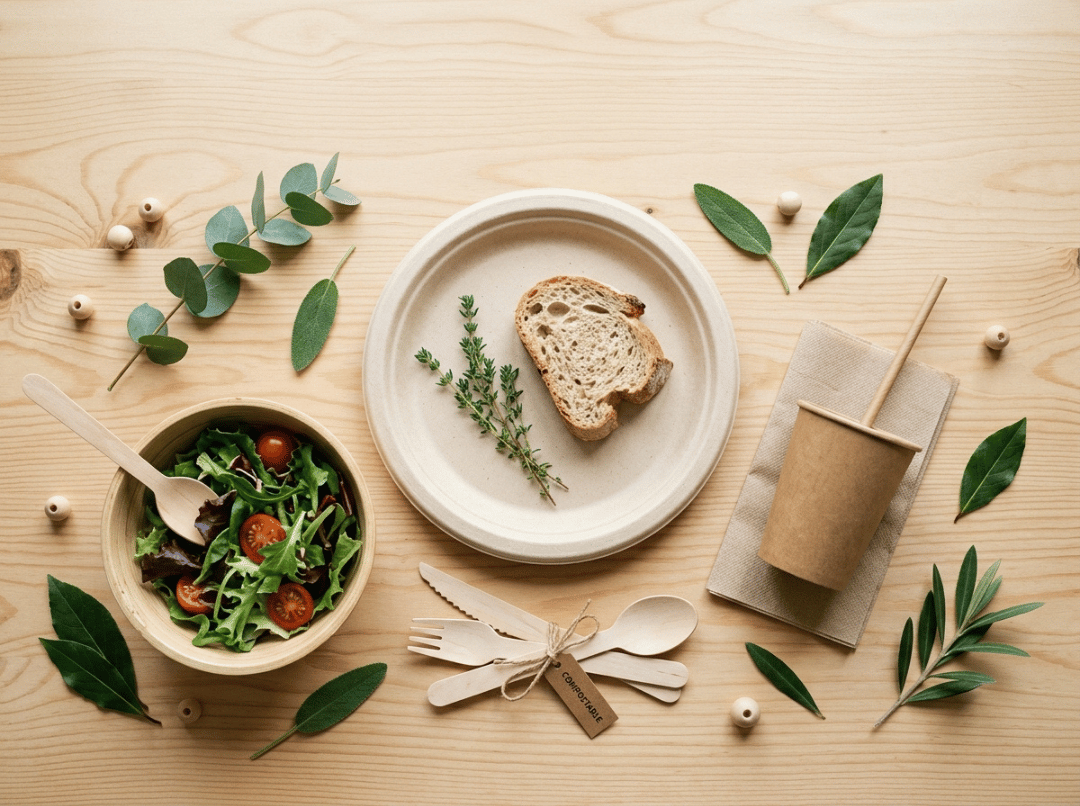
Compostable tableware is single-use dinnerware, cutlery, and cups made from plant-based materials that fully break down into non-toxic organic matter under the right composting conditions. It leaves behind no plastic fragments, no toxic residue—just compost.
Most products are made from bagasse (sugarcane fiber), PLA (a corn-based bioplastic), cornstarch blends, bamboo, wood, or paper with a compostable lining. But here’s what many buyers miss: the word “compostable” on a label doesn’t tell you everything. Whether an item actually breaks down depends entirely on where and how it’s composted—and those two things vary more than most people expect.
This guide is built around the questions buyers actually ask. By the end, you’ll know which materials work for which food types, how to read a certification without being misled, and how to make a confident sourcing decision for your business.
Compostable vs Biodegradable vs Recyclable: What’s the Real Difference?
These three terms are used all the time interchangeably. They’re not the same—and confusing them is one of the most common mistakes in sustainable sourcing.
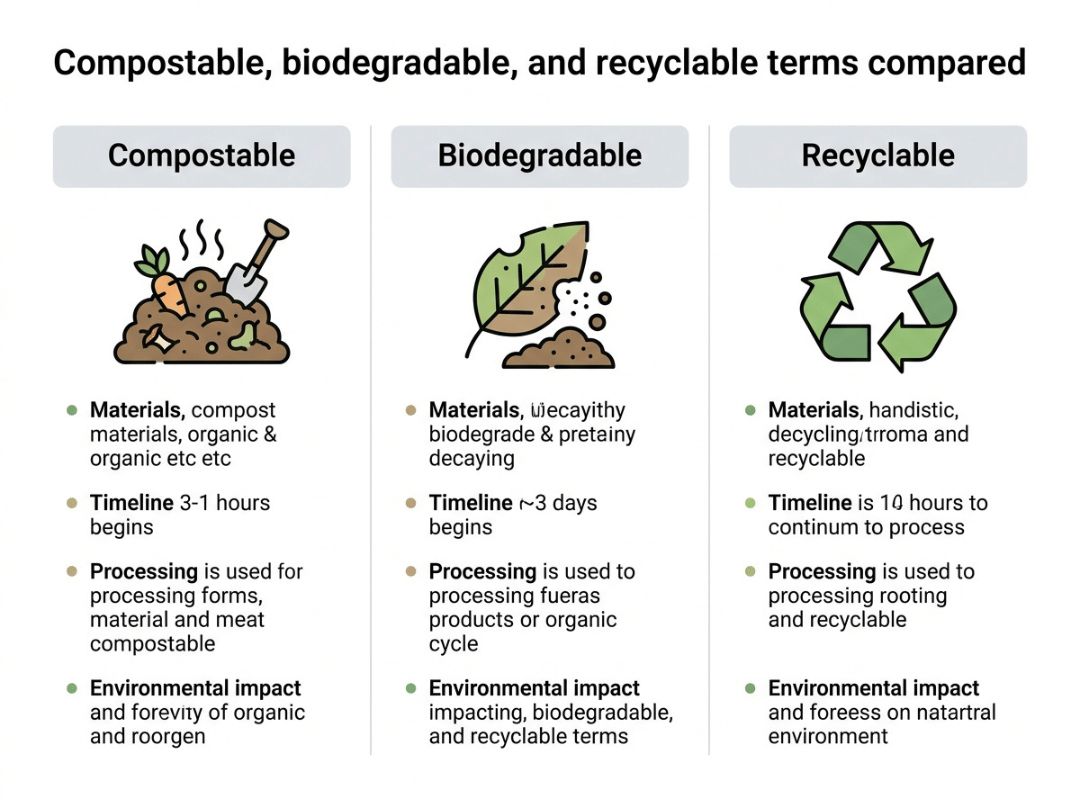
Compostable means an item breaks down into usable compost within a defined timeframe and under specific conditions, leaving no toxic residue. The process is testable and certifiable.
Biodegradable means an item will eventually break down—but there’s no required timeframe, no standard conditions, and no guaranteed outcome. A conventional plastic fork is technically biodegradable over hundreds of years. The label means almost nothing without further detail.
Recyclable means an item can be collected and reprocessed into new materials, but only if the right collection infrastructure exists. Many “recyclable” products still end up in landfill because local systems can’t handle them.
|
Feature |
Compostable |
Biodegradable |
Recyclable |
|---|---|---|---|
|
Definition |
Breaks down into compost under set conditions |
Breaks down over undefined time |
Reprocessed into new products |
|
Requires specific conditions? |
Yes (home or industrial) |
Not defined |
Yes (collection + facility) |
|
Leaves toxic residue? |
No |
Possibly |
No, if processed correctly |
|
Typical timeframe |
Weeks to months |
Unspecified |
N/A |
|
Verified by standards? |
Yes |
Rarely |
Varies |
|
Good for food packaging? |
Yes |
Unreliable |
Sometimes |
Why this matters for buyers: If a supplier claims their product is “biodegradable” but holds no compostability certification, treat that claim with caution. Certified compostable means a third party has tested it against a defined standard. Biodegradable alone means very little.
What Materials Are Used in Compostable Tableware?
Material choice determines everything: heat tolerance, grease resistance, how the item looks and feels, its cost, and which composting method it needs. Choosing the wrong material for a use case is one of the most expensive mistakes a buyer can make—not just financially, but in customer experience.
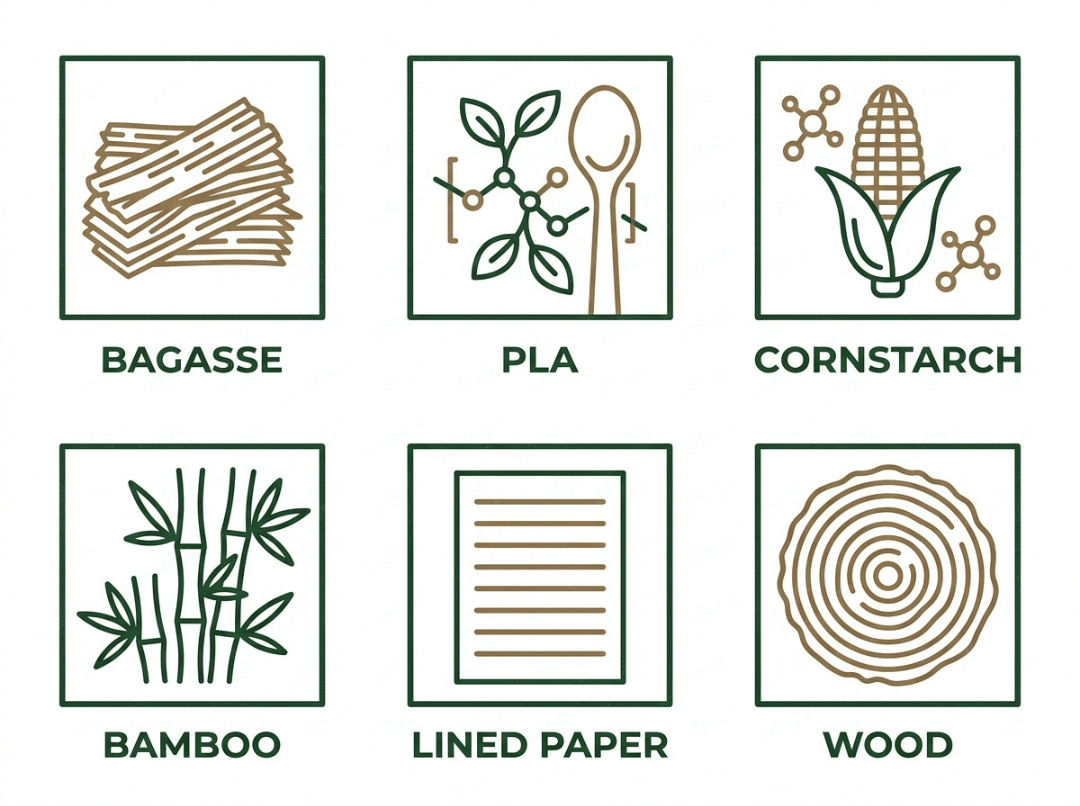
Here’s a practical breakdown of the most common materials and where each one performs best.
Bagasse (Sugarcane Fiber)
Bagasse is the fibrous pulp left after crushing sugarcane for juice. It’s pressed into plates, bowls, and containers, and it’s one of the strongest performers in foodservice.
- Heat tolerance: High. Handles hot soups, rice, curries, and grilled foods without softening.
- Grease resistance: High. Holds oily foods without soaking through.
- Compost method: Both home and industrial.
- Best for: Plates, bowls, clamshell takeaway containers.
- Limitation: Absorbs moisture over extended holds (several hours), which can cause softening around the edges.
Bagasse is the go-to choice for hot food applications. For restaurants, food stalls, and catering, it covers most of what you need.
PLA (Polylactic Acid)
PLA is a bioplastic derived from fermented plant starch—usually corn. It looks and feels almost identical to conventional clear plastic, which is both its biggest advantage and its biggest source of confusion.
- Heat tolerance: Low. PLA begins to soften around 55–60°C, making it unsuitable for hot drinks or warm food.
- Grease resistance: Medium.
- Compost method: Industrial only in most cases.
- Best for: Cold drink cups, clear lids, deli containers, cold-fill packaging.
- Limitation: Frequently mislabeled or misunderstood. If your customers try to recycle PLA items in a standard plastic stream, they’ll contaminate the batch—PLA is not compatible with conventional plastic recycling.
PLA is not a universal “eco-plastic.” It excels in cold-fill applications. It’s a poor choice for anything hot.
Cornstarch Blends
Cornstarch-based compounds are flexible, easy to mold, and typically cost-effective for high-volume, lightweight items.
- Heat tolerance: Medium.
- Grease resistance: Medium.
- Compost method: Varies by blend—always verify.
- Best for: Cutlery, straws, lightweight trays.
- Limitation: Quality and compost performance vary significantly between manufacturers. Always request the test data for the specific blend, not just the base material.
Bamboo
Bamboo is a fast-growing grass (not a tree), making it a highly renewable material. It has a premium, natural aesthetic that appeals to consumers.
- Heat tolerance: High.
- Grease resistance: Medium.
- Compost method: Home and industrial.
- Best for: Premium plates, cutlery sets, catering and hospitality.
- Limitation: Higher unit cost. Sourcing transparency matters—look for suppliers who can confirm responsible harvesting.
Bamboo works well when presentation matters. It’s a strong choice for catered events, hotel dining, and upscale takeaway brands where the look of the product reflects on the business.
Paper with Compostable Lining
Paper cups and containers need a liner to hold liquids. The type of liner determines whether the product is genuinely compostable.
- Heat tolerance: Medium (depends on liner).
- Grease resistance: Medium to high.
- Compost method: Depends on the liner—PLA-lined needs industrial; aqueous-coated may qualify for home.
- Best for: Hot drink cups, takeaway bags, food wraps.
- Critical note: A polyethylene (PE) lining is not compostable. If you’re sourcing paper cups for a sustainability-focused brand, always confirm the liner type in writing. “Paper cup” alone tells you nothing about compostability.
Wood Cutlery
Wooden forks, knives, and spoons are rigid, natural, and among the most straightforward items to compost.
- Heat tolerance: High.
- Grease resistance: Low.
- Compost method: Home compostable.
- Best for: Cutlery for picnics, events, cafes, grab-and-go.
- Limitation: Surface texture can feel rough. Shape options are more limited than molded materials.
Material-at-a-Glance Comparison
|
Material |
Heat tolerance |
Grease resistance |
Compost method |
Best use |
|---|---|---|---|---|
|
Bagasse |
High |
High |
Home + industrial |
Plates, bowls, clamshells |
|
PLA |
Low |
Medium |
Industrial |
Cold cups, clear cutlery |
|
Cornstarch blends |
Medium |
Medium |
Varies |
Cutlery, straws |
|
Bamboo |
High |
Medium |
Home + industrial |
Premium plates, catering |
|
Paper + lining |
Medium |
Medium–high |
Depends on liner |
Cups, wraps, bags |
|
Wood cutlery |
High |
Low |
Home |
Forks, knives, stirrers |
Which Material Is Best for Your Foodservice Setting?
This is the question most guides skip. Knowing what materials exist is useful. Knowing which one fits your operation is what actually saves you money and prevents complaints.
Restaurants (dine-in or fast casual): Bagasse plates and bowls for hot mains. Paper-lined cups for hot drinks. PLA cups for cold beverages and fountain drinks.
Takeaway and delivery: Bagasse clamshells for hot meals. Paper bags with a compostable liner for dry items. PLA lids on cold cups. Avoid PLA containers for hot items—they risk deforming in transit.
Cafes: Paper cups with a plant-based lining for hot coffee. PLA cold cups for iced drinks. Wood or cornstarch cutlery for ambient food service.
Catering and events: Bamboo plates and cutlery for presentation-focused settings. Bagasse for bulk hot food. Avoid materials that soften during extended holds.
Airline catering: Lightweight bagasse or molded fiber trays. Stackability and weight-per-unit matter as much as performance.
Supermarkets and retail: Paper-based packaging with printable surfaces for branded SKUs. Ensure the lining is verifiably compostable, not PE.
Distributors and wholesalers: Focus on supplier certification, consistent quality control, and MOQ flexibility. Your customers will ask for certification documentation—make sure you can provide it.
Home Compostable vs Industrial Compostable: Why the Distinction Matters
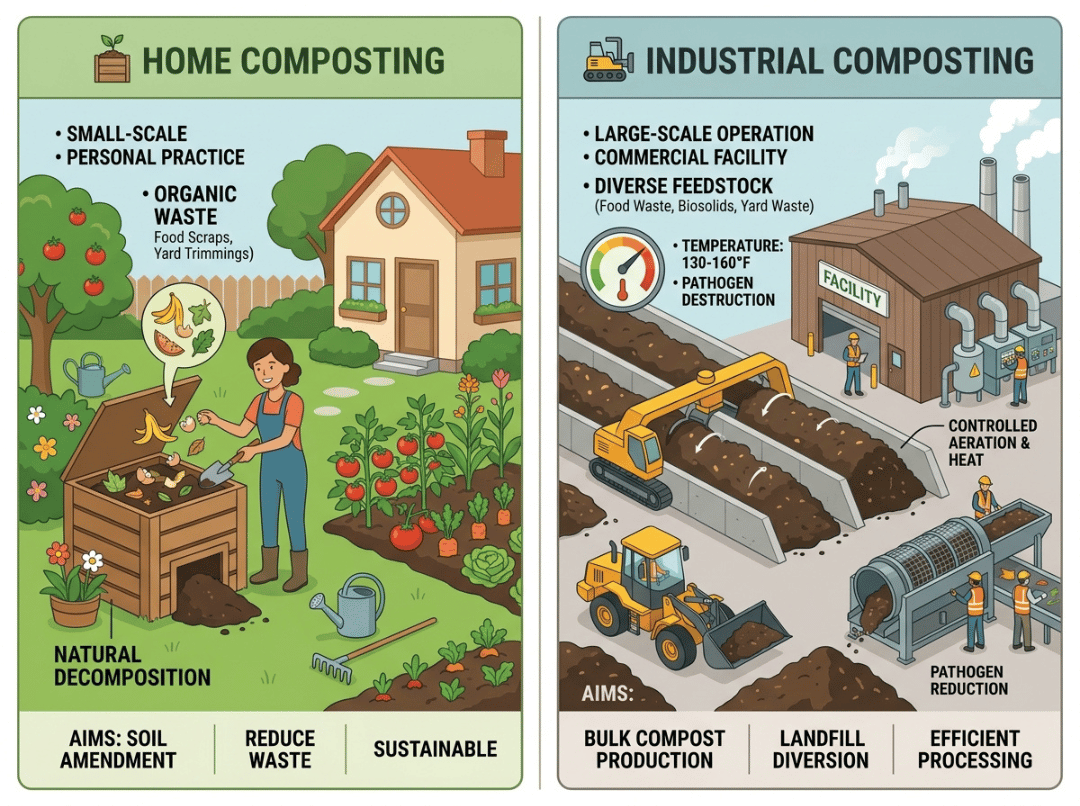
One of the most common mistakes buyers make is assuming that “compostable” means the product can go in a backyard bin. It often can’t.
Home composting happens in lower-temperature, less controlled conditions. It typically suits wood, uncoated paper, and some bagasse. The breakdown is slower—often several months to a year.
Industrial composting happens in commercial facilities with high temperatures (typically above 55°C), managed humidity, and controlled microbial activity. PLA and many bioplastic blends require this environment to break down within the tested timeframe. Without it, they may persist almost indefinitely.
This distinction has real consequences. If you’re selling compostable cups to a café in a region with no industrial composting infrastructure, those cups may end up in landfill regardless of what the label says. That’s worth knowing—both for your own claims and for how you guide your customers.
How to read a label:
- “Home compostable” = suitable for backyard composting bins.
- “Industrially compostable” or “commercially compostable” = requires a commercial facility.
- “Compostable” with no qualification = ask the supplier which standard it was tested against and under what conditions.
Which Certifications Should Buyers Verify?
A logo printed on packaging is not the same as a valid certification. Certifications that matter are issued by independent third-party bodies and tied to a specific product, a specific standard, and a verifiable certificate number.
Here are the main marks buyers encounter:
|
Certification |
Region |
Compost type |
What it means |
|---|---|---|---|
|
EN 13432 |
EU |
Industrial |
Meets EU standard for packaging compostability |
|
ASTM D6400 |
US |
Industrial |
Standard for plastics designed to compost in facilities |
|
BPI Certified |
US |
Industrial |
Third-party verification of ASTM D6400 compliance |
|
OK Compost |
EU / Global |
Industrial |
TÜV Austria certification for industrial composting |
|
OK Compost HOME |
EU / Global |
Home |
TÜV Austria certification for home composting |
|
AS 4736 |
Australia |
Industrial |
Australian standard for industrial compostability |
|
AS 5810 |
Australia |
Home |
Australian standard for home compostability |
How to Verify a Certification Before You Buy
Most greenwashing happens at this exact step. Follow these three checks:
- Ask for the actual certificate document—not a logo image, not a website badge, not a marketing claim. Request the PDF with the certificate number.
- Cross-check the certificate number against the issuing body’s online database. BPI, TÜV Austria, and DIN CERTCO all maintain public registries.
- Confirm the certification covers the finished product, not just the raw resin or base material. A supplier’s raw material may be EN 13432 certified while the molded final product has never been tested.
If a supplier can’t provide a verifiable certificate for the exact product you’re ordering, that’s a meaningful red flag.
How to Choose Compostable Tableware for Your Business
Sourcing compostable tableware at scale involves more than comparing material specs. Here’s how to structure the decision.
Step 1: Define your use case first
Before looking at products, answer these questions:
- What temperature will the food or drink be?
- How long will the packaging hold contents before disposal?
- Does your customer base have access to home or industrial composting?
- Does your target market have specific compliance requirements?
These four answers will immediately narrow your material options.
Step 2: Confirm certification before sampling
Don’t spend time and money testing products from suppliers who can’t verify their certifications. Run the verification check described above as a first filter.
Step 3: Test with your actual products
Lab performance and real-world performance sometimes differ. A bagasse container that performs well with rice may not hold up with a high-acid curry. Always test samples with the food or drink you’ll actually serve, at the temperature and hold time you expect.
Step 4: Evaluate the full sourcing picture
Once performance and certification are confirmed, evaluate:
- MOQ and lead times: Can the supplier meet your volume at your pace? Confirm both in writing.
- Custom printing: What printing methods are available? What’s the minimum order for custom branding?
- Packaging specs: Case dimensions, units per case, pallet configuration—these affect your storage and logistics costs.
- Market compliance: If you’re selling into the EU, US, or Australia, different rules apply. Ask your supplier for documentation specific to your target market.
- Quality consistency: Ask how the supplier handles batch-to-batch variation and what their QC process looks like.
Supplier Evaluation Checklist
Before committing to a bulk order, confirm all eight:
- ☐ Valid, verifiable certification for the finished product (not just the raw material)
- ☐ Clear labeling distinguishing home vs industrial compostability
- ☐ Material performance data for heat, grease, and load
- ☐ Transparent MOQ, unit pricing, and lead times
- ☐ Sample availability before bulk commitment
- ☐ Custom branding and printing options
- ☐ Documentation supporting target-market compliance
- ☐ Documented quality control process
Frequently Asked Questions
Is compostable tableware safe for hot food?
Yes—with the right material. Bagasse and bamboo handle hot food well and are safe for soups, grilled dishes, and warm meals. PLA is not suitable for hot food; it softens at relatively low temperatures and risks deforming. For hot applications, stick to bagasse, bamboo, or wood.
Can compostable cups hold hot coffee?
Not if they’re PLA. PLA cups are designed for cold beverages and begin to soften around 55–60°C. For hot coffee, use paper cups with a plant-based compostable lining—either PLA-lined paper (which handles moderate heat) or cups with an aqueous coating. Always confirm the liner type with your supplier.
How long does compostable tableware take to decompose?
In an industrial composting facility: typically a few weeks to a few months, depending on the material. In a home compost bin: several months to over a year, and only if the item is certified for home composting. Items like PLA won’t break down meaningfully in a home bin regardless of how long they sit there.
How do I verify a compostable certification?
Ask your supplier for the certificate document with its certificate number. Then look up that number on the issuing body’s public registry—BPI, TÜV Austria (OK Compost), and DIN CERTCO all maintain searchable databases. Confirm the certificate applies to the specific finished product you’re ordering, not just the raw resin.
Is bagasse better than plastic for single-use food packaging?
For most food-contact applications: yes. Bagasse handles heat and grease well, it’s made from a renewable agricultural byproduct, and it composts into organic matter rather than persisting in landfill. Conventional plastic costs less upfront and has predictable performance, but it faces growing regulatory restrictions and increasing disposal costs. For businesses with sustainability commitments or compliance obligations, bagasse typically offers better long-term value.
Can compostable tableware go in a home compost bin?
Only if the item is specifically labeled “home compostable” and certified to a home composting standard (such as OK Compost HOME or AS 5810). Many compostable products—especially PLA—require industrial conditions and won’t break down in a backyard bin. If the label only says “compostable” without qualification, assume industrial-only until you can confirm otherwise with your supplier.
Conclusion
Compostable tableware is a credible, practical alternative to conventional plastic—but only when you match the right material to the right use case, understand the composting conditions required, and verify certifications against the actual finished product.
The four things that determine whether you make a good sourcing decision:
- Material fit: Does the product handle your food type, temperature, and hold time?
- Composting method: Will your customers actually have access to the right composting facility?
- Verified certification: Can the supplier provide a certificate number you can look up?
- Supplier reliability: Can they meet your MOQ, lead time, branding, and compliance needs consistently?
Get those four right, and you’ll avoid the most common mistakes buyers make in this category.
Ready to take the next step?
- Request samples matched to your specific food type and temperature requirements.
- Ask for certification documents you can verify against the issuing body’s database.
- Discuss custom printing, MOQ, and compliance needs if you’re sourcing at scale or for a specific market.