


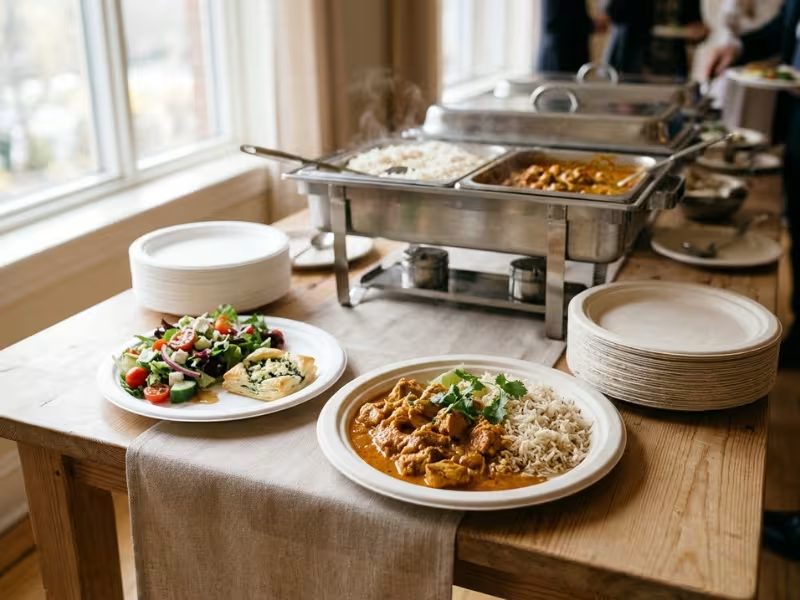
A caterer ladles hot curry onto a stack of plates. Ten minutes later, guests carry them across a crowded room. Will the plates hold?
I work with caterers and food service buyers who compare bagasse and bamboo pulp plates every season.
The material name matters less than real performance. Buyers want strength, heat resistance, grease handling, compostability, and fair cost.
In this guide, I explain how makers turn these fibers into sturdy plates. I compare the differences that matter in use and show you when to choose each one.
What Bagasse and Bamboo Pulp Really Are
Both materials start as plant fiber, and both end up as molded plates. But they come from very different sources, and that shapes cost, supply, and feel. Here’s what each one is, in plain terms.
Bagasse: A Sugar Industry Byproduct
Bagasse is the fibrous leftover after mills crush sugarcane for juice. It’s waste from an industry that already exists. No one grows sugarcane just to make plates.
That matters for buyers. Sugar mills produce bagasse in huge volumes, so supply stays steady and prices stay reasonable. That steady supply is also why you can find such a wide range of sugarcane bagasse tableware in standard sizes and shapes. Factories pulp the fiber, mold it into shape, and press it with heat. The result is a dense, off-white plate with a smooth surface.
Bagasse fibers are short and mixed with some soft pith. Good processing turns that mix into a solid, even sheet. Poor processing leaves weak spots. I always check both sides of a sample plate for thin or uneven areas.
Bamboo Pulp: A Processed Plant Fiber, Not the Same as Bamboo “Wood” Products
Bamboo pulp comes from bamboo stalks that makers chip, cook, and break down into fiber. Bamboo grows fast and regrows from its roots, which helps its green image. Its fibers run longer than bagasse fibers. Plates made from it often feel smoother and look more refined.
Here’s a point that trips up many buyers. A bamboo pulp plate is not the same as:
- A solid bamboo plate, cut or pressed from bamboo pieces
- A “bamboo fiber” plate bound with melamine, which won’t compost at all
- Viscose bamboo, a textile fiber used in clothing and towels
Also, read the spec sheet closely. Many “bamboo” plates actually blend bamboo pulp with bagasse. That isn’t bad, but it changes performance and price. Ask your supplier for the exact fiber ratio before you compare quotes.
Why These Plates Feel Stronger Than Ordinary Paper Plates
Pick up a cheap paper plate and a good bagasse plate, one in each hand. The difference hits you right away. The paper plate bends at the edge. The molded fiber plate barely flexes.
That strength doesn’t come from the plant alone. It comes from a handful of production choices that most buyers never see. Here are the ones I watch most closely when I judge a sample.
Clean Fiber Means Fewer Weak Spots
Every strong plate starts with clean raw fiber. Sugarcane bagasse arrives at the mill with dirt, sand, and leftover pith. Bamboo stalks carry knots and hard nodes.
Good factories wash, screen, and sort that fiber before pulping. Weaker factories skip steps to save cost. The leftover grit and clumps end up inside the plate as thin patches or tiny dark specks.
Those specks look harmless. But each one marks a spot where fibers didn’t bond well. Under hot gravy, that’s where a plate softens first.
My quick check is simple. Hold a sample up to a window. A good plate shows even color and density. A poor one shows light patches where the fiber runs thin.
Pulping and Blending Build the Plate’s Backbone
Once the fiber is clean, makers break it down into a wet slurry. How far they refine it matters a lot.
Under-refined pulp leaves stiff fiber bundles that don’t lock together. Over-refined pulp turns too short and weak. The sweet spot gives you fibers that tangle tightly, like a well-woven mat.
Blending changes the result too. Bamboo pulp has longer fibers, which add tensile strength and a smoother finish. Bagasse has shorter fibers, which fill gaps and add density. That’s why so many suppliers blend the two. A smart blend often outperforms either fiber alone.
Wet-Press Molding and Heat: Where Rigidity Comes From
This step explains most of the gap between molded fiber and paper plates.
A paper plate starts as a flat sheet of paperboard. A machine presses that sheet into a shallow shape. The fibers stay mostly flat and layered, so the edge folds easily under load.
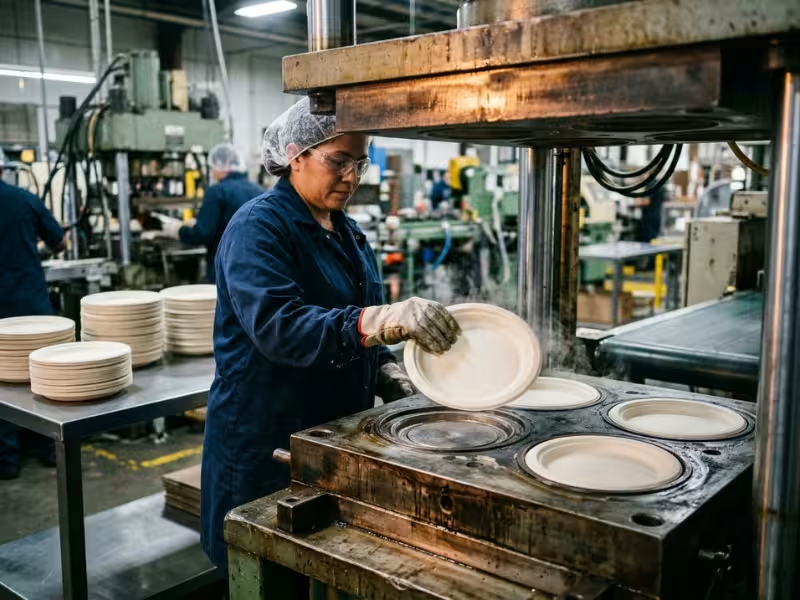
A molded fiber plate forms in three dimensions from the start. A mesh mold pulls slurry into the full plate shape, so fibers lock together in every direction. Then heated metal dies squeeze out the water at high temperature and pressure.
That hot press does two things. It packs the fibers into a dense, solid wall. It also sets the shape, much like ironing a shirt collar. The result holds its form even when wet food sits on it.
Pressing time matters here. Rushed pressing leaves moisture inside, and those plates warp in storage or soften quickly at the table.
Rim, Depth, and Density Beat the Material Name
Buyers often ask me which fiber is stronger. I usually point to the plate’s shape first.
A raised, rolled rim works like the edge of a steel beam. It stops the plate from folding when a guest holds it with one hand. A flat, thin rim gives you none of that support.
Plate depth helps as well. A slightly deeper well keeps sauce in the center and spreads the weight toward the stiff rim.
Then check density. Weigh two 10-inch plates of the same size. A heavier plate usually means a thicker, denser wall. In my tests, a well-designed bagasse plate often beats a thin, flat bamboo pulp plate, regardless of the material name on the box.
Coatings Help With Grease, but Not Always
Many plates carry an oil- and water-resistant treatment or a thin PLA lining. These help with oily curry and wet salads.
But a coating can’t fix a weak plate. A thin, poorly pressed plate with a coating still sags. A dense, uncoated plate often handles hot food just fine.
Coatings bring trade-offs too. PLA linings can soften under very hot food and usually rule out home composting. Some older grease barriers relied on PFAS chemicals. So treat a coating as one feature to verify, not proof of better performance.
Bagasse vs Bamboo Pulp: Where the Real Differences Show Up
On a spec sheet, these two materials look almost the same. Both are molded fiber, both are plant-based, and both claim to handle hot food. The gaps only appear when you put real meals on real plates.
Here’s how they compare in the five areas buyers ask me about most.
Which Plate Holds Up Better Under Heavy Food?
Buyers expect one fiber to win this round. In practice, the material name tells you less than the plate itself.
Bamboo pulp has longer fibers, so it resists tearing and cracking slightly better at the same thickness. Bagasse has shorter fibers that pack densely, which adds stiffness. When both plates match in weight and design, the difference stays small.
Manufacturing quality creates the big gaps. A 22-gram bagasse plate with a rolled rim will outperform a 16-gram bamboo pulp plate with a flat edge every time.
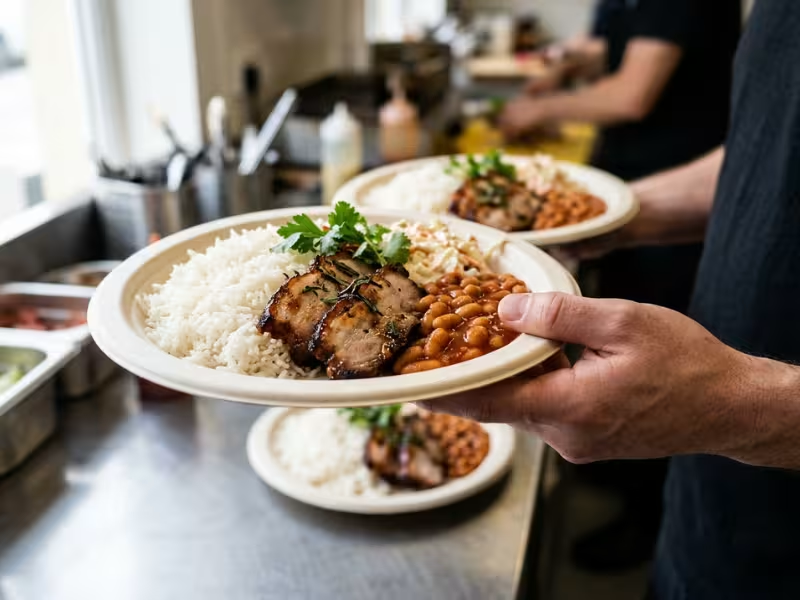
My test is simple. Load each sample with about 1 pound of food, such as rice, roast meat, and a scoop of beans. Then hold it by the rim with one hand for two minutes. Watch for bending at the edge and cracks near the well. The plate that stays flat wins, whatever the box says.
How Do They Handle Heat, Grease, and Moisture?
Both materials handle hot food well. Quality plates in either fiber take food up to about 212°F without softening right away. Both also handle short microwave reheating, usually one to two minutes.
Grease and moisture tell a more mixed story:
- Uncoated plates: Bagasse and bamboo pulp behave much alike. Oil can start to show through the bottom after 20 to 30 minutes with very greasy food.
- Plates with an oil- and water-resistant treatment: Both can hold curry, BBQ sauce, or dressing for an hour or more.
- Long soaks: Soup or watery stews pooled on any fiber plate will soften it over time. Use a bowl instead.
Bagasse has one practical edge. Far more foodservice suppliers have tested it with greasy menus, so you can find proven options more easily.
If your menu runs hot and saucy, test both materials with your messiest dish. Leave it for 30 to 45 minutes. Then check the bottom for dark spots or a soft feel.
What Do Guests Notice First? Texture and Appearance
This is where bamboo pulp often pulls ahead.
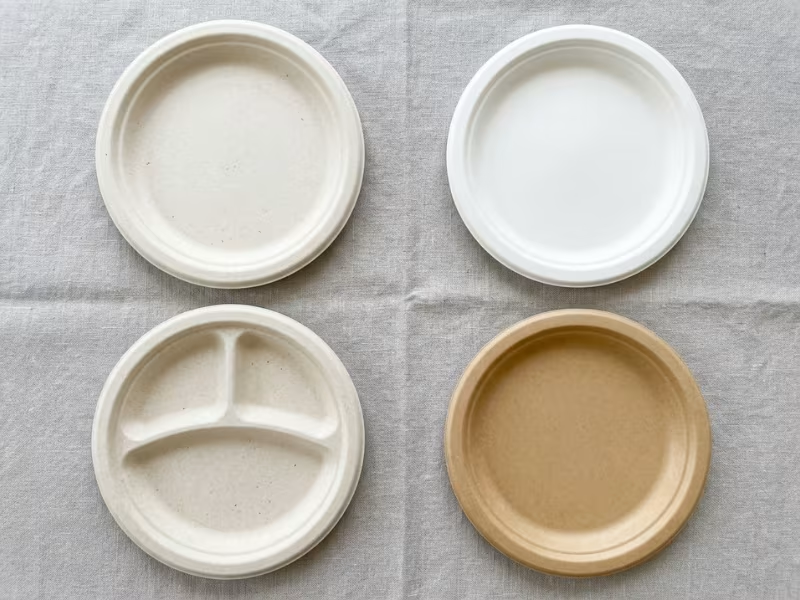
Its longer fibers create a smoother, tighter surface. Bamboo pulp plates often look more refined, with crisp edges and an even finish. Bleached versions come out bright white. Unbleached versions show a warm, natural tan.
Bagasse looks clean but plainer. Most plates come in off-white or light beige, with a slightly matte, fibrous feel. Some batches show small specks from the raw cane.
For a hotel brunch, a branded café, or a corporate lunch, that refined finish can matter. Guests read it as a premium touch. For a food truck or a school cafeteria, few people notice the difference.
One tip: if you plan to emboss a logo into the plate, ask for samples in both fibers. Bamboo pulp usually holds fine detail more crisply.
Can Both Really Be Composted?
On paper, both break down well. In reality, the label decides more than the fiber does.
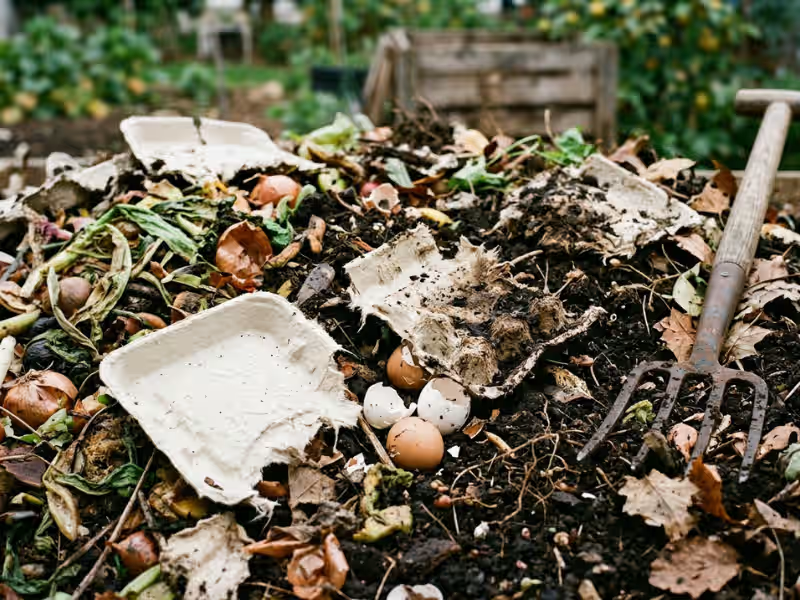
Uncoated, certified bagasse and bamboo pulp plates both break down in industrial compost, often within 60 to 90 days. Thin, uncoated plates of either fiber can also break down in a well-managed backyard pile, though that may take several months.
Here’s where buyers get caught. “Plant-based” and “made from bamboo” don’t mean compostable. Watch for three warning signs:
- Melamine binders. Some “bamboo fiber” plates use resin to hold the fiber together. They won’t compost at all.
- PLA linings. These usually require industrial composting and rule out home bins.
- Unverified grease barriers. Some older treatments relied on PFAS chemicals.
So I ask every supplier the same question: which certification covers this exact item? Look for BPI, EN 13432, or TÜV Austria OK Compost, and match the certificate to the product code. A generic factory certificate isn’t enough.
Which One Costs Less, and Can You Count on Supply?
Bagasse wins this round for most buyers.
Sugar mills produce bagasse in huge volumes as a byproduct. That keeps raw material costs low and supply steady. Bagasse plates also have broad foodservice adoption, so factories run them at scale. You’ll find more sizes, more compartment options, and more stock items.
Bamboo pulp plates often cost about 10% to 30% more for the same size. That price tends to shift with bamboo pulp supply, which is concentrated in fewer regions. Lead times can also stretch during peak season.
For a buyer ordering 50,000 plates a month, that gap adds up fast. In my experience, bagasse makes the safer default for high-volume programs. Bamboo pulp earns its higher price when appearance helps sell the meal.
Whichever you choose, ask for batch samples from at least two production runs before a large order. Consistent thickness and color between runs matter as much as the fiber itself.
When to Choose Bagasse Plates, and When Bamboo Pulp Makes More Sense
Knowing how each fiber performs is useful. But buyers rarely order plates in the abstract. They order them for a menu, a guest count, and a budget.
So I sort the decision by situation. Here’s how I guide clients through the four I see most often.
For Hot, Saucy, Everyday Meals
If your menu leans on curry, chili, BBQ, or anything with gravy, start with bagasse. It’s the safer bet for messy food.
Bamboo pulp can handle heat too. But bagasse has far more field testing behind it in greasy, high-moisture service. More suppliers offer heavy-weight versions, deep-well shapes, and compartment plates built for exactly this kind of food. That gives you more proven options to choose from.
For this scenario, I tell clients to look for three things:
- A plate weight of about 20 grams or more for a 10-inch size
- A raised, rolled rim that resists folding when guests carry it one-handed
- A compartment design if sauces sit next to rice or sides
For menus like this, many buyers also compare compartment-style bagasse food trays, which keep sauces separated and make carry-out easier.
Pick the heaviest plate your budget allows. A sturdy bagasse plate that holds through a long lunch is worth more than a sleek one that sags by the second bite.
For Catering and Takeout
High-volume service changes the math. When you buy plates by the pallet, cost per unit and steady supply matter as much as performance.
This is where bagasse usually wins. It costs less, ships from more factories, and comes in a much wider range of stock sizes. If you run a catering company serving 2,000 meals a week, a 20% price gap adds up quickly over a year.
Supply matters too. I’ve watched clients switch to bamboo pulp for a premium feel, then struggle with stockouts during peak wedding season. Bagasse rarely puts you in that spot.
For takeout, bagasse also pairs well with matching clamshells, bowls, and trays. You can source a full set from one supplier, so lids fit and colors match across your line.
My advice is simple. Make bagasse your default for catering and takeout. Only add bamboo pulp if a specific client or event asks for a more refined look.
For Premium Presentation
Some meals sell partly on appearance. Think hotel brunches, branded cafés, corporate lunches, and boutique dessert counters. In these settings, bamboo pulp can work very well.
Its smoother surface and crisper edges look more polished on the table. Bright white bamboo pulp feels clean and modern. Unbleached versions give a warm, natural tone that suits farm-to-table menus.
Bamboo pulp also holds embossed detail more sharply. If you want your logo pressed into the rim, it usually gives a cleaner result.
Still, keep the menu in mind. A premium plate under a heavy, saucy entrée can let you down. For lighter food like pastries, salads, sandwiches, and canapés, bamboo pulp shines. For a plated entrée with gravy, test it carefully first, or use bagasse for the main course and bamboo pulp for dessert.
For Buyers Balancing Cost and Sustainability Claims
Many buyers want a plate that’s both affordable and easy to defend as eco-friendly. Here, I push them to separate performance from marketing.
Both fibers can carry solid compostable credentials. Neither one is automatically greener than the other. The fiber name on the box tells you less than the certification on the exact product code.
If you aren’t sure where your plates will end up, choose on performance first. Pick the plate that holds your food, fits your budget, and arrives on time. For most buyers, that points to bagasse.
Then look at the claim. A certified, uncoated plate gives you the most honest story to tell customers. A plate labeled only “plant-based” or “made from bamboo” gives you very little.
Pay extra for bamboo pulp when its look adds real value to your brand. Don’t pay extra just because “bamboo” sounds greener. That premium only makes sense when guests actually see and feel the difference.
What to Check Before You Buy
A great sample and a great pallet are not always the same thing. Most plate problems I see show up after the order arrives, not before. A few checks upfront can save you a warehouse full of soft, warped, or mislabeled plates.
Work through these four areas with your supplier before you approve a bulk order.
Certifications and Food-Contact Claims
Start with the paperwork. Ask for the certificate that covers the exact plate you plan to buy:
- BPI for the North American market
- EN 13432 for Europe
- TÜV Austria OK Compost, INDUSTRIAL or HOME
Match the product code on the certificate to the item code on your quote. A generic factory certificate only proves the factory makes some certified products. It says nothing about your 10-inch, three-compartment plate.
Food contact needs separate proof. Ask for a recent test report for FDA requirements in the US or EU 1935/2004 in Europe. Check the date as well. I ask for a fresh test when a report is more than two years old.
PFAS-Free and Coating Questions
Next, ask one direct question: Is this plate coated or uncoated, and what is the coating?
The answer affects both performance and disposal:
- Uncoated: This option gives you the simplest compost story and moderate grease resistance.
- Oil- and water-resistant additive: This option works better with curry and sauces. Ask for the chemical name.
- PLA lining: This option creates a strong liquid barrier but usually requires industrial composting.
PFAS needs extra care. Anyone can print a “PFAS-free” sticker. Ask for a lab report that shows the total fluorine result for this exact item. Many buyers look for results under 100 ppm, which matches BPI’s limit and several US state rules. If the supplier can’t provide one, treat the claim as marketing.
Sample Testing With Your Real Menu
Lab data won’t tell you how a plate handles your braised short rib. Only your own food can show you that.
Order 20 to 30 samples of each candidate. Then run this test:
- Plate your hottest, greasiest, or saucy dish at serving temperature.
- Leave it for 30 to 45 minutes. That matches a typical buffet line or delivery window.
- Check three things:
-
- Rim deformation. Lift the plate by the edge with one hand. Does it droop or fold?
- Soak-through. Flip it over. Look for dark spots, oil rings, or a damp feel.
- Cut resistance. Cut meat with a plastic knife and fork. Does the surface score, tear, or fuzz?
Test bagasse and bamboo pulp side by side with the same dish. The differences show up fast.
Storage, Humidity, and Bulk Order Consistency
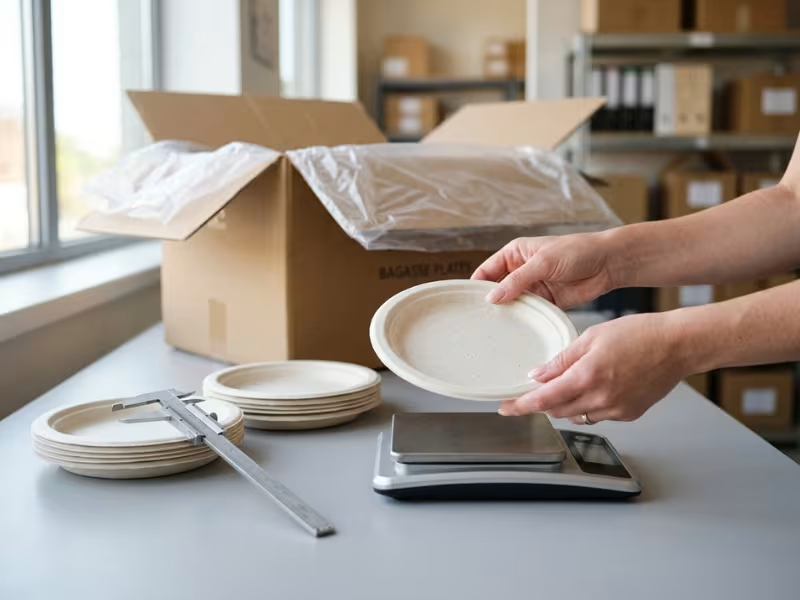
Molded fiber pulls moisture from the air. Damp storage can make plates soft or warped, and it can even cause mold spots. Keep cartons on pallets, off the floor, and away from outside walls. Aim for roughly 65% relative humidity or lower. Ask whether the supplier packs plates in moisture-proof inner bags. This step matters for sea freight through tropical ports.
Then confirm consistency. Request samples from at least two production runs and compare them:
- Weight: Weigh 10 plates from each run. Flag any gap above about 5%.
- Thickness: Measure both the rim and the center.
- Color: Lay the plates side by side under daylight.
Ask the supplier to keep a reference sample from the batch you approve. Then write weight and thickness tolerances into your purchase order. If a later shipment falls short, you’ll have a clear standard to point to.
How These Plates Compare With Other Disposable Plate Options
Bagasse and bamboo pulp don’t win every matchup. But when I compare them with the other plates buyers ask about, they keep landing in a practical middle spot. If you’re sourcing bowls, trays, and cups at the same time, the broader range of biodegradable tableware is worth reviewing with the same comparisons in mind. Here’s how that works.
Compared With Plastic-Coated Paper Plates
Coated paper plates cost a little less and stack neatly. The trouble starts after the meal.
Most of them carry a thin polyethylene lining to stop grease. That plastic film won’t break down in compost. It also makes the plate hard to recycle, because mills struggle to separate film from fiber. Food residue spoils the load too. So these plates almost always end up in the trash.
A certified, uncoated molded fiber plate has a clearer path. It can go into an organics bin with the food scraps still on it. Molded fiber is also stiffer, so guests rarely need to double up plates. That doubling is a hidden cost with thin paper.
If your venue or city collects organics, this switch gives your plates a real end-of-life plan.
Compared With Styrofoam and Plastic
Foam and plastic plates hold up well and cost very little. I won’t pretend otherwise.
But the market is moving away from them. Many US states and cities now ban foam foodware. The EU’s Single-Use Plastics Directive bans expanded polystyrene food containers. More retailers and caterers also set their own plastic-free policies. If you stock up on foam today, you may have to switch on short notice.
Molded fiber fits where rules and customer expectations are heading. It handles hot food, short microwave reheats, and most greasy dishes. That covers most of what foam did.
The trade-off is price, often a few cents more per plate. For many buyers, that cost beats scrambling for a replacement when a ban takes effect.
Compared With Palm Leaf Plates
Palm leaf plates look beautiful. For weddings and plated appetizers, I often recommend them.
For daily, high-volume service, they’re harder to manage. Each plate comes from a single fallen leaf, so supply depends on the season. Color, thickness, and size vary from plate to plate. Shapes are limited, and compartment designs are rare. Prices often run two to three times higher than bagasse.
Bagasse and bamboo pulp start as pulp, not whole leaves. Factories mold them to set weights and sizes, batch after batch. You can also source compartment plates, bowls, and clamshells from the same line.
My rule is simple. Choose palm leaf when the plate is part of the show. Choose molded fiber when you serve thousands of meals a week and need every carton to match.
Quick Comparison: Bagasse vs Bamboo Pulp Plates
Start with the factor that matters most to your menu or budget, then read across both columns to see which plate leads. Next, cross-check the remaining rows, especially “Main caution,” before you request samples.
|
Factor |
Bagasse Plates |
Bamboo Pulp Plates |
|---|---|---|
|
Typical feel |
Dense and stiff, with a slightly matte, fibrous surface |
Smooth and tight, with crisp edges and a refined finish |
|
Best use case |
Hot, saucy everyday meals, catering, and high-volume takeout |
Hotel brunches, branded cafés, corporate lunches, and desserts |
|
Heavy hot food |
Strong choice. Pick 20 g or more (10-inch) with a rolled rim |
Good at matching weight. Test carefully under saucy entrées |
|
Grease / moisture handling |
Uncoated: oil may show after 20–30 minutes. Treated: holds an hour or more |
Similar to bagasse. Fewer proven options for very greasy menus |
|
Appearance |
Off-white or light beige, plain look, small specks possible |
Bright white or warm natural tan. Holds embossed logos more sharply |
|
Composting route |
Certified uncoated plates break down in industrial compost, often in 60–90 days. Home composting is slower |
Same route when certified and uncoated. Melamine-bound plates won’t compost |
|
Price tendency |
Lower cost, steady supply, and wide stock range |
Often 10%–30% higher, with longer lead times in peak season |
|
Main caution |
Thin, light plates flex under heavy loads |
Check the fiber ratio. Many “bamboo” plates blend in bagasse or use resin binders |
Frequently Asked Questions
Are bagasse plates safe for hot food?
Yes. Quality bagasse plates handle food up to about 212°F, so soup, curry, and fried dishes are fine.
The real risks are time and thickness. Thin plates can soften under very hot, wet food after about 30 minutes. For hot entrées, choose a 10-inch plate of 20 grams or more with a rolled rim. Test it with your hottest dish before you order in bulk.
Can bagasse and bamboo pulp plates go in the microwave?
Usually yes, for short reheats. One to two minutes on medium works for most uncoated plates of either fiber.
Avoid long cycles. The plate can dry out, brown at the edges, or soften under pooled liquid. Skip the microwave for PLA-lined plates, which can warp. Check the spec sheet for a clear microwave statement before you promise it to customers.
Which is stronger, bagasse or bamboo pulp plates?
Bamboo pulp has longer fibers, so it resists tearing slightly better at the same weight. But that edge is small.
Plate weight, rim design, and pressing quality matter more. A 22-gram bagasse plate with a rolled rim beats a 16-gram flat bamboo pulp plate. Compare samples of the same size by weight. Then load each with about a pound of food and hold it by the rim.
Do bagasse plates contain PFAS?
Some do, but many don’t. Older or low-cost plates may use fluorinated grease barriers. The same risk applies to bamboo pulp.
BPI no longer certifies products with intentionally added PFAS, and several US states ban PFAS in food packaging. Ask for a lab report showing total fluorine for your exact item. Under 100 ppm is a common benchmark. A “PFAS-free” sticker alone proves nothing.
Are these plates compostable at home?
Sometimes. Thin, uncoated plates of either fiber can break down in a backyard pile, often within three to six months.
Tear plates into small pieces. Mix them with food scraps, keep the pile moist, and turn it every week or two. Keep PLA-lined, melamine-bound, or industrial-only plates out. An OK compost HOME certification that matches the product code is your most reliable signal.
Can bagasse or bamboo pulp plates be recycled?
Usually not. Grease and food residue contaminate the fiber, and most curbside programs reject used foodware. Coatings make sorting even harder.
The best route is an organics bin or commercial composting, with food scraps still on the plate. If you have no compost access, put used plates in the trash, not the recycling bin. One greasy load can spoil a whole bale.
Choose by Performance First, Then by Claim
The words “bagasse” or “bamboo pulp” on a box only start the conversation. Plate weight, rim design, pressing quality, and verified certifications decide how a plate performs at the table.
For most buyers, bagasse is the smarter default. It handles hot, saucy food, costs less, and keeps high-volume programs well supplied. Bamboo pulp earns its higher price when a smooth finish and premium look add real value, such as at a hotel brunch or a branded café.
Before you switch at scale, take three steps:
- Order samples. Compare plates of the same size by weight and rim design.
- Test them with your real menu. Plate your hottest, greasiest dish and wait 30 to 45 minutes.
- Confirm your disposal route. Ask your hauler, venue, or city whether they accept molded fiber plates.
Pick the plate that holds up under your food first. Then make sure the claim on the box holds up too.