


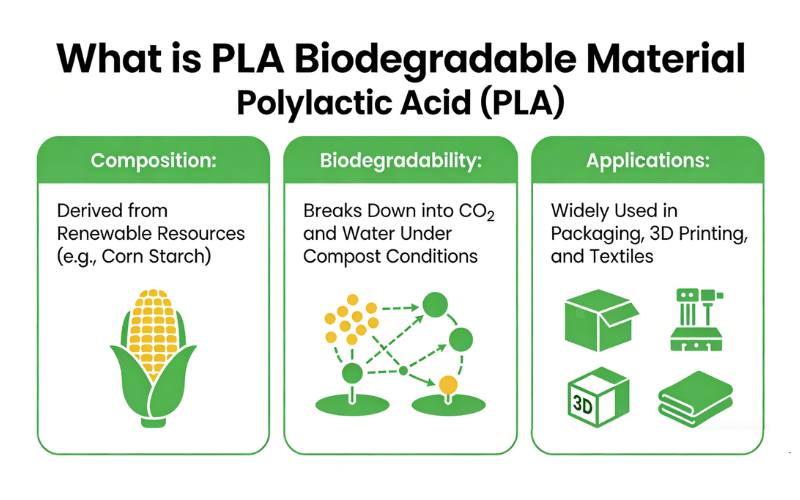
Polylactic Acid (PLA) is a versatile and innovative biodegradable thermoplastic derived entirely from renewable resources such as corn starch, cassava roots, or sugarcane. Unlike traditional petroleum-based plastics that dominate the market, PLA offers a sustainable alternative that aligns with the growing global emphasis on environmental responsibility. It has found widespread application across diverse industries, from food packaging and disposable cutlery to sophisticated medical devices and 3D printing filaments. As the demand for eco-friendly materials accelerates, PLA stands out as a key player in reducing our reliance on finite fossil fuels.
PLA is produced through the fermentation of plant sugars, resulting in a material that mimics the physical properties of conventional plastics such as polystyrene and polyethylene. Its unique composition allows it to be used in various forms, including films, fibers, and rigid containers. The shift toward bio-based materials like PLA represents a significant step forward in sustainable manufacturing, offering a practical solution to the plastic pollution crisis while maintaining the functionality consumers expect.
- PLA is a biodegradable thermoplastic made from renewable plant resources.
- It is widely used in packaging, medical implants, and 3D printing.
- The material mimics traditional plastics but offers a lower carbon footprint.
- Rising demand for eco-friendly solutions is driving PLA adoption.
- It plays a crucial role in reducing reliance on non-renewable petroleum.
Advantages of Using PLA Biodegradable Material
PLA is rapidly becoming a preferred material for environmentally conscious businesses and consumers due to its renewable origins and impressive versatility. Because it is bio-based, it significantly lowers the carbon footprint associated with plastic production. The plants used to produce PLA absorb carbon dioxide as they grow, offsetting emissions from manufacturing. This makes PLA a far more carbon-neutral option compared to conventional oil-based plastics, which release sequestered carbon into the atmosphere.
In addition to its environmental credentials, PLA is highly adaptable. It can be molded into intricate shapes for medical implants that dissolve harmlessly in the body, extruded into clear films for food packaging, or spun into fibers for textiles. Its biodegradability is another major advantage: under the right industrial composting conditions, PLA breaks down into water, carbon dioxide, and biomass, leaving no toxic residue. This closed-loop life cycle appeals to industries looking to minimize waste and move towards a circular economy.
- PLA is derived from renewable agricultural crops like corn and sugarcane.
- It has a significantly lower carbon footprint than petroleum-based plastics.
- The material is highly versatile, suitable for packaging, textiles, and medical use.
- It is biodegradable under industrial composting conditions.
- PLA offers a sustainable path toward reducing plastic pollution.
Disadvantages of Using PLA Biodegradable Material
While PLA offers significant environmental benefits, it is not without its limitations. A primary drawback is that “biodegradable” does not mean it will decompose anywhere. PLA requires specific conditions found in industrial composting facilities—high temperatures (around 140°F) and controlled humidity—to break down effectively. It will not degrade in a standard home compost pile or a landfill, where it can persist for decades just like regular plastic. This distinction is often misunderstood, leading to improper disposal.
Another significant limitation is PLA’s low heat resistance. It has a relatively low glass transition temperature, meaning it can soften or deform at temperatures as low as 60°C (140°F). This makes it unsuitable for holding hot liquids, microwaving, or being stored in hot vehicles, restricting its use in certain food service and industrial applications. Furthermore, the production cost of PLA remains higher than that of mass-produced conventional plastics, which can be a barrier for widespread adoption. Finally, PLA presents recycling challenges; it cannot be mixed with standard plastics like PET in recycling streams, as it can contaminate the batch and degrade the quality of the recycled material.
Manufacturing and Recycling of PLA Biodegradable Material
The manufacturing process of PLA is a fascinating blend of agriculture and chemistry. It begins with milling crops like corn to extract starch, which is then processed into dextrose (sugar). This sugar undergoes fermentation by bacteria to produce lactic acid. The lactic acid is then polymerized—chemically linked—to form polylactic acid resin pellets. These pellets can be melted and shaped using standard plastic processing machinery, such as injection molding or extrusion, to create everything from 3D printing filament to clear cups.
However, the end-of-life management for PLA is critical. While it reduces reliance on fossil fuels, its environmental benefits depend on proper disposal. If PLA ends up in a landfill, it decomposes anaerobically, potentially releasing methane, a potent greenhouse gas. Therefore, the most effective way to dispose of PLA is through industrial composting, where it can return to the earth as nutrient-rich soil.
Recycling PLA is technically possible but logistically difficult. Because it looks nearly identical to PET plastic, it can be easily mistaken and missorted at recycling facilities. Since PLA has a lower melting point than PET, even a small amount can ruin a batch of recycled PET. Consequently, PLA requires its own separate collection and recycling stream, which is not yet available in many regions. Expanding composting infrastructure and clearer labeling are essential steps to ensuring PLA fulfills its environmental promise.
Are You Considering PLA Biodegradable Material?
PLA, a biodegradable material, is an excellent choice for businesses and individuals looking to reduce their environmental impact. Its derivation from renewable resources and its ability to be industrially composted make it a strong contender in the fight against plastic pollution. It is particularly well-suited to short-term packaging, disposable items, and 3D printing projects where heat resistance is not a primary concern.
However, adopting PLA requires a commitment to responsible use and disposal. It is not a magic solution that disappears on its own; it relies on access to industrial composting facilities to truly be “green.” Potential users must weigh the higher costs and heat sensitivity against the sustainability benefits. By understanding the full lifecycle of PLA—from corn field to compost heap—you can make an informed decision that genuinely benefits the planet.